
Decoding Influence: Reverse Engineering Hidden Social Networks from Public Beliefs
Online Graph Learning from Social Interactions
This paper introduces the Online Graph Learning (OGL) algorithm, a novel approach to identifying the hidden influence patterns (adjacency matrices) in social networks by observing the evolution of agent beliefs. Utilizing an inverse modeling framework for adaptive social learning, it successfully recovers network topologies even when the underlying true hypothesis and graph edges change dynamically over time.
TL;DR
Understanding who influences whom in a social network is often a "black box" problem. This paper presents Online Graph Learning (OGL), an algorithm that reconstructs the hidden architecture of a social network simply by watching how opinions evolve. It specifically tackles the "inverse problem": if we see the results of social learning, can we find the graph that caused them?
The "Inverse" Challenge: Why Opinions Aren't Enough
In a typical social learning scenario, agents update their beliefs based on private data and the opinions of their neighbors. Usually, we use a known graph to predict what the agents will eventually think.
However, in reality, the graph is hidden. We see the "beliefs" (public tokens of opinion) but we don't know the "combination weights"—the degree of trust or influence one agent has over another. Prior work in graph learning often requires access to the raw data agents receive, but in a social context, these "private observations" stay private. The challenge is to infer the network using only the shared opinions while allowing for the fact that the underlying truth (the hypothesis) and the network itself might be changing.
Methodology: From Nonlinear Dynamics to Linear Regression
The core insight of the authors is the transformation of the complex, nonlinear social learning rule into a manageable linear form.
Adaptive social learning typically uses geometric means to fuse neighbor beliefs. By applying a logarithmic transformation, the authors turn these products into sums, resulting in a linear update equation for the "log-belief ratios" ():
Where:
- represents the public beliefs.
- is the hidden influence matrix we want to find.
- represents the private observations (the "hidden" part).
To solve this without knowing , the authors use a Majority Vote mechanism. Since social learning eventually leads agents to the truth, the group's consensus can be used as a proxy to estimate the private data distribution, allowing the OGL algorithm to iterate towards the correct matrix using a stochastic gradient descent approach.
 The linear relationship derived from the nonlinear belief updates.
Experiments: Performance and Plasticity
The researchers tested OGL on a 30-agent Erdos-Renyi network. The results were striking in two areas:
- Topology Recovery: As seen in the comparison between Figure 1(a) and 1(b), the algorithm successfully identifies the presence and weight of edges. While some "ghost" edges appear, they are significantly weaker and can be filtered out via simple thresholding.
- Tracking Dynamic Changes: Perhaps the most impressive feature is the algorithm's "plasticity." When the network structure is suddenly re-generated (simulating a change in social ties), the OGL algorithm doesn't break; it adapts, as shown in the error evolution plots.
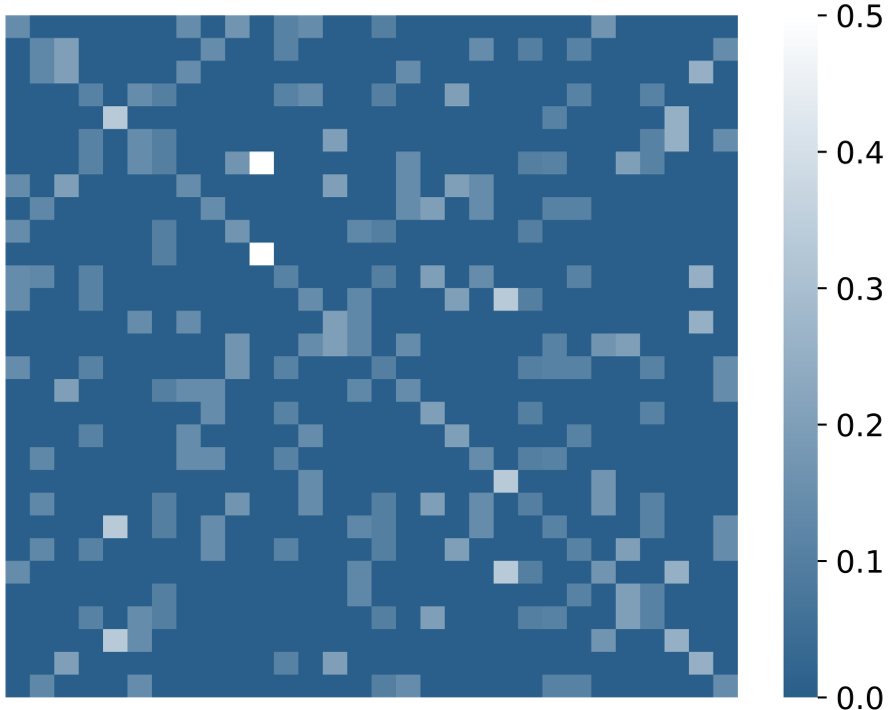 (a) The True Hidden Graph vs (b) The Learned Graph.
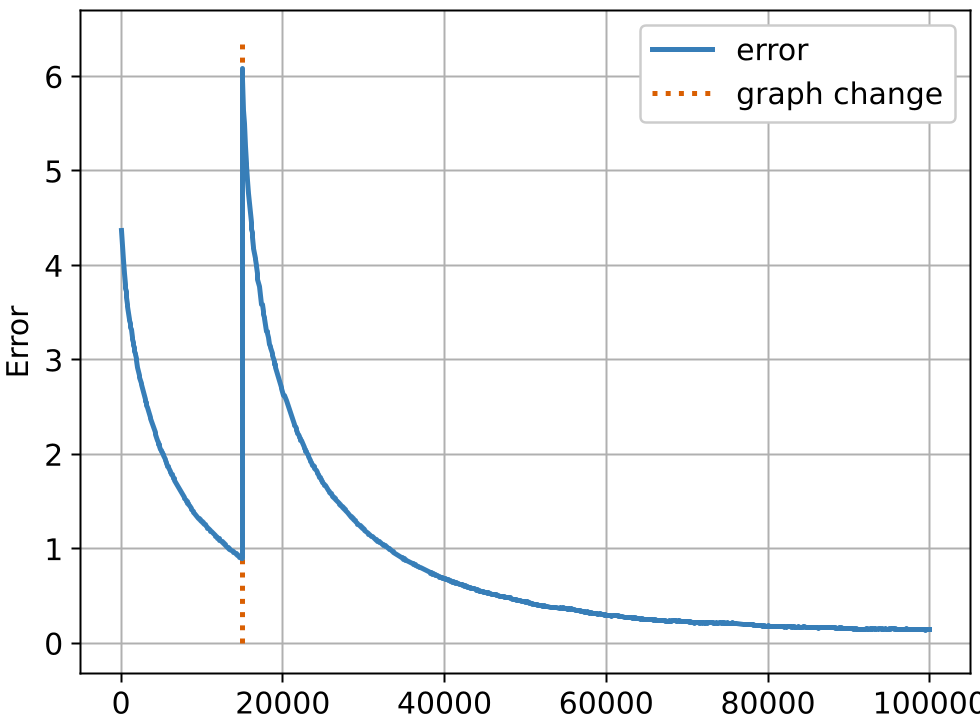 The algorithm's ability to recover from a sudden change in network topology at step 15,000.
Deep Insight & Future Horizons
The OGL algorithm demonstrates that the "flow" of information is encoded in the temporal correlations of beliefs. By treating graph learning as an online adaptive process, the authors avoid the pitfalls of static batch-processing, making this highly applicable to real-time social media monitoring or decentralized sensor networks.
Limitations: Currently, the model assumes we can observe every agent's belief. In the real world, we often deal with "latent agents" or hidden nodes. The authors' future work on "partial information settings" will be critical for applying this to massive, partially-observable social platforms.
Conclusion: This paper bridges the gap between social learning theory and practical signal processing, proving that the structure of influence can be unmasked through the lens of adaptive filtering.