
Decoding Influence: Online Graph Learning from Social Interactions
Online Graph Learning from Social Interactions
This paper introduces the Online Graph Learning (OGL) algorithm, a method to reconstruct hidden social network topologies by observing the evolution of agent beliefs. Utilizing an adaptive social learning framework, the method successfully identifies pairwise influence weights and can track dynamic changes in both network structure and the underlying true hypothesis.
Executive Summary
In digital and physical social networks, our opinions are rarely formed in a vacuum; they are the result of personal observations filtered through the influence of our peers. While social learning models traditionally predict how opinions form given a graph, this paper tackles the inverse problem: Can we look at the evolution of public opinions (beliefs) and figure out who is influencing whom?
The authors present Online Graph Learning (OGL), a framework that treats social interactions as a data stream to reveal hidden network topologies. It is an "online" approach, meaning it learns on the fly and can adapt if the network structure or the "ground truth" changes—a common reality in the fluid world of social media.
The Problem: The Hidden Strings of Influence
In most social learning studies, the graph topology (the combination matrix ) is assumed to be known. In reality, an external observer only sees the output—the shifting beliefs of individuals.
The challenges are twofold:
- Privacy: Agents' raw data (private observations) are not public; only their processed beliefs are shared.
- Non-stationarity: Social networks are not static. Friendships form, influencers lose their' status, and the "truth" being discussed can shift.
Existing graph learning methods often rely on heat diffusion or static Gaussian models, which fail to capture the complex, iterative nature of social opinion exchange.
Methodology: Turning Beliefs into a Linear System
The core insight of the paper is a mathematical transformation of the social learning update rule.
1. Log-Belief Ratios
The authors define the social learning process through a two-stage update (incorporating local data and then fusing neighbor beliefs). By looking at the log-ratio of beliefs between a reference hypothesis and others, the complex multiplicative fusion rule (geometric mean) becomes a linear update:
Where represents the publicly observed beliefs and is the hidden graph we want to find.
2. The Stochastic Approximation
Since the private likelihoods () are unknown, the algorithm uses a Majority Vote among agents to estimate the true state of the world (). This estimate allows the observer to approximate the missing data and update the graph estimate () using a simple, efficient recursion:

Experimental Validation
The researchers tested OGL on a network of 30 agents. The results show a striking ability to recover the "hidden strings" of the network.
Visualizing the Recovery
The algorithm effectively distinguishes between active links and no-edge zones. While the raw learned matrix might have small noise where edges don't exist, simple thresholding can recover the exact sparsity pattern.
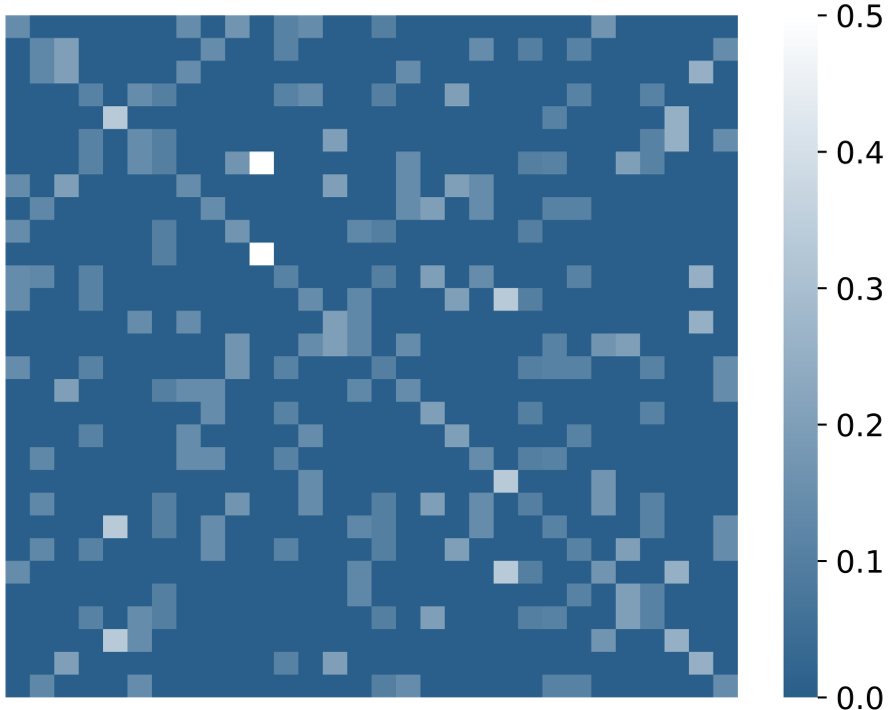 (a) The actual influence network; (b) The network as reconstructed by the OGL algorithm.
Resilience to Change
Perhaps the most impressive feature is the algorithm's adaptability. In dynamic tests, when the graph edges were completely changed at , the OGL algorithm didn't break. Instead, it re-tracked the new topology at a linear convergence rate.
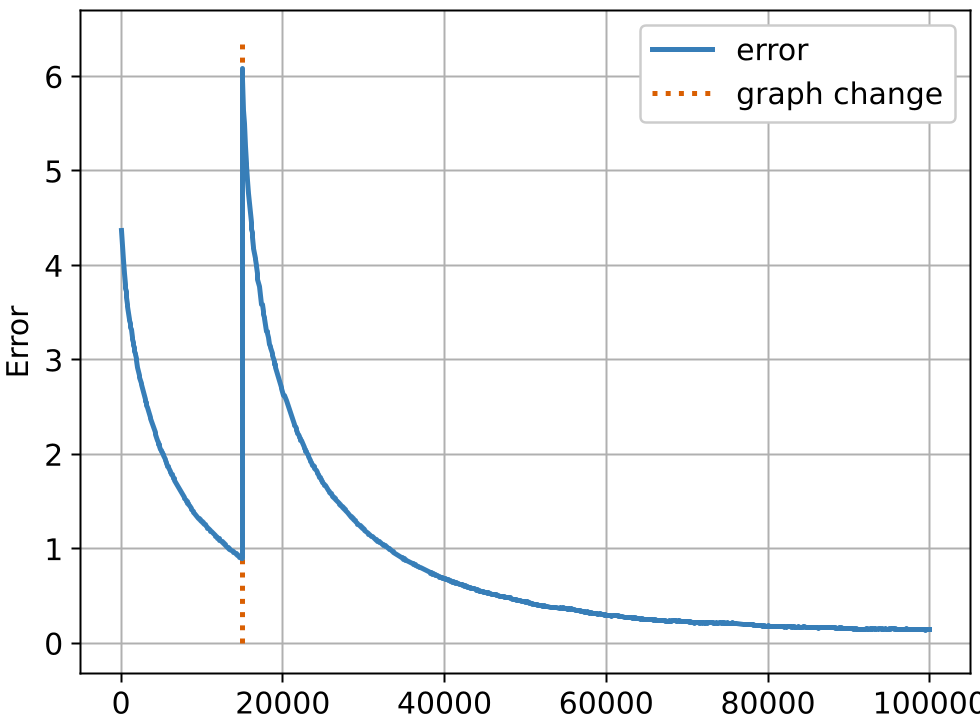 The Mean Squared Deviation (MSD) spikes during a change but rapidly converges back to a low error state.
Critical Analysis & Conclusion
The OGL algorithm bridge the gap between Control Theory and Social Science. By treating opinion dynamics as a signal processing task, it provides a mathematically rigorous way to "dox" the influence structure of a group without needing their private data.
Limitations:
- The model currently assumes the observer can see everyone's beliefs.
- It assumes agents follow a specific "non-Bayesian" update rule. If agents are irrational or use different fusion logic, the linear approximation might degrade.
Future Outlook: The next frontier is Partial Observability. In massive networks (like Twitter/X), we can't see every user. Tuning this algorithm to work with "sampled" nodes will be the key to making it a standard tool for digital forensic and social network analysis.