
From Consultation to Collaboration: How Online Social Networks are Redefining Health Decisions
Online Health Social Networks and Patient Health Decision Behavior: A Research Agenda
This paper proposes a conceptual framework to investigate how Online Health Social Networks (OHSNs) influence the health decision behaviors of patients and physicians. It maps the transition from traditional face-to-face social support to technology-mediated interactions, emphasizing the roles of social presence and knowledge sharing in clinical outcomes.
TL;DR
This research establishes a framework for understanding the "Social Dimension" of medical decision-making. It argues that Online Health Social Networks (OHSNs) are not mere information repositories but dynamic extensions of a patient’s social fabric. By enhancing Social Presence, these platforms allow geographically isolated patients and specialized physicians to collaborate, challenging the traditional paternalistic model of healthcare.
The Core Motivation: Beyond the Search Bar
For decades, health decisions were a dyadic interaction between a "custodian" (the physician) and a "recipient" (the patient), occasionally influenced by a small circle of family. However, the rise of platforms like PatientsLikeMe and CureTogether has disrupted this bubble.
The authors identify a critical gap: we know social networks improve health, but we don't know how digital interactions translate into actual behavioral changes. The motivation here is to move past the "internet as a library" metaphor and view the internet as a "distributed decision-making" ecosystem.
Methodology: The Social Presence Framework
The researchers posit that the efficacy of an OHSN depends on its ability to project Social Presence—the psychological sense that one is interacting with real, empathetic humans rather than a screen.
The Framework Mechanism
- Extended Networks: OHSNs complement rather than replace traditional networks.
- Self-Presentation: Users build trust through the "relaxation of privacy," sharing intimate data to gain specific, experiential knowledge.
- Physician Integration: The framework acknowledges that physicians must adapt to "patient-generated content," shifting from authority figures to partners.
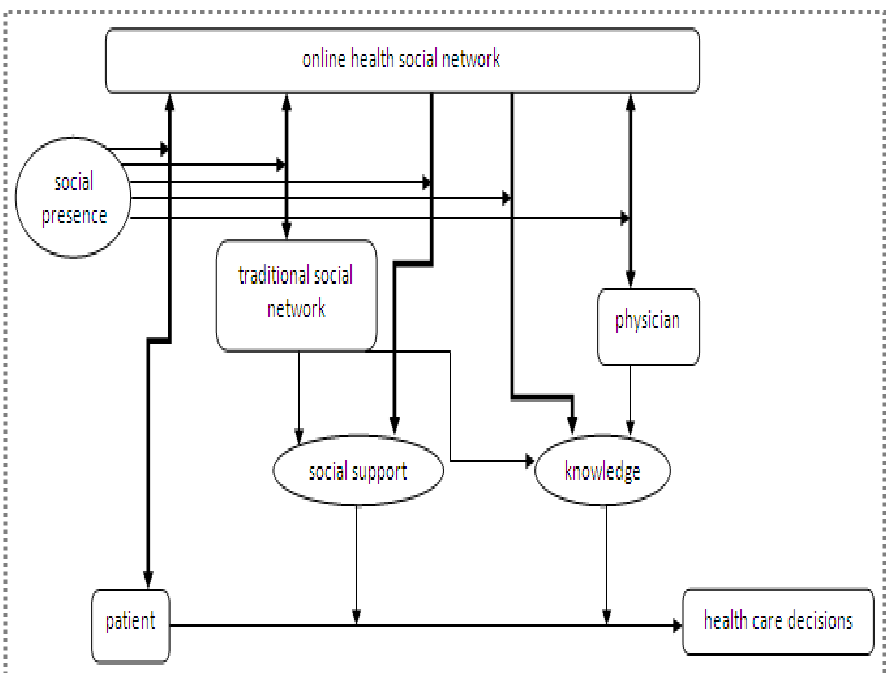 Figure 1: The proposed framework mapping the interplay between traditional networks, OHSNs, physicians, and decision behavior.
Specialized Insight: The Rural Context
A standout feature of this research is its focus on Rural Isolation. In a small town, a patient with a rare condition might be the only one for miles.
- The "Just Enough" Theory: Even if a text-based chatroom lacks the "richness" of a face-to-face meeting, it provides "just enough" social presence to bridge the gap for those in geographically isolated areas.
- Professional Commiseration: Rural doctors use these networks to consult with distant peers, reducing the professional isolation that often leads to burnout and outdated practices.
Experiments & Research Agenda
The paper shifts from theory to a call for action, proposing several key metrics for future study:
- Partner-like Relationships: Do OHSN users experience more "collaborative" care?
- Mediation Factors: Does social presence actually change the type of treatment chosen (e.g., Treatment A vs. B), or does it simply increase the patient's confidence in the decision?
Critical Analysis & Conclusion
Takeaway
The shift in health care is irreversible. OHSNs have democratized medical data, turning patients into experts of their own lived experiences. The value of this paper lies in its recognition that trust and presence are the true currencies of medical networks, not just raw data.
Limitations
The primary challenge remains the "dot-connecting" problem. As the authors admit, identifying a direct causal link between a forum post and a clinical outcome (like lowered BMI or survival rates) is "devilishly complicated" due to the myriad of confounding environmental factors.
Future Outlook
As we move toward a world of "Quantified Self-Tracking" and AI-mediated health advice, this framework provides the necessary social scaffolding to ensure technology remains human-centric. The next frontier will likely be the "Collective Action" phase, where these networks don't just influence individual decisions but organize to change healthcare policy and insurance structures.