
The CAS Perspective: Decoding the Collective Intelligence of Online Knowledge Communities
Online Knowledge Community: Conceptual Clarification and a CAS View for Its Collective Intelligence
This position paper defines and conceptualizes the "Online Knowledge Community" (OKC) as a distinct entity centered on collective knowledge activities. The authors propose a Complex Adaptive System (CAS) framework to explain how "Collective Intelligence" emerges through the co-evolution of communal social networks and knowledge structures.
TL;DR
This paper moves beyond simple "groupware" discussions to define Online Knowledge Communities (OKC) as complex adaptive systems. By comparing them to traditional Communities of Practice, the authors argue that the "Collective Intelligence" seen in Wikipedia or Linux is an emergent property arising from the co-evolution of social ties and knowledge networks.
Strategic Positioning: This is a foundational theoretical piece that bridges Computer-Supported Cooperative Work (CSCW) and Knowledge Management, shifting the focus from "Community Informatics" (how we use tools) to "Community Intelligence" (how the system thinks).
The Conceptual Gap: Knowledge-Intensive vs. Knowledge-Centered
The authors identify a critical nuance often missed in organizational theory: the difference between a community that uses knowledge (like a medical consultation forum) and a community that is formed by knowledge (like Wikipedia).
While traditional Communities of Practice (CoP) require "tightly-knit" social bonds and shared physical/cultural environments, OKCs can thrive on weak social ties. In an OKC, people are glued together by the knowledge domain itself rather than interpersonal relationships. This explains why thousands of strangers can build a world-class encyclopedia without ever meeting.
Methodology: The Super-Network Model
The core of the paper’s argument lies in the Complex Adaptive System (CAS) View. The authors propose that an OKC isn't just a website; it’s a triple-layered "super-network":
- The Human Network: Participants with high freedom of movement.
- The Knowledge Network: Interlinked semantic items (articles, code, tags).
- The Computer Network: The ICT infrastructure enabling the two above.
The Mechanism of Co-Evolution
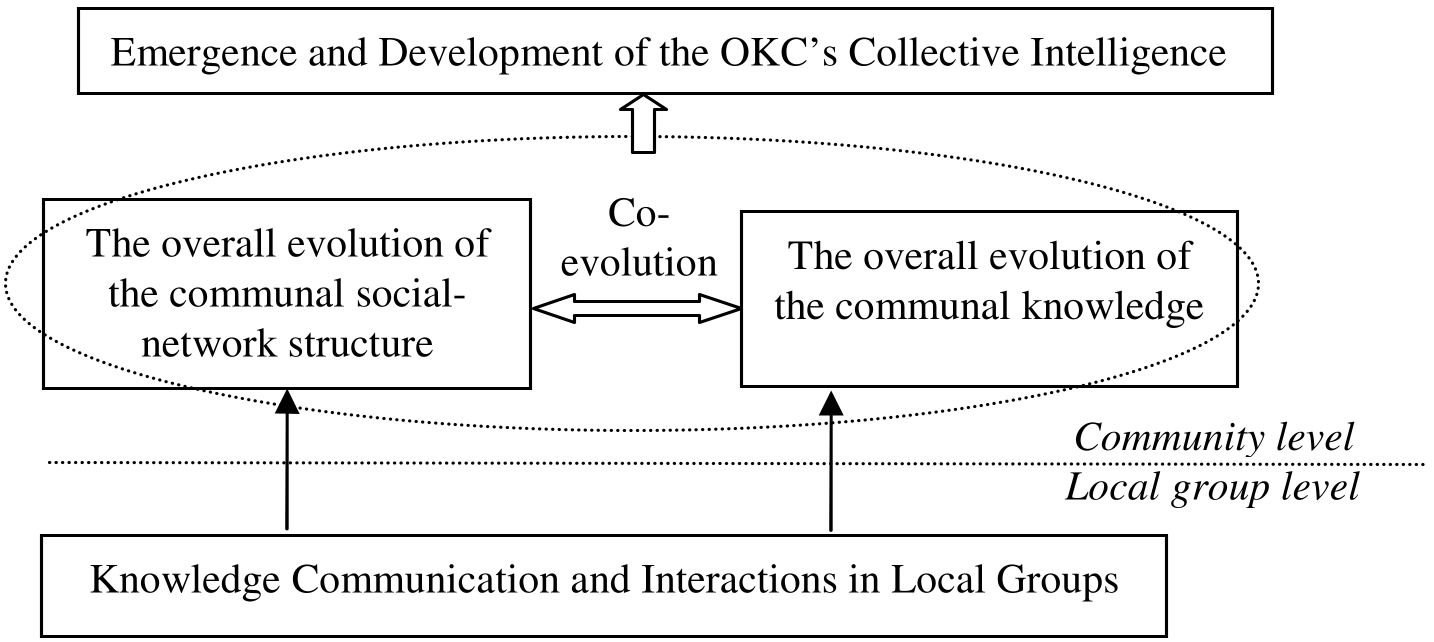
The "Magic" of collective intelligence happens through a feedback loop. When a user performs a local action (e.g., editing a wiki page), it triggers two simultaneous global shifts:
- Knowledge Evolution: The communal knowledge pool expands and becomes more refined.
- Social Evolution: A self-organizing structure emerges (often a center-periphery model where core contributors provide stability and the periphery provides diversity).
Comparative Analysis: OKC vs. VCoP
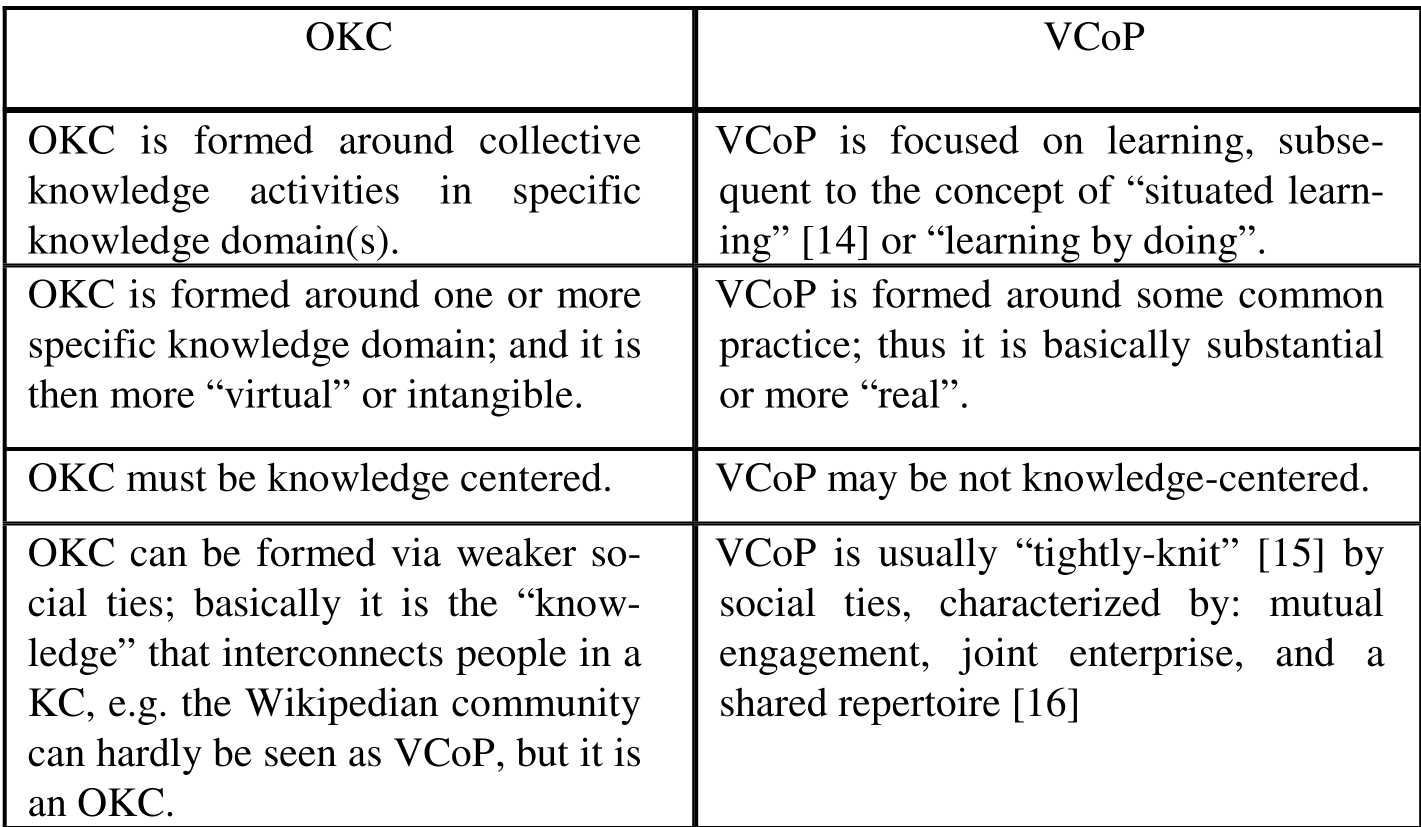
To solidify the identity of OKCs, the authors provide a rigorous comparison table:
| Dimension | Online Knowledge Community (OKC) | Virtual Community of Practice (VCoP) |
|---|---|---|
| Core Focus | Knowledge work (creation, dissemination) | Situated learning (learning-by-doing) |
| Nature | Virtual/Intangible (Domain-driven) | Substantial/Real (Practice-driven) |
| Cohesion | Weaker social ties are sufficient | Tightly-knit by mutual engagement |
Deep Insights: Why It Works
The paper highlights that diversity is often more valuable than cohesion in an OKC. Unlike corporate teams where conflict is minimized to ensure "alignment," the loose connectivity of an OKC allows for a broader range of expertise to collide. This "wisdom of crowds" is what allows an open-source project to outpace a closed corporate development team.
Case Study: The Linux Kernel
The authors point to the Linux Kernel developer community. With no centralized "boss," the system uses self-organization to manage thousands of developers. The mailing list acts as the medium for local interactions, while the resulting "center-periphery" social structure ensures that only high-quality code reaches the kernel.
Critical Analysis & Conclusion
The authors successfully move the needle from viewing online communities as mere "databases" to viewing them as living organisms. However, the paper is primarily theoretical (Position Paper); while it provides a robust framework, the "proof" relies heavily on qualitative observation of established giants like Wikipedia and Linux.
Future Implications: As we move toward AI-driven knowledge synthesis, the human-knowledge-computer super-network model becomes even more relevant. The challenge for future researchers will be to integrate "Machine Agency" into this CAS framework—how does a LLM (Large Language Model) fit into the co-evolution of an OKC?
The Bottom Line: If you want to build a platform that generates "Intelligence" rather than just "Information," you must design for the co-evolution of social participation and semantic structure.