
Exposed by the Crowd: How Social Groups Leak Your Private Friendships
Online Link Disclosure Strategies for Social Networks
This paper introduces an efficient online attack strategy to disclose hidden friendship links in Online Social Networks (OSNs) like Facebook using only legitimate API queries. By exploiting the structural relationship between group memberships and friend lists, the authors develop a k-hop graph traversal algorithm that uncovers private connections with high accuracy and minimal query overhead.
TL;DR
Even if you hide your friend list on Facebook, your group memberships act as a "backdoor" for privacy attacks. This paper demonstrates a highly efficient crawling strategy that uses group density and k-hop traversal to uncover hidden friendship links using only standard, legitimate API requests. On average, a single query can reveal up to 5 private connections.
Background: The Illusion of the "Private" Friend List
Most privacy-conscious users believe that by setting their friend list to "Only Me," they are safe from prying eyes. However, this paper argues that social networks are not just collections of individuals, but a dual architecture of Friendship Graphs (who you know) and Membership Graphs (what you join). These two graphs are intrinsically linked. Because humans tend to form "homophilic" clusters—joining small, dense groups with their real-life acquaintances—an attacker can use your public group memberships to reconstruct your private social circle.
The Problem: The Needle in the Social Haystack
Why is this difficult for an attacker?
- Network Scale: Exploring "friends of friends" (the 2-hop neighborhood) on Facebook involves tens of thousands of users. Querying all of them to check for a link to the target is slow and easily detected as bot behavior.
- API Constraints: Modern OSNs have rate limits and anti-bot protections.
- Dynamicity: Social networks change constantly; an attack must be fast to be accurate.
Methodology: High-Density Group Traversal
The authors' core observation is that Group Density (the probability that two members of a group are friends) decreases as group size increases. Small groups (under 50 members) are goldmines for attackers.
The Attack Strategy
The authors propose a k-hop traversal algorithm. Instead of crawling the whole network, they follow "gateways"—users who belong to the same groups as the target and also have public friend lists.
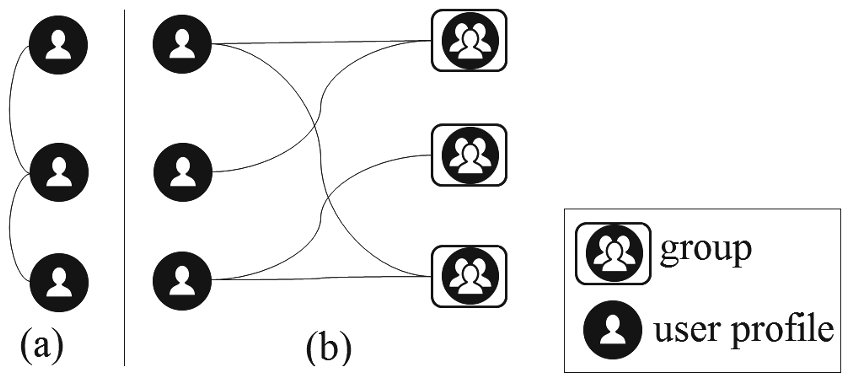 Figure 1: The dual relationship between the Friendship Graph (a) and the Group Membership Graph (b).
The algorithm (Algorithm 2 in the paper) follows these steps:
- Identify Seed Groups: Find the public groups the target belongs to.
- Breadth-First Exploration: Use members of these groups to find 2-hop and 3-hop distant groups.
- Friendship Verification: Use specific API features (like the
/friendship/<id1>/<id2>or mutual friend queries) to confirm hidden links.
Mathematical Insight: Group Densities
The authors define three types of density to guide the attack:
- Public Density (): Known friendship links within a group.
- Real Density (): The total (hidden + public) links; what the attacker wants to find.
- Maximal Density (): The upper bound of potential links if all private users are friends.
They proved that for groups of 10-20 members, the probability of any two members being friends is between 34.3% and 51.5%. This high probability allows the attacker to prioritize these small clusters, ensuring each "query" has a high hit rate.
Results: Efficiency and Scale
The researchers tested their bot against 1,000 active Facebook profiles. The results were startling:
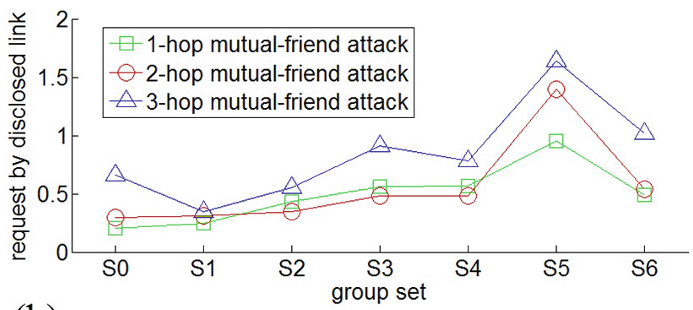 Figure 2: Efficiency of friendship vs. mutual-friend attacks across different hop counts.
- Accuracy: In 2-hop attacks, the number of queries required to find one link drops significantly because overlapping groups provide more "evidence" of a connection.
- Mutual Friend Advantage: By querying mutual friends (Algorithm 3), the attacker can reveal entire lists of friends in one go, rather than checking users one-by-one.
- Success Rate: About 49% of users are vulnerable to this specific attack because they join at least one group with fewer than 50 members and leave that membership public.
Critical Insights & Takeaways
- The "Gateway" Risk: Your privacy is only as strong as your least-private friend. If you hide your list, but your friend doesn't, the link is public.
- Structural Leakage: Group memberships are often overlooked as "non-sensitive," but they provide the structural roadmap needed to bypass friend-list privacy.
- Legitimate Query Risks: This attack doesn't use any "hacks" or exploits—it uses the tools Facebook provides for developers and users. This makes it almost impossible for OSNs to distinguish an attacker from a normal power-user or a third-party app.
Conclusion: This work serves as a warning that privacy isn't an individual toggle; it is a collective property of the social graph. To truly stay hidden, users must manage not just who they "know," but what groups they "join."