
mlBroker: Slashing Costs of Geo-Distributed ML via Dynamic Volume-Discounting
Online Placement and Scaling of Geo-Distributed Machine Learning Jobs via Volume-Discounting Brokerage
The paper introduces "mlBroker," a specialized brokerage service for geo-distributed machine learning (ML) jobs. It utilizes a novel online placement and scaling algorithm to minimize long-term costs by aggregating resource demands to exploit volume discounts and strategically managing worker/Parameter Server (PS) locations.
TL;DR
Training machine learning models on globally dispersed datasets is notoriously expensive due to massive data transfer and high-performance computing costs. mlBroker is a new system that acts as a "middleman" for ML jobs. It aggregates multiple jobs to unlock cloud "volume discounts"—the "buy more, save more" principle—and uses a sophisticated online algorithm to decide where to place workers and servers in real-time. The result? A 20% to 50% reduction in total operational costs.
Background: The Price of Geo-Distributed Intelligence
In the modern era, data is generated everywhere—from click-streams in London to IoT sensors in Tokyo. Moving all this data to a central "brain" for training is often impossible due to bandwidth costs and privacy laws. Instead, we use Parameter Server (PS) architectures where "Workers" stay near the data and "PS nodes" sync the model.
However, cloud providers like AWS and Rackspace offer tiered pricing: the more resources you use, the cheaper they get. Individual ML jobs are rarely large enough to hit these tiers. This creates a massive inefficiency that mlBroker seeks to exploit through aggregation.
The Core Challenge: The "Online" Complexity
The problem is inherently difficult because:
- Temporal Coupling: Today's decision to deploy a worker in Data Center A affects tomorrow's "deployment cost" (you don't pay to launch it twice).
- Integer Constraints: You can't rent 0.7 of a GPU or 1.2 of a Parameter Server.
- Non-Linearity: Volume discounts create piecewise price functions that are mathematically "ugly" to optimize.
Methodology: The mlBroker Secret Sauce
The researchers solved this using a elegant two-step mathematical pipeline.
1. Regularization-Based Decomposition
To handle the "Online" nature (where you don't know future data volumes), they used a Regularization technique. They replaced the discrete, non-convex deployment costs with a smooth, logarithmic "Relative Entropy" function. This allowed them to break the massive long-term problem into small, solvable "one-shot" problems for each time slot without losing long-term efficiency.
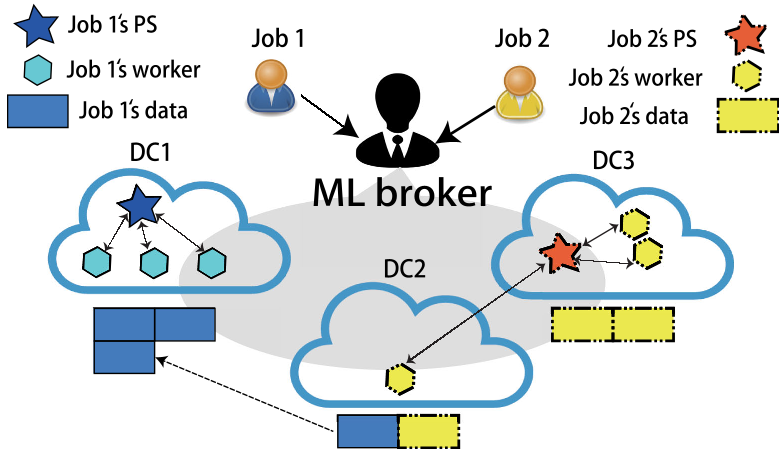 Figure 1: The ML Broker service model, illustrating how training data and computing nodes are selectively rescheduled across data centers.
2. Dependent Rounding
Once they have "fractional" solutions (e.g., "rent 2.4 workers"), they use a Dependent Rounding algorithm. Unlike simple rounding (rounding 2.4 to 2), dependent rounding ensures that if one variable is rounded down, another is rounded up to keep the total system capacity (processing power) stable.
Proving the Value: Experimental Results
The authors didn't just stop at math; they simulated 15 data centers and even ran a real-world test on Amazon EC2 GPU clusters using k8s and MXNet.
Key Findings:
- Cost Efficiency: Compared to "Local" processing (processing data where it's born) or "Central" processing, mlBroker consistently found the "Goldilocks" zone, balancing transmission costs against resource discounts.
- Scaling Performance: As training data size increases, the savings actually become more pronounced because the algorithm is better at triggering higher discount tiers.
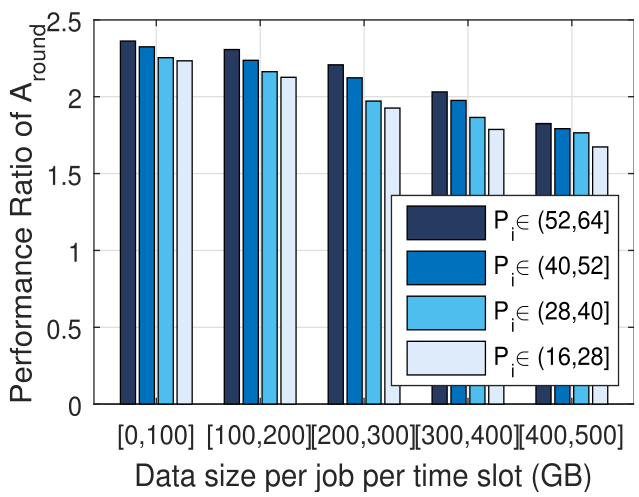 Figure 2: Total cost comparison across different data sizes. mlBroker outperforms OASiS, Local, and Centralized strategies consistently.
Critical Insight: Why This Matters for the Industry
Many engineers assume that "Cloud Orchestration" only means keeping services running. This paper proves that Financial Orchestration is just as critical. By treating cloud resources as a financial commodity subject to volume discounts, mlBroker moves the goalposts from mere technical feasibility to economic sustainability.
Limitations & Future Work
The current model assumes a fixed execution window. Future iterations could integrate Job Scheduling (deciding when to run) with Placement (deciding where to run) to exploit time-of-use pricing and "spot" instances even further.
Conclusion
As ML models grow into the "Trillion Parameter" territory, the infrastructure cost becomes the primary bottleneck. Algorithms like mlBroker, which leverage advanced online optimization and financial awareness, will be essential for the next generation of geo-distributed AI.