
OSBCF: Leveraging Social Circles to Solve the Online Recommendation Cold-Start Problem
Online Recommender System Based on Social Network Regularization
This paper introduces OSBCF, an Online Social-Based Collaborative Filtering framework that integrates social network regularization into stochastic gradient descent (SGD). By leveraging friendship ties and taste similarity, the method achieves superior real-time recommendation accuracy and addresses the cold-start problem in sequential rating environments.
TL;DR
Current recommender systems struggle with "streaming" data—new ratings arrive every second, and batch retraining is too slow. OSBCF (Online Social-Based Collaborative Filtering) solves this by updating user profiles in real-time while using social network ties as a "regularizer." It doesn't just learn from what you buy, but also from what your friends like, effectively solving the "Cold-Start" problem for new users through a novel social-based initialization.
Problem & Motivation: The Batch-Training Bottleneck
In the "static" era of machine learning, we trained a Matrix Factorization (MF) model on a fixed dataset. But in modern apps, data is a river, not a lake.
- Computational Cost: Retraining a model with millions of users every time a single person clicks "like" is impossible.
- The Data Sparsity Wall: Online systems often encounter new users. Without historical data, a standard algorithm has no "anchor" to place this user in the latent feature space, resulting in random, poor recommendations.
The authors' key insight: Social taste homophily. We are who we follow. If we can't see your history, we can look at your friends' latent vectors to guess yours.
Methodology: Socially-Aware Real-Time Updates
The paper proposes moving from standard Stochastic Gradient Descent (SGD) to a Socially Regularized version.
1. OSBCF-I: Average-Based Regularization
This model assumes you are a general reflection of your social circle. The loss function adds a penalty term that prevents your latent vector from drifting too far from the average of your friends' vectors.
2. OSBCF-II: Similarity-Based Weighting
Since not all friends have identical tastes, OSBCF-II uses the Pearson Correlation Coefficient to weight the influence of each friend. This ensures that a friend with a 90% taste overlap influences your profile more than a casual acquaintance.
Note: The framework involves a Trust Matrix T updated via similarity scores and an Online Matrix Factorization loop.
3. Solving Cold-Start: Live Initialization
Instead of initializing a new user with a random vector (which is essentially "noise"), the authors propose: This places the new user at the "centroid" of their social circle, giving the system a massive head start in accuracy.
Experiments & Results
The authors tested OSBCF on Epinions and Flixster datasets, focusing on RMSE (Root Mean Square Error).
| Method | Epinions (20% Train) | Flixster (20% Train) |
|---|---|---|
| Traditional OCF | 0.9744 | (Higher Error) |
| OSBCF-I | 0.9637 | (Lower Error) |
| OSBCF-II | 0.9621 | (Best Performance) |
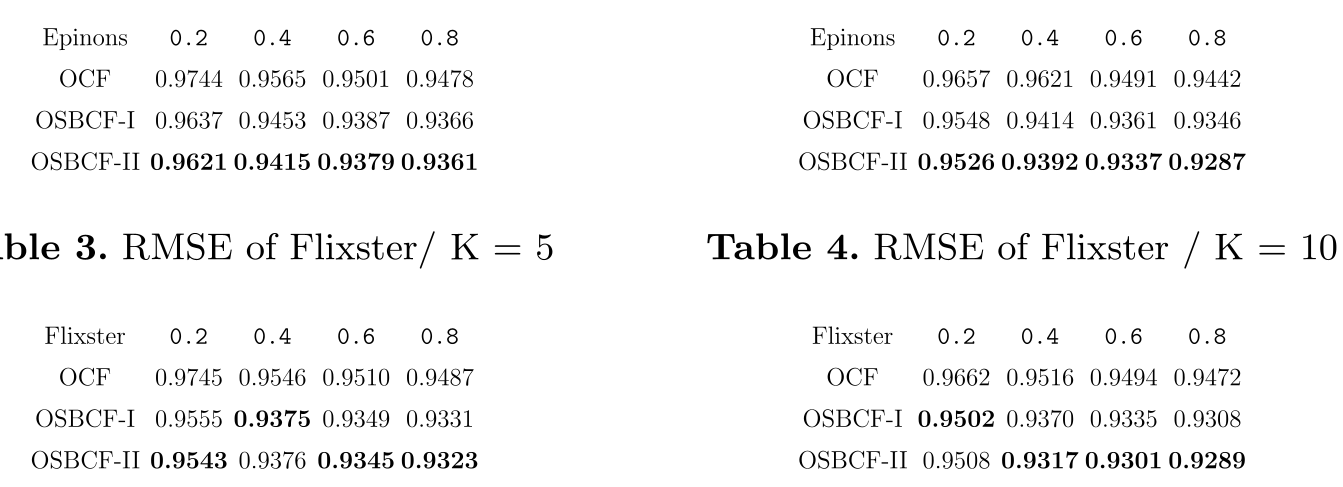
Key Finding: The performance gap between traditional OCF and the social-based versions widens as the latent factor dimension () increases. This suggests that social information is vital for filling in the "blanks" when the model tries to learn complex, high-dimensional user features.
Critical Analysis & Conclusion
The Takeaway
OSBCF proves that social networks aren't just for features; they are essential for regularizing the learning process in real-time. By treating a user's social circle as a prior distribution, the model remains stable even when ratings are sparse.
Limitations
- Dynamic Similarity: The similarity matrix is computationally expensive to update for every single rating.
- Social Noise: The paper assumes friends influence tastes, but in many platforms, "followers" do not equal "friends" (e.g., following a celebrity doesn't mean you share their taste in books).
Future Outlook
As we move toward Graph-based recommendations, the logic in OSBCF serves as the foundation for Temporal Graph Neural Networks, where the edge (social tie) and the node update (the rating) happen simultaneously in a streaming fashion.