
Mitigating Data Incest: Why Your Online Reputation System is Biased (and How to Fix It)
Online Reputation and Polling Systems: Data Incest, Social Learning, and Revealed Preferences
This paper investigates the phenomenon of "Data Incest" in online reputation and expectation polling systems, where the reuse of non-independent information leads to biased social learning. The authors propose a decentralized data fusion protocol using a Directed Acyclic Graph (DAG) model and provide a validated "Incest Removal Algorithm" based on transitive closure matrices to restore unbiased state estimates.
TL;DR
In a world of Yelp reviews and Twitter polls, our opinions are rarely our own. We are "social sensors" in a massive network where information loops back on itself. This paper identifies a critical systemic failure called Data Incest—the accidental double-counting of information—and provides a mathematical framework to "purify" social beliefs using graph theory and Bayesian filters.
The Hidden Trap of Social Learning
Imagine Agent A rates a restaurant as "Excellent." Agent B, influenced by A, also gives it a 5-star review. Agent A then sees B's review and thinks, "Wow, everyone loves this place!" and confirms their own bias.
This is Data Incest. In statistical terms, the information gathered by each agent is mistakenly considered independent. When these dependent observations are fused naively, the result is an estimate of the state (reputation) that is wildly overconfident and biased.
The Problem with Prior Work
Most reputation systems assume a "Mean Field" or simple averaging approach. They treat every "Like" or "5-star" as an independent data point. This ignores the topology of the social network—the specific paths through which influence flows.
Methodology: The Geometry of Beliefs
The authors model the flow of information as a Directed Acyclic Graph (DAG). To solve the incest problem, they introduce a protocol that acts as a "Fair Rating" filter.
1. Transitive Closure and Weighting
The core innovation is the use of the Transitive Closure Matrix (). While an adjacency matrix only shows direct friends, the transitive closure matrix maps every possible path of influence between any two nodes in the history of the system.
By calculating weights , the system can effectively "subtract" the redundant information that a person already received from other paths.
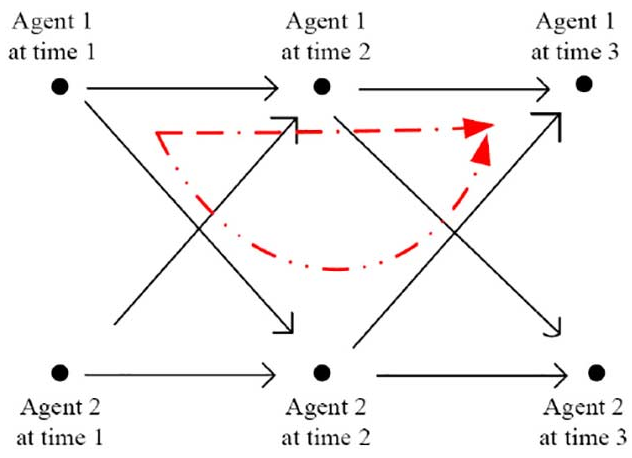 Figure 1: Red paths illustrate how Agent 1's initial opinion is double-counted by the time it reaches Agent 7.
2. Bayesian Utility Maximization
The paper assumes that humans are "Utility Maximizers." Using Afriat’s Theorem from microeconomics, the authors prove that if a human's decisions follow certain ordinal patterns (more favorable news leads to higher ratings), they can be modeled as Bayesian agents even if they don't know the math.
Experimental Evidence: Humans in the Loop
The authors didn't just stay in the realm of theory. They conducted experiments with 36 students involving perceptual tasks (judging circle diameters).
- Herding was real: In 66% of trials, participants reached an agreement (herded), even if it was the wrong answer.
- Incest caused flip-flopping: In 21% of cases where "incestuous" information patterns were present, participants changed their choice solely because they saw their own influence reflected back to them through their partner.
Performance in Complex Networks
In simulations involving corporate and mesh networks (where managers and workers influence each other in loops), the Incest Removal Algorithm dramatically outperformed naive fusion.
| Node | MSE (Naive/Incest) | MSE (Incest Removal) |
|---|---|---|
| Node 10 (Senior Manager) | 0.3119 | 0.1376 |
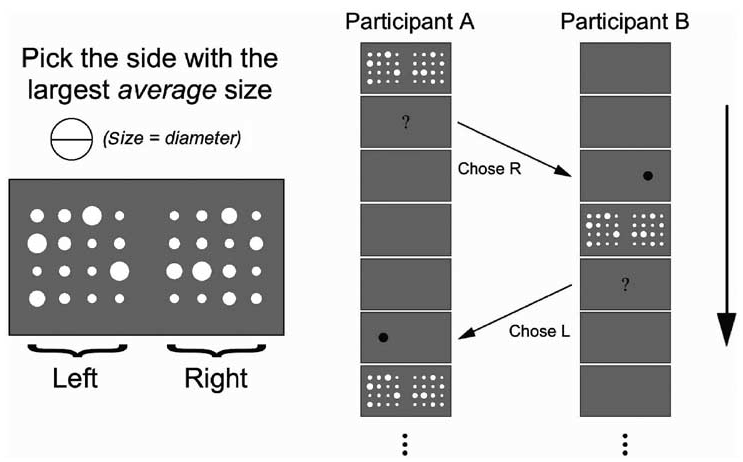 Typical stimuli used in the circle diameter judgment task to measure social influence.
Case Study: Twitter and Revealed Preferences
The authors analyzed 24 hours of Twitter data from major reputation agencies like @IGN and @RottenTomatoes. They found that the "Retweet" behavior of followers can be modeled as a utility function. Specifically:
- Twitter users balance a "Social Impact Budget."
- There is a "Diffusion of Responsibility": As the number of followers increases, the time it takes for the first retweet actually increases, as individuals feel less personally "responsible" for spreading the news.
Conclusion and Deep Insights
The paper concludes that Fair Polling and Unbiased Reputation are impossible without knowing the underlying social graph.
Why This Matters for the Future of AI:
As we build "AI Agents" that learn from each other (Multi-Agent Systems), they will encounter the exact same "Data Incest" problem. If Agent A trains on data generated by Agent B, which was in turn trained on Agent A, the models will "hallucinate" overconfidence and lose diversity. The mathematical "Incest Removal" logic provided here is a blueprint for keeping multi-agent learning systems sane and unbiased.
Takeaway: If you are designing a recommendation engine or a polling system, stop averaging. Start looking at the weights of the transitive closure.