
Online Social Behavior Modeling: Turning Group Dynamics into Tracking Robustness
Online Social Behavior Modeling for Multi-target Tracking
This paper introduces an Online Social Behavior Model (SBM) for Multi-Target Tracking (MTT) that represents spatio-temporal relationships between individuals. By integrating a graphical model learned online with tracklet association, the method achieves SOTA-level performance (e.g., Fragments reduced to 7 and ID Switches to 7 on CAVIAR) without requiring offline training data or future video frames.
TL;DR
Tracking people in a crowd is notoriously difficult when everyone looks similar. This paper proposes a Social Behavior Model (SBM) that learns how groups move together on-the-fly. By treating nearby people as "spatio-temporal context" for one another, the system resolves identity switches and track fragments without needing to see the future of the video or requiring any offline training data.
Problem & Motivation: The "Look-Alike" Trap
In high-clutter environments like shopping malls or busy intersections, appearance-based trackers frequently fail. When two people wearing similar clothes cross paths, a standard tracker often suffers an ID Switch.
The authors observed a simple human truth: People are often seen together. If person A and person B are part of a group, their relative motion is highly predictable. Most prior works attempted to model this using "Batch Processing" (analyzing the whole video at once) or "Offline Learning" (pre-training on thousands of hours of video). This paper breaks those constraints, proposing a causal system that learns social ties as it goes.
Methodology: The Social Graph
The core of the work is a graphical model designed for tracklet association.
1. The Graphical Logic
Each node () in the graph represents a hypothesis: "Does tracklet in time window belong to the same person as tracklet in window ?".
The edges () are where the "Social" part happens. An edge connects two hypotheses. It asks: "If I assume person A followed path , does that make person B's path look socially consistent?"
2. Motion Consistency and Parameter Estimation
Instead of assuming a fixed "social force," the model estimates a linear relationship between targets: By calculating the least-square estimates of transformation parameters ( and ) in the current window, the model checks if that same relationship holds in the next window. If it does, the "social weight" increases.
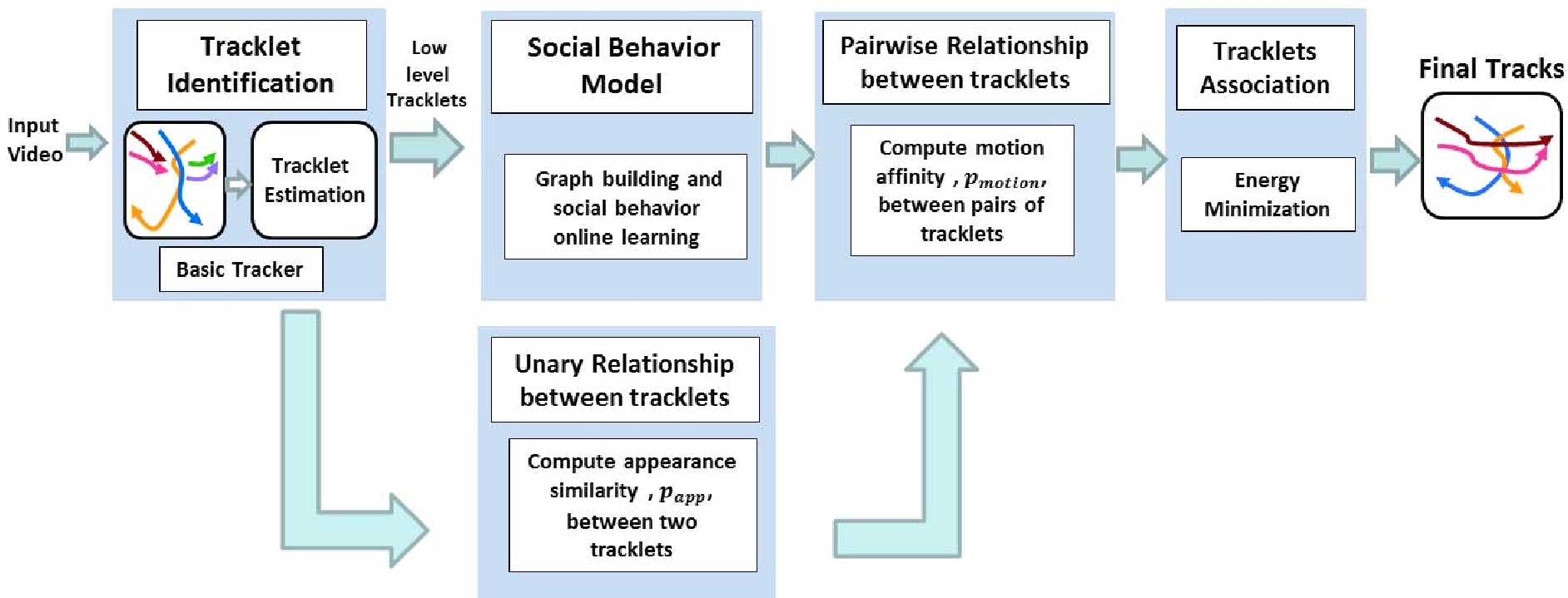 Figure 1: The framework overview. Tracklets are fed into the SBM, which uses Belief Propagation to refine affinity scores before a final Hungarian association.
3. Max-Product Message Passing
To solve this graph, the authors use Loopy Belief Propagation. Nodes "talk" to their neighbors (supporting targets), passing messages about their confidence. This allows a target's association to be influenced by the movement of its neighbors—essentially using the group as an "anchor" to prevent individual tracking drift.
Experiments: Proving the "Social" Advantage
The authors tested the SBM on three datasets: CAVIAR, TUD Crossing, and ETHZ.
Key Results:
- CAVIAR: The method achieved an MT (Mostly Tracked) rate of 85.3%. Notably, it reduced ID switches to 7, outperforming many batch-processing methods that have the unfair advantage of "seeing the future."
- TUD Crossing: Specifically designed to test interacting pedestrians, the SBM reduced fragments from 4 to 2 and ID switches from 4 to 1.
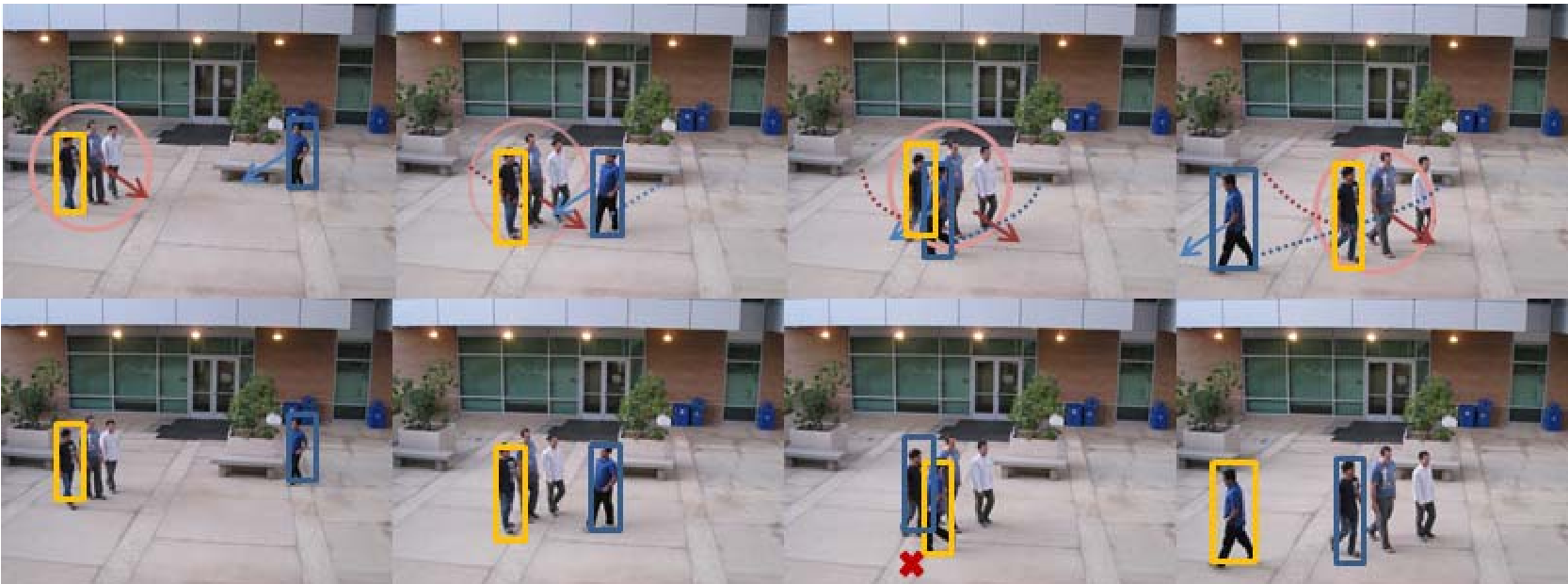 Figure 2: Visual Comparison. The bottom row shows an ID switch when tracking independently. The top row (with SBM) uses the group context (pink circle) to maintain correct identities despite proximity.
Critical Insight & Conclusion
Why it works
The SBM acts as a dynamic constraint. While appearance features () can be noisy due to lighting or occlusion, the relative geometry of a group ( via SBM) is surprisingly stable over short durations. By combining these via a weighted linear combination, the tracker gains an inductive bias that "groups stay together."
Limitations
- Complexity: Loopy belief propagation can be computationally expensive as the number of targets in a scene grows.
- Initial Discovery: The model relies on "tracklets" (short, confident tracks) being existing. If the base tracker fails to generate these, the SBM has no nodes to work with.
Takeaway
This research demonstrates that social context isn't just a high-level behavioral concept—it's a mathematically formalizable tool that can serve as a robust feature for low-level data association in computer vision.