
Beyond Polarization: Decoding the Multi-Platform Complexity of the Syrian Conflict
Online social media in the Syria conflict: Encompassing the extremes and the in-betweens
This paper analyzes online political activism during the Syria conflict by employing a multi-view network representation that integrates Twitter and YouTube data. By utilizing community detection on a curated set of authoritative accounts, the authors identify four distinct categories of actors: Jihadist, Kurdish, Pro-Assad, and Secular/Moderate opposition, highlighting a complexity that transcends typical binary political polarizations.
TL;DR
The Syrian Civil War is perhaps the most documented conflict in the history of social media, yet its digital footprint is often oversimplified. This paper moves beyond the naive "Pro-regime vs. Anti-regime" binary by analyzing a unified network of Twitter and YouTube activity. It uncovers four distinct ideological clusters and reveals how different factions—specifically Jihadist vs. Secular groups—react fundamentally differently to "real-world" events like chemical attacks.
Context: Why "Big Data" Often Misses the Mark
Most studies on online political activism (e.g., US Republicans vs. Democrats) benefit from static, well-defined boundaries. In a shifting conflict like Syria, using predefined hashtags can lead to significant selection bias. Instead of casting a wide, shallow net, the authors focused on authoritative curation, mapping accounts recognized by journalists and ground-level entities.
Methodology: The Unified Multi-View Graph
The researchers didn't just look at who follows whom. They constructed a unified graph representation by merging seven distinct "views" of social media interaction:
- Explicit Networks: Follower/friend links.
- Interaction Networks: Mentions and retweets.
- Content/Implicit Networks: Co-occurrence in Twitter lists and shared YouTube channels.
By using SVD (Singular Value Decomposition) rank aggregation, they combined these sparse data sources into a single weighted graph, allowing the OSLOM algorithm to find overlapping communities that mirror the fragmented reality of the Syrian battlefield.
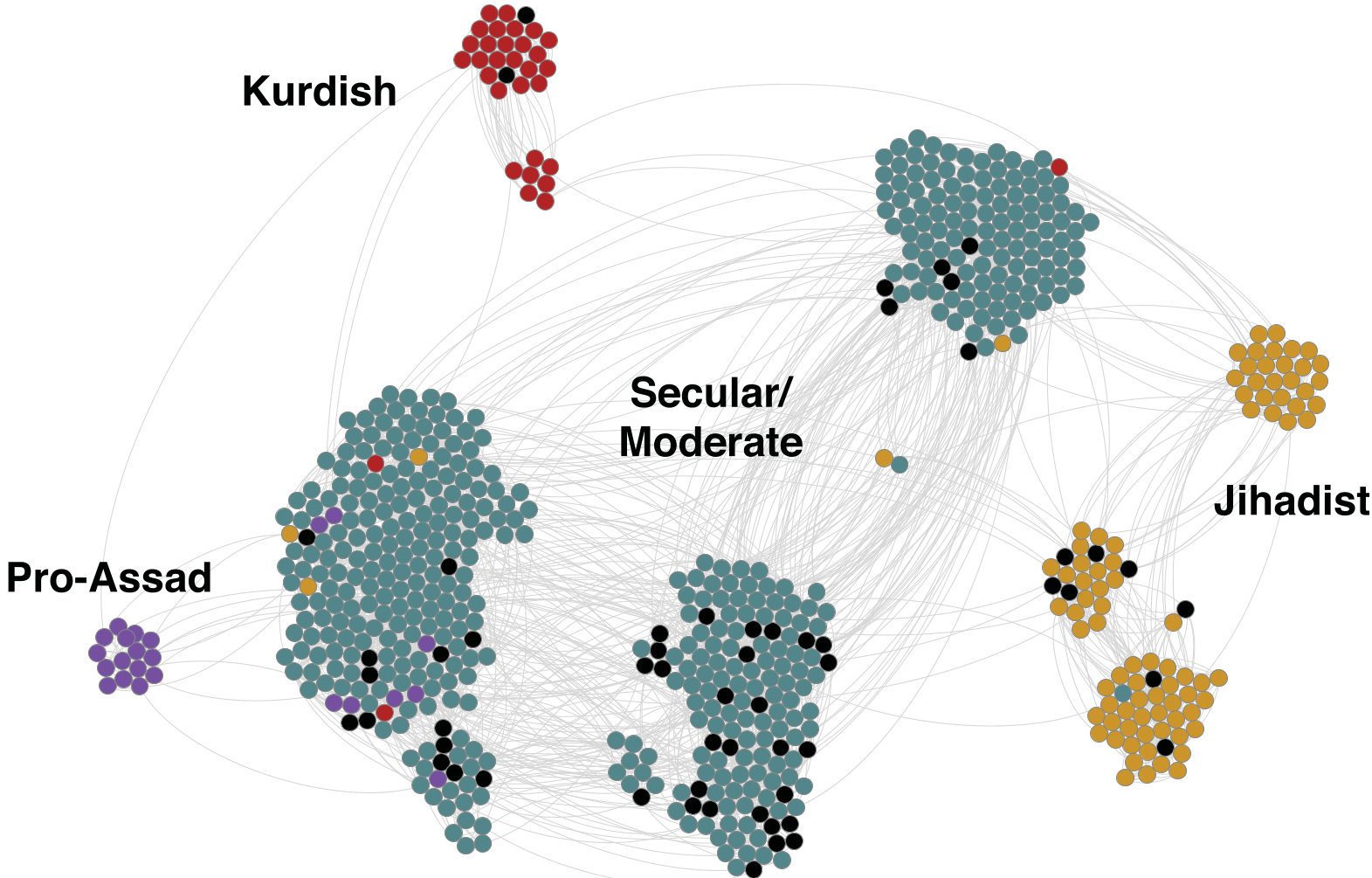 Fig 1: The resulting network visualization showing four categories: Jihadist (Gold), Kurdish (Red), Pro-Assad (Purple), and Secular/Moderate (Blue).
Deep Dive: The Three Extremes of the Opposition
The paper provides a fascinating "close reading" of three specific anti-regime communities:
- C-Jihadist: Small, almost exclusively Arabic, and heavy on "Black Banner" iconography. This group is an island; its preferred YouTube channels even critique the very groups (like ISIS) that share its ideological space.
- C-Revolutionary: The most prolific tweeters, largely supporting the Free Syrian Army (FSA). They operate as a digital news network, documenting ground-level violence.
- C-Moderate: Largely the Syrian diaspora. Unlike the others, this group is multi-lingual (English/Arabic), contains significantly more female voices, and focuses on humanitarian issues and civic dissent (e.g., Kafranbel banners).
The "Real World" Litmus Test: The Ghouta Attack
The most striking evidence of community difference appeared during the Ghouta chemical weapon attack on August 21, 2013.
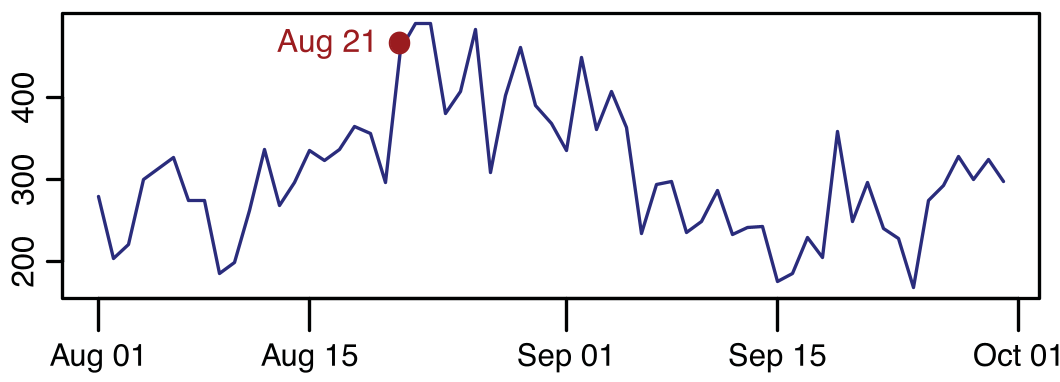 Fig 2: YouTube upload volume following the Ghouta attack. C-Revolutionary (Left) reacted instantly. C-Jihadist (Right) showed a delayed and muted response.
The data shows that while Revolutionary and Moderate groups flooded YouTube with evidence and calls for help within hours, the Jihadist channels lagged by 48 hours. Their content focused on religious themes (Anasheed) rather than the immediate humanitarian crisis, proving that their digital agenda was distinct from the broader revolution.
Critical Insight & Conclusion
This study proves that digital sociology requires more than just high-volume data scraping. By integrating Freebase topic modeling from YouTube, the authors bypassed the "language wall" to objectively categorize groups based on their shared interests.
Takeaway: Future social media analysis in conflict zones must be multi-platform. Relying on Twitter alone misses the visceral documentation stored on YouTube, and ignoring the "silent spaces" in a network (like the Jihadist lag in reporting) reveals as much about group priorities as their active presence does.
Limitations
The study acknowledges the potential for bias in the manual filtering of authoritative accounts and the limitations imposed by the Twitter API's rate limits at the time of data collection. However, as an exercise in "interpretable network science," it remains a SOTA reference for conflict analysis.