
OPL: Scaling Profile Linkage Across Social Networks with Linear Complexity
Online Social Network Profile Linkage
The paper introduces OPL (Online Profile Linkage), a probabilistic framework for linking user identities across different Online Social Networks (OSNs) like Twitter and LinkedIn. It utilizes a threshold-based canopying mechanism and a Naïve Bayes-based probabilistic classifier to achieve OPL, reaching an 85% F1-measure on large-scale real-world datasets.
Executive Summary
TL;DR: OPL (Online Profile Linkage) is a specialized framework designed to connect user identities across disparate social networks (e.g., matching a Twitter handle to a LinkedIn professional profile). By combining a threshold-based canopying framework with a probabilistic Naïve Bayes classifier, the authors overcome the traditional quadratic bottleneck of pairwise comparisons, achieving nearly linear scalability and an 85% F1-measure on real-world datasets.
Background Positioning: This work bridges the gap between theoretical record linkage and large-scale OSN production. It moves beyond "toy" datasets to address the dual challenges of computational explosion and extreme class imbalance in social media analytics.
Pain Points & Motivation
Why is linking profiles so hard? Traditional "Record Linkage" assumes a manageable number of records, but modern OSNs involve millions of users.
- The Trap: Comparing every user in Twitter against every user in LinkedIn is computationally suicidal at scale.
- The Imbalance Problem: For any given user, there is at most one "true" match in another network among millions of candidates. Standard classifiers often collapse under this imbalance, favoring negative predictions.
- Missing Data: Users rarely fill out every field. A robust system must work even when location, avatars, or bios are missing.
Methodology: The Core of OPL
1. Token-Based Canopying
To avoid comparing everyone with everyone, OPL uses "Canopies." It breaks usernames and names into tokens. The insight is that if two profiles belong to the same person, they likely share at least one rare token.
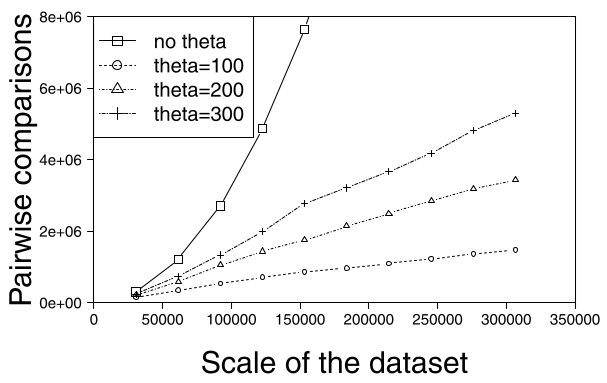
- Zipf's Law Integration: Common tokens (like "John" or "admin") are useless for filtering. OPL sets a frequency threshold . Tokens appearing more than times are discarded to prune the search space.
- Linear Complexity: The authors mathematically prove that by filtering tokens based on Zipf’s distribution, the total number of comparisons becomes , where and are the sizes of the two networks.
2. Probabilistic Classifier
Instead of a simple "yes/no" based on string similarity, OPL uses a modified Naïve Bayes model. It doesn't just look at if tokens are shared, but how rare those tokens are.
- Prior Knowledge: A shared rare token provides much stronger evidence of a match than a shared common one. This is formulated as: This ensures that the "uniqueness" of the username directly influences the match probability.
Experiments & Results
The authors tested OPL on a massive dataset of 150,000+ users from Twitter and LinkedIn.
SOTA Comparison
OPL was compared against traditional classifiers (SVM, C4.5) and previous identity linkage methods (Liu et al.).
| Method | Precision | Recall | F1 | Identity-Acc |
|---|---|---|---|---|
| SVM | 0.942 | 0.456 | 0.614 | 0.727 |
| Naïve Bayes | 0.934 | 0.625 | 0.748 | 0.801 |
| OPL | 0.866 | 0.846 | 0.856 | 0.865 |
Insights from Results:
- Robustness: Standard SVMs suffered significantly in recall (only 45.6%) because they struggled with the sparse features and unbalanced data.
- The Power of Priors: By incorporating the rarity of tokens, OPL achieved a much higher recall (84.6%) without sacrificing too much precision.
The Canopy Threshold ()
The experiment shows that as increases, the number of "missing pairs" (matching pairs that were accidentally filtered out) drops. The sweet spot was found around , where complexity remains low but accuracy plateaus.
Critical Analysis & Conclusion
Takeaways: OPL proves that for large-scale social data, simple but theoretically grounded indexing (canopying) is more valuable than complex black-box classifiers. The use of domain-specific priors (Zipf's law) is the "secret sauce" that allows the system to handle the inherent noise of the web.
Limitations:
- Token Dependence: If a user uses completely different usernames (e.g., "TechWizard" on Twitter vs. "RealName" on LinkedIn) and has no other shared tokens, OPL will fail to match them.
- Feature Sparsity: The reliance on Google Maps API and Avatar downloads adds external dependencies that might be slow or rate-limited in high-throughput production environments.
Future Work: The authors suggest moving toward content-based linkage (e.g., linking a forum poster to an OSN profile based on writing style) to capture users who maintain separate identities.