
The Social Network as a Criminal Toolbox: Beyond Digital Threats
16936_Online Social Networks, a Criminals Multipurpose Toolbox (Poster Abstract).
This paper explores the exploitation of Online Social Networks (OSNs) as a multi-functional "toolbox" for conventional physical criminals. It categorizes the criminal utility of platforms like Facebook, Twitter, LinkedIn, and YouTube into three strategic phases: incentive identification, crime planning, and escape execution.
TL;DR
Social media is no longer just a digital playground; it has become a sophisticated reconnaissance suite for physical criminals. This paper highlights how platforms like Facebook and LinkedIn are used to identify high-value targets, plan the timing of burglaries via event attendance, and even recruit specialized "talent" for organized crime. By aggregating fragmented public data, criminals can transform a simple status update into a successful heist.
Background & Motivation: The Physical-Digital Gap
Most academic discourse on social network security revolves around identity theft, cyber-bullying, or account hijacking. However, Mahmood and Desmedt argue that the most significant danger might be the bridge between digital oversharing and physical vulnerability.
The authors' central insight is that criminals act as "information synthesizers." While a single post about a new Rolex might seem innocuous, when combined with a "check-in" at a distant airport, it signals an unguarded high-value asset. The "Real Name" policies of major platforms act as the ultimate indexing key, allowing criminals to bridge the gap between a profile picture and a physical GPS coordinate.
Methodology: Mapping the Toolbox
The paper categorizes the criminal workflow into a three-stage pipeline facilitated by different platform mechanics:
- Incentive Identification: Scouring Twitter and Facebook for "boasting" keywords (e.g., "I bought a diamond").
- Tactical Planning: Using YouTube to learn physical bypass skills (lockpicking, RFID cloning) and LinkedIn to map a victim's professional network for potential coercion or kidnapping.
- Operations & Logistics: Utilizing Facebook events to determine when a victim will be away from home and using steganography within shared media for covert coordination between gang members.
Data Leakage via Public Phrases
The authors provide a stark look at how much actionable intelligence is shared voluntarily.
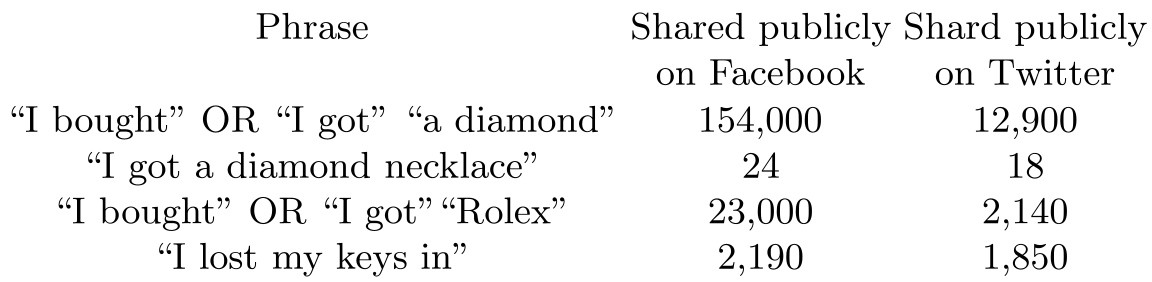
The table above illustrates the sheer volume of "incentives." For a criminal, the overlap between the 154,000 diamond owners and the 2,190 people who "lost their keys" represents a low-resistance, high-reward opportunity.
The Skill Acquisition Phase: YouTube as a Criminal Academy
A unique contribution of this paper is the analysis of YouTube as a technical training ground. It’s not just about what to steal, but how.

The massive view counts on lock-picking and CCTV hacking tutorials (Table 2) suggest that the barrier to entry for sophisticated physical crimes is being lowered by the democratized sharing of "security research" that can be easily repurposed for illicit ends.
Critical Insights & Future Directions
The paper concludes that the "weakest link" is often not the user themselves, but their social graph. Even if a target is private, their friends might post photos or event tags that leak the target's location or assets.
Key Takeaways:
- The Privacy-Parity Paradox: Platforms demand real names for "safety," but this very feature enables physical stalking and targeted burglary via third-party "people finder" sites.
- Proactive Defense: The authors propose the development of "Incentive Warners"—tools that analyze a post's sentiment and content to warn users: "This post indicates you have high-value items and will be away from home."
Limitations: As a poster abstract, the work provides a high-level taxonomy rather than a longitudinal empirical study linking specific posts to documented crimes. Future research must validate if "incentive-heavy" users actually experience higher rates of victimization compared to a control group.
Conclusion
We must stop viewing social media privacy as a purely digital concern. Every "like," "check-in," and "brag" is a piece of a puzzle that, when completed, creates a vulnerability map for the physical world. In the hands of a criminal, your social network isn't a community—it's a scouting report.