
The Economics of Connection: Why Your Social Circle is a Resource Allocation Problem
Online social networks in economics
This paper provides a comprehensive review of how economic theory and empirical methods are applied to study social networks. It distinguishes the economic approach through its focus on "choices under constraints" and evaluates the impact of networks on job matching, educational attainment, and the transitioning landscape of online social interactions.
TL;DR
Social networks are not just social—they are economic engines. This paper argues that unlike the random interactions often modeled in physics or computer science, human networks are the result of utility-maximizing choices under constraints. Whether it's finding a job or choosing a college major, your network acts as a conduit for information that "perfect" markets fail to provide.
Contextual Positioning
Written in the early stages of the Web 2.0 explosion (2009), Adalbert Mayer’s work serves as a bridge between classical labor economics and the then-emerging field of digital social dynamics. It positions network analysis not as a subset of sociology, but as a critical component of Industrial Organization and Labor Economics.
Problem & Motivation: The Market for "Hidden" Information
In a perfect economic world, all information—job openings, product quality, prices—is transparent. In reality, markets are "frictional."
The author’s core insight is that social networks exist to solve Information Transmission problems. Why do you ask a friend for a job referral instead of just looking at an ad?
- Learning: You observe their success to mitigate your risk.
- Trade Options: You discover opportunities that aren't indexed on public exchanges.
Methodology: The Strategic Choice of "Friends"
Mayer contrasts two ways of looking at how networks form:
- The Mechanical View (Stochastic): Links form by chance or simple algorithms (e.g., Random Graphs).
- The Economic View (Strategic): An agent maintains a link to only if the utility (benefits of info) exceeds the cost (time/effort).
Architecture of Stability
The paper utilizes the concept of Pair-wise Stability. A network is only stable if:
- No one wants to cut an existing link.
- No pair wants to form a new link unless one side finds it too costly.
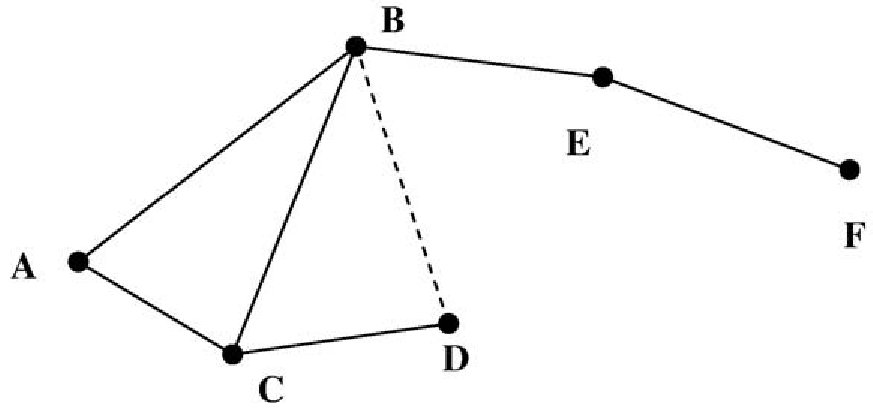 In the figure above, adding a link between B and D doesn't just help them; it creates a "Positive Externality" for E and F, who now have a shorter path to D's information.
Experiments & Results: The Reality of Silos
The paper analyzes data from Facebook (2005) across Texas universities. The findings on Homophily (like-seeking-like) are stark:
- Race as a Filter: Even controlling for dorms and majors, students are disproportionately likely to connect with their own race. In some samples, the "Relative Probability of Friendship" for same-race pairs was 16 times higher than random chance.
- The Small World: Despite the silos, the average "degrees of separation" remained between 2.3 and 3.0. We are separated by a few "hubs," but we live in highly clustered "islands."
 Table 1 illustrates that despite different campus sizes, structural metrics like the "Cluster Coefficient" remain remarkably consistent (0.17–0.27).
Deep Insight: Is More Connection Always Better?
The most provocative part of Mayer’s analysis is the Non-monotonic Matching Rate. You might assume that a denser network (everyone being more connected) always lowers unemployment. However, the model suggests a Congestion Point:
- If a network is too dense, the same job vacancy reaches too many people simultaneously, leading to "noise" and inefficiency in the hiring process.
- Digital Divide: While the internet lowers the cost of distance, it allows us to be more selective, potentially increasing segmentation by interests/class (a phenomenon Rosenblat and Mobius call "Drifting Apart").
Takeaway & Future Outlook
Mayer concludes that while online social networks (OSNs) facilitate the flow of data, they struggle to generate Social Collateral (Trust).
- For Research: The future lies in understanding how "Reputation Systems" (like eBay or Airbnb) replace the trust once provided by close-knit physical communities.
- For Product: Building platforms that connect different "islands" is harder than building ones that connect the same island—but it is where the true economic value (the "Weak Tie" benefit) resides.