
Why Do "We" Use Facebook? Understanding the Shift from Personal to Collective Intention
Online Social Networks: Why Do “We” Use Facebook?
This study investigates the drivers of Facebook usage by conceptualizing participation as an intentional social action. Applying Social Influence and Social Presence theories, the researchers identify "We-Intention"—a collective commitment to joint action—as the primary psychological mechanism for online social network engagement.
TL;DR
Why do social networks stick? This paper argues that we don't use Facebook just because we like it (I-Intention), but because we have a collective commitment to use it together (We-Intention). Through an empirical study of 182 users, the researchers found that Social Presence—the feeling that others are actually "there" with you—is the single most important factor driving this collective behavior.
The Shift: From "I" to "We"
For decades, technology adoption was studied through the lens of individual productivity (the Technology Acceptance Model). But social networks are different. If you are the only person on Facebook, the platform is useless.
The authors argue that using Facebook is a "Joint Action." They move the focus from Individual Intention to We-Intention: a commitment where an individual views themselves as part of a social group performing a shared act. The core question shifts from "Why do I use this?" to "Why do we use this together?"
The Conceptual Framework
The researchers combined two major theoretical pillars to explain We-Intention:
- Social Influence Theory: Divided into Compliance (doing it because others expect it), Internalization (doing it because it aligns with your values), and Identification (doing it to maintain a relationship).
- Social Presence Theory: The degree to which a medium allows you to feel the "salience" of another person. It’s the difference between reading a static webpage and seeing a "News Feed" where your friends are active right now.
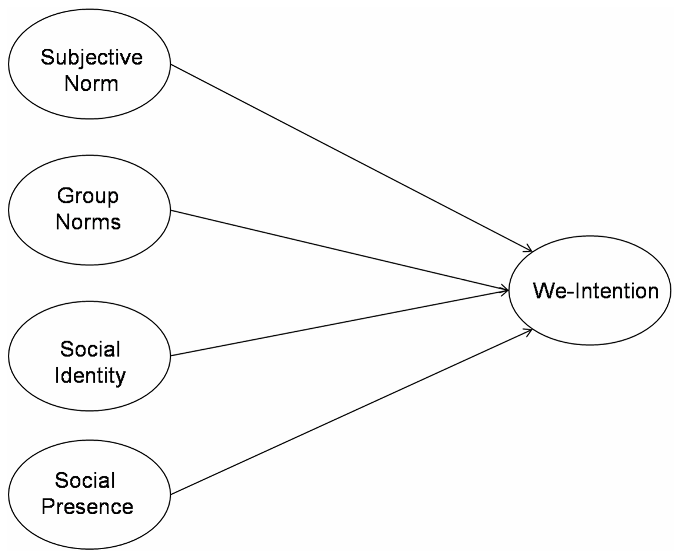 The proposed model linking Social Presence and Social Influence to We-Intention.
Methodology and Insights
The team surveyed 182 Facebook users, ensuring they were active by having them visualize and name their online friends before answering. Using Partial Least Square (PLS) analysis, they tested which factors actually moved the needle.
Key Findings:
- Social Presence is King: Features like the "News Feed" or "Join Invitations" create a psychological sense of human contact. This was the strongest driver of engagement.
- Group Norms Matter: When users feel the community share similar values (Internalization), they are more likely to participate.
- The Identity Paradox: Interestingly, "Social Identity" (sense of belonging) was not significant. The authors suggest that because users join so many different groups on Facebook, their relative sense of belonging to any single one is diluted.
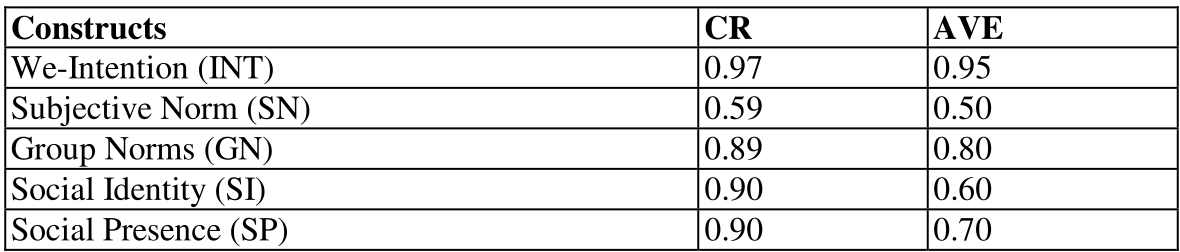 Psychometric properties showing the validity of the scales used.
Why This Matters for the Future of Social Tech
This paper, while early in the history of social media research, provides a timeless insight: Sociability is a technical feature.
If you are building a social platform, "Utility" (what the app does) is secondary to "Presence" (how much I feel my friends are here). The success of Facebook's "News Feed"—and later, the "Real-time" nature of Twitter and TikTok—validates the authors' findings.
Critical Reflection
While the model explains 24% of the variance, a large portion of "Why we use Facebook" remains unexplained. Future research might look into algorithmic nudges—how the AI's presence, rather than just human presence, shapes our "We-Intention."
Conclusion
We use social networks because they make us feel less alone in the digital void. By emphasizing Social Presence, developers can move beyond simple "tools" and create "places" where collective action thrives.
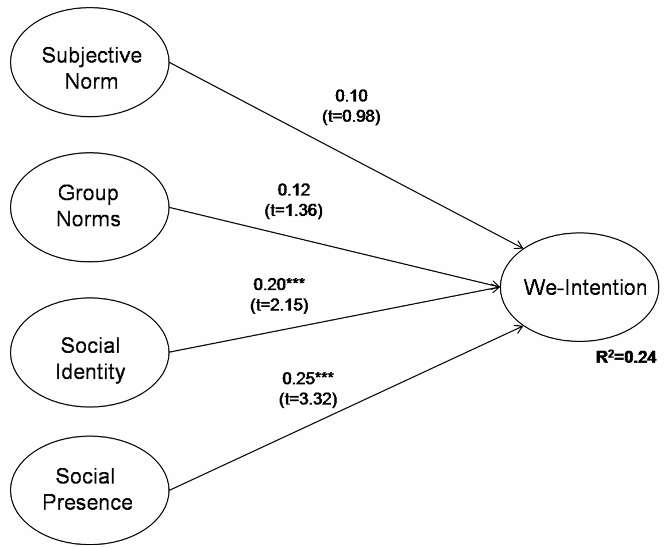 The final PLS results highlighting the significance of Social Presence and Group Norms.