
The Evidential Shield: Correcting Noise in Social Networks via Belief Functions
Online social networks and media
This paper proposes an evidential method based on the Theory of Belief Functions to correct noisy information in attributed social networks. By modeling nodes and links as triplets and leveraging Jousselme distance and Dempster's rule, the method iteratively reassigns memberships to achieve network coherence.
TL;DR
In the chaotic realm of social media and complex networks, data is rarely pristine. This paper introduces a sophisticated evidential framework that treats nodes and links as "triplets" of information. By utilizing the Theory of Belief Functions, the authors have developed an iterative algorithm that can look past the noise and reconstruct the "true" coherent structure of a network, outperforming standard probabilistic methods by massive margins.
The Motivation: When Probability Isn't Enough
Most social network analysis assumes we know exactly who is who and how they are connected. But in reality, attributes are often:
- Imprecise: "User A might belong to Group X."
- Noisy: Inaccurate metadata or malicious bots.
- Inconsistent: A link exists between two nodes that logically shouldn't be connected given their profiles.
Probabilistic models struggle here because they force a "sum-to-one" constraint, often failing to distinguish between conflict (evidence pointing in different directions) and ignorance (lack of evidence).
Methodology: The Coherent Triplet
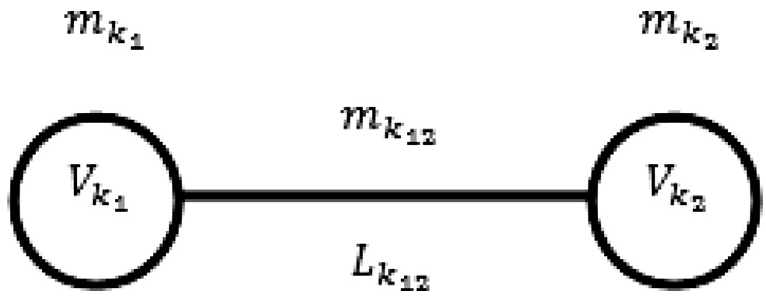
The genius of this work lies in the Coherent Triplet definition. A triplet consists of two nodes () and the link connecting them.
1. Mass Function Modeling
Instead of a single probability value, every attribute is a "mass function" . This allows the model to assign belief to subsets of communities or even the entire frame of discernment (the "I don't know" state).
2. The Iterative Correction Logic
The algorithm follows a rigorous 4-step cycle:
- Distance Calculation: Use Jousselme Distance to see how far a node/link's current state is from "ideal" community representatives.
- Average Dissimilarity: Compute how "coherent" the current triplet is.
- Knowledge Review: Generate new evidence based on the triplet's neighbors.
- Dempster’s Rule: Merge the new evidence with the old. Because Dempster's rule is conjunctive, it reinforces agreement and stabilizes the network over iterations.
Experiments: Evidential vs. Probabilistic
The authors tested their method against a probabilistic baseline on the Karate Club network and synthetic LFR benchmarks.
Key Findings:
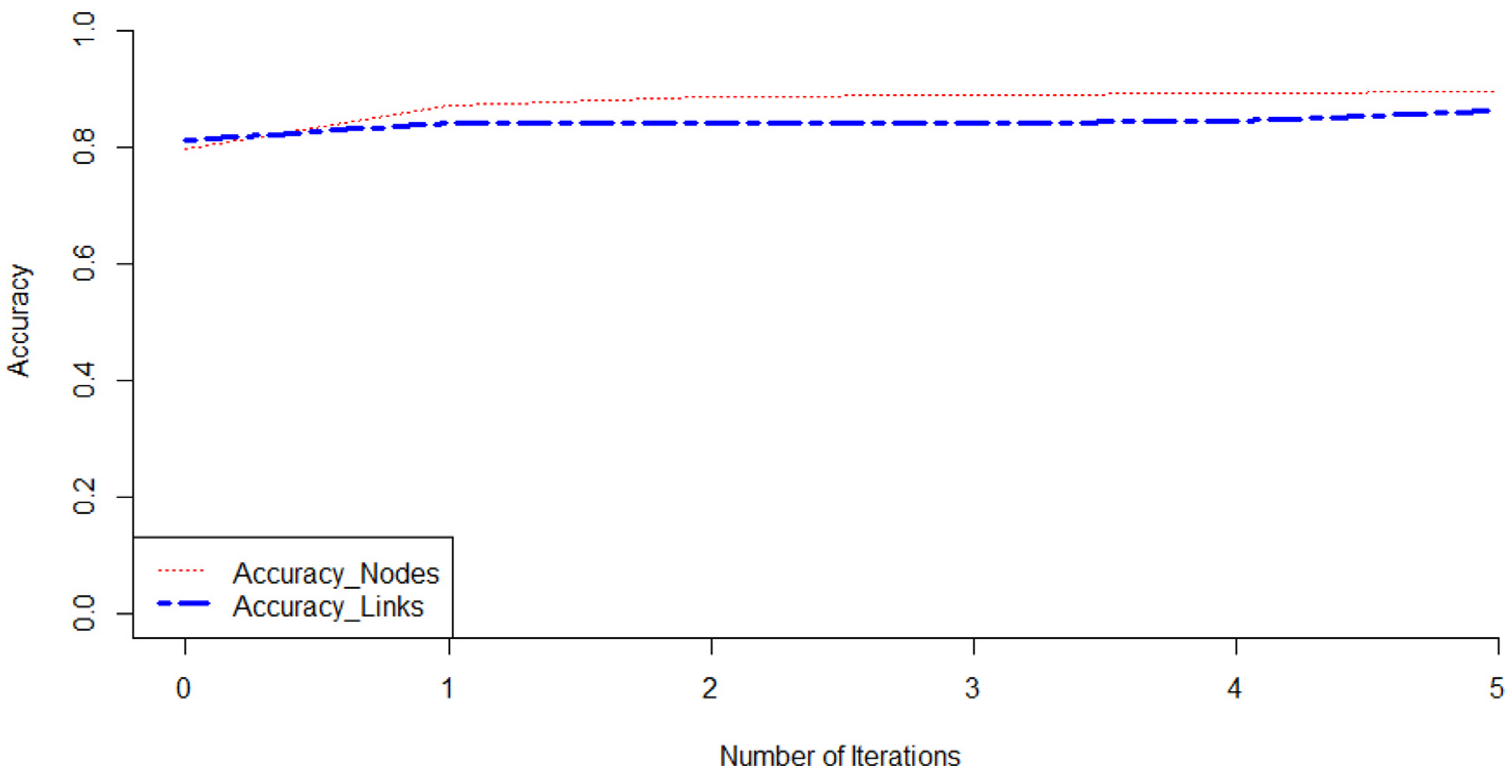
- Robustness to High Noise: When 30 nodes in a 99-node network were corrupted, the evidential method maintained high accuracy while the probabilistic baseline nearly collapsed.
- Improvement Rates: In nearly all cases—whether noise was in nodes, links, or both—the evidential approach showed an improvement rate ranging from 7% to 60%.
Critical Deep Dive
Why it works:
The Theory of Belief Functions provides a math-heavy but intuitive way to handle "Ignorance." In Step 3, if a triplet is highly incoherent (high distance), the algorithm assigns mass to the "Ignorance" set . This prevents the noisy data from over-influencing the final decision, allowing the surrounding "clean" nodes to eventually pull the noisy node into the correct community.
The Cost of Precision:
The primary drawback is Computational Complexity. As shown in the results, the execution time for the evidential method scales much faster than the probabilistic one (e.g., 19,225 seconds for 6 communities vs. 9.45 seconds). This is the classic "Belief Function Tax"—the price you pay for superior accuracy in uncertain environments.
Conclusion
This research proves that "Belief" is often more resilient than "Probability" when the ground truth is obscured. While execution time remains a challenge for billion-node scales, for high-stakes network reconstruction where accuracy is paramount, this evidential method is a powerful new tool in the data scientist's arsenal.
Future Outlook: Transitioning this framework to handle overlapping communities and optimizing it for real-time dynamic streams will be the next frontier.