
Beyond the Buddy List: Why Your "Activity Network" Is the True Social Graph
Comparison of Online Social Relations in Terms of Volume vs. Interaction: A Case Study of Cyworld
This paper presents a comparative study of the "Friends Network" (explicit declarations) and the "Activity Network" (actual interactions) within Cyworld, Korea's largest social portal at the time. By analyzing two years of guestbook logs, the authors quantify the gap between formal social links and real-world digital engagement.
TL;DR
In the world of social networking, a "friend" button click is just the beginning. This seminal study on Cyworld dissects the difference between the Friends Network (what we say) and the Activity Network (what we do). The findings reveal a striking reality: our real digital social circles are limited by a cognitive "capacity cap" near 200 people, and our actual interactions are far more reciprocal and structured than our messy friend lists suggest.
The "Friendship" Illusion
For years, researchers treated social network analysis as a study of static links. If User A friended User B, they were "connected." However, this creates a noisy dataset filled with "zombie" relationships—links created and forgotten. The authors of this paper argue that the Guestbook (interaction logs) provides a high-fidelity "Activity Network" that filters out this noise.
Methodology: Mapping the Pulse of Cyworld
The researchers analyzed over 8.4 billion guestbook entries spanning the peak growth years of Cyworld (2003-2005). They modeled this as a weighted, directed graph:
- Node: A user.
- Directed Edge: A message from writer to recipient.
- Weight (): The frequency of messages.
The Structural Comparison
One of the key insights comes from k-core analysis, which identifies the "dense nucleus" of a network.
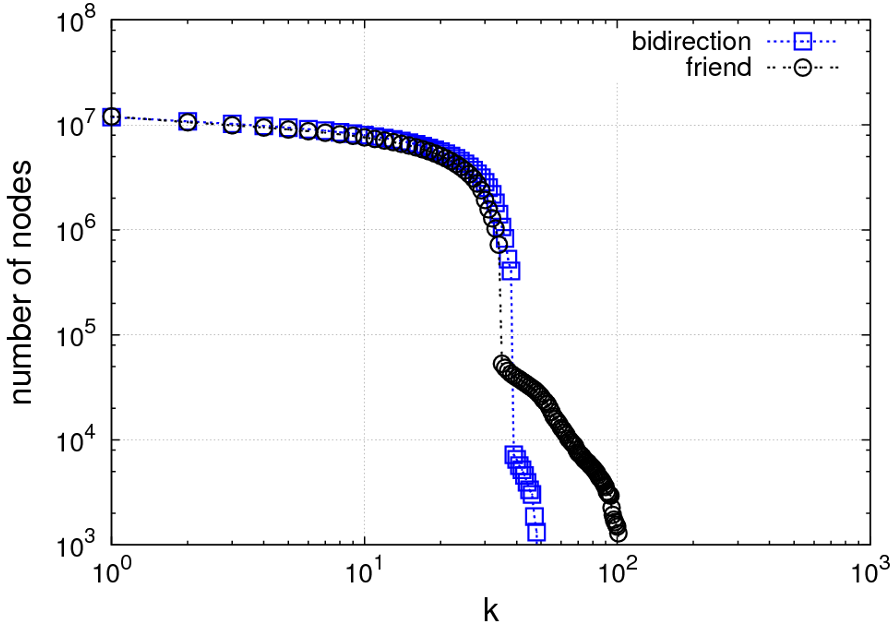 Figure: The Friends network (circles) has an unusually large number of highly connected cores compared to the more "natural" decay seen in the Activity network.
The Activity network behaves much more like "traditional" social systems, showing that interaction-based graphs are better at identifying the true influential cores of a community.
The Ghost of Dunbar: The 200-Friend Limit
One of the paper's most fascinating contributions is the empirical evidence of a Capacity Cap. It is often assumed that more friends lead to more social activity.
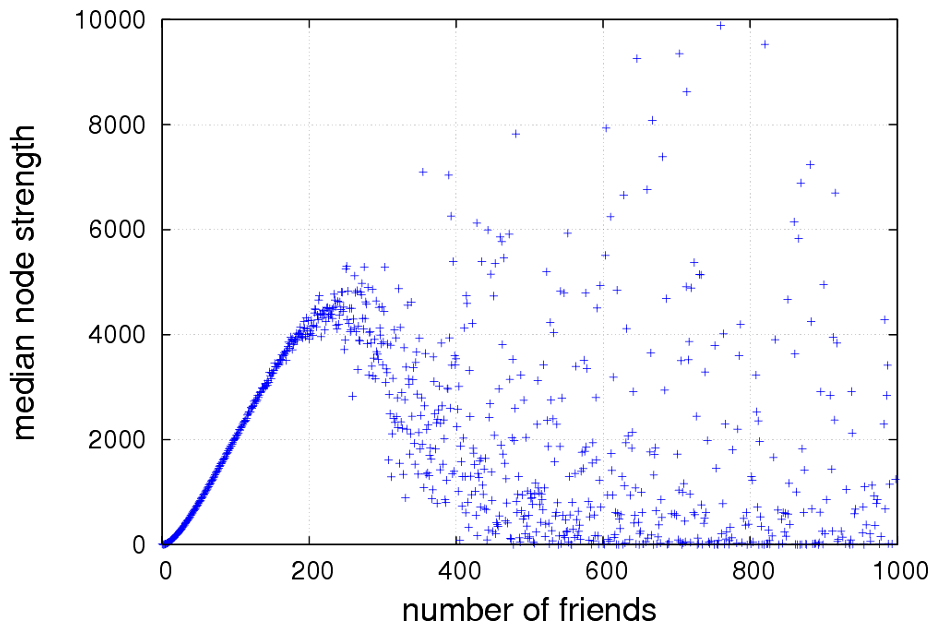 Figure: Social activity (node strength) peaks and then falls off once a user passes roughly 200 friends.
The data shows that up to 200 friends, activity increases with network size (Pearson 0.62). Beyond 200 friends, the correlation vanishes (0.009). This suggests a biological or cognitive limit—similar to Dunbar's Number—on how many active digital relationships a human can maintain. Technology can help us "track" thousands of friends, but it cannot expand our neocortex's ability to "groom" them.
Interaction Dynamics: Reciprocity & Motifs
The study finds that online social life is intensely reciprocal. The reciprocity coefficient () of the network was 0.77, significantly higher than the World Wide Web or Email networks. If you write in my guestbook, I am highly likely to write in yours.
Through Network Motif analysis (the study of 3-node interaction patterns), the authors discovered that:
- Transitive Triangles (friend of a friend interactions) are abundant.
- Spam/Celebrity Patterns (One-way broadcasting) create distinct disruptions in the motif distribution, allowing for structural detection of non-human or asymmetric behavior.
Critical Insight & Conclusion
This paper serves as a vital reminder for the AI and Social Graph era: Volume Value.
- For Researchers: Relying on "Follow" or "Friend" graphs leads to an overestimation of network density.
- For Product Designers: To build effective recommendation engines, one should weight "interaction strength" (Activity) significantly higher than "connection status" (Friends).
The study concludes that while digital tools allow us to expand our social volume indefinitely, our Interaction Network remains anchored to human limits—making the "Activity Network" the only one that truly matters.