
BetaTopK: Streamlining Crowdsourced Selection with Online Bayesian Inference
Online Top-K Selection in Crowdsourcing Environments
The paper introduces BetaTopK, an online active learning algorithm for selecting the top-K items in crowdsourcing environments. It leverages Beta distributions to model item quality and uncertainty, achieving comparable precision to global ranking methods with significantly fewer comparisons.
TL;DR
Researchers from UC Santa Cruz have developed BetaTopK, a dynamic algorithm that identifies the best items in a set without the wasteful overhead of a full ranking. By treating item quality as a probability distribution, the system "promotes" or "discards" items in real-time. It cuts crowdsourcing costs by up to 90% compared to traditional recursive methods while remaining robust to worker noise.
The Wastefulness of Global Ranking
In many scenarios—such as hiring 10 candidates from 1,000 applicants or picking the top 50 photos for a gallery—we don't actually care if the 1st place is better than the 2nd. We only care that both are in the "top" group.
Traditional algorithms like TrueSkill or Elo attempt to build a total order. They spend as much effort deciding if the 500th best item is better than the 501st as they do on the items near the selection boundary. Furthermore, specialized top-K algorithms often act as "black boxes": they need a fixed amount of data before they can tell you anything. If your budget runs out at 90%, you get zero results.
Methodology: The Physics of "Wins" and "Losses"
The core intuition of BetaTopK is to model the fractional rank of an item using a Beta Distribution ().
- : Represents the "evidence" of an item being high quality (wins).
- : Represents the "evidence" of an item being low quality (losses).
As the crowd performs pairwise comparisons, the algorithm updates these parameters. Using a defined error tolerance (), the algorithm checks the Cumulative Distribution Function (CDF) to see if an item belongs in the top fraction of the population with high confidence.
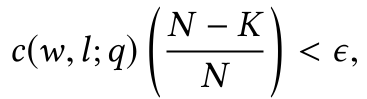 The algorithm promotes an item if the probability of it being in the top-K exceeds .
Optimized Strategy: Cumulative Information
Instead of resetting at each iteration, the optimized version (Algorithm 3) retains historical data and performs concurrent promotion and elimination. This allows the model to converge much faster as it "recycles" every comparison ever made between remaining candidates.
Performance & Benchmarks
The authors validated BetaTopK against TrueSkill (online global ranking) and RecurTopK (state-of-the-art offline selection).
1. Superior Selection Accuracy (Loss)
"Selection Loss" measures how much total quality we miss by picking the wrong top-K set. BetaTopK converges significantly faster than TrueSkill, especially in noisy environments where crowd workers make mistakes 20% of the time ().
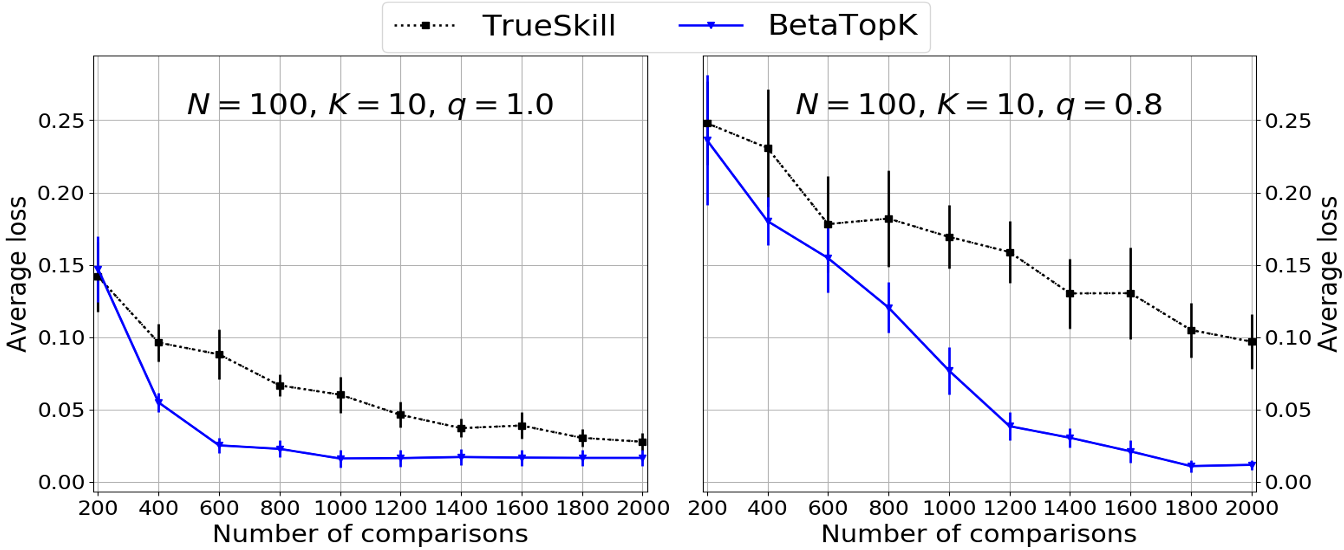 Graph: Selection loss of BetaTopK vs TrueSkill. Note the rapid decline in loss for BetaTopK even with limited comparisons.
2. Radical Budget Efficiency
The most striking result is the comparison with RecurTopK. In a test of 10,000 items with a target of 5,000 (), RecurTopK required over 331 million comparisons when worker accuracy was low. BetaTopK achieved the same result with only 1.1 million—a 300x improvement.
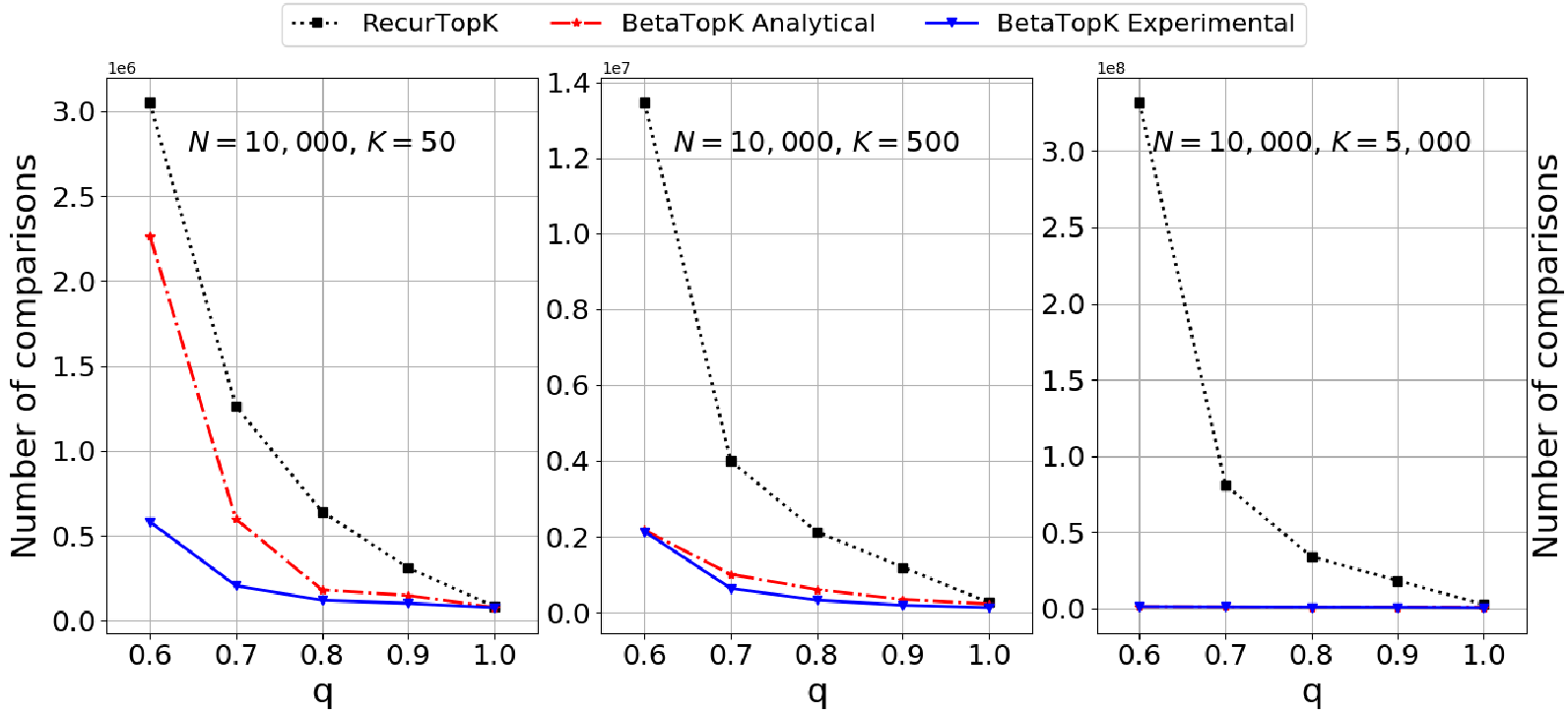 Graph: Number of comparisons required. BetaTopK (bottom lines) shows near-linear scaling compared to the exponential growth of prior recursive methods.
Critical Analysis & Takeaways
The brilliance of BetaTopK lies in its anytime property. Because it maintains a running posterior for every item, you can stop the algorithm at any second and get the "best possible" top-K list.
Limitations:
- The current model assumes a uniform worker error rate (). In the real world, some workers are "spammers" and others are experts.
- It assumes item qualities are somewhat static during the process.
Future Outlook: This work paves the way for "Active Crowd Learning" where the system doesn't just collect data, but intelligently asks: "Which two items, if compared right now, would give me the most information to finalize my top-K list?"
Conclusion
BetaTopK is a vital contribution for anyone running large-scale human evaluations. It proves that by focusing solely on the "boundary" between acceptance and rejection, we can make crowdsourcing faster, cheaper, and more reliable.