
Trust Index: Quantifying Credibility in the Social Media Wilderness
Not Every Friend on a Social Network Can be Trusted: An Online Trust Indexing Algorithm
This paper introduces an online Trust Index (TI) algorithm designed to quantify user trustworthiness in social networks. By leveraging "certified users" (verified icons) as anchors and applying a propagation model inspired by PageRank and the Six Degrees of Separation theory, the system assigns a ranked TI to users based on their social distance and connection types.
TL;DR
Social networks are rife with "friends" who may not be who they claim to be. This paper proposes a Trust Index (TI)—a quantitative metric that automatically calculates a user's trustworthiness based on their network proximity to verified public icons. By applying a propagation algorithm similar to Google's PageRank but optimized for social security, the system identifies suspicious accounts (zombies) and ranks users by their reliability.
Background: The Trust Deficit in Virtual Worlds
In modern platforms like X (Twitter) or Weibo, anyone can connect with anyone. While platforms verify "Public Icons" (celebrities, politicians), the vast majority of users remain uncertified. The core challenge is: How do we evaluate the trustworthiness of an average user without manual investigation?
The authors' insight is grounded in a social reality: Untrustworthy users or spammers rarely have meaningful connections with verified, high-trust individuals. Therefore, trust can be treated as a fluid that "leaks" or "decays" as it moves further away from a verified source.
Methodology: How Trust Index (TI) Works
The system architecture consists of a Policy Decision Point (PDP) and an Access Control Point (ACP). It operates on a graph-traversal logic where verified users act as "seeds" with a TI of 1.0.
1. The Core Propagation Rules
The algorithm uses several specific rules to adjust the TI during traversal:
- Reduction Factor (): When moving from a trusted user to an uncertified friend, the TI is multiplied by (e.g., 0.99), representing a slight decay in trust per "hop."
- Incremental Factor (): If an uncertified user is linked to a verified icon, their trust score receives a boost (+).
- Quadratic Difference: For complex paths between uncertified users, a quadratic calculation is used to determine the final score, penalizing those far removed from the trust hierarchy.
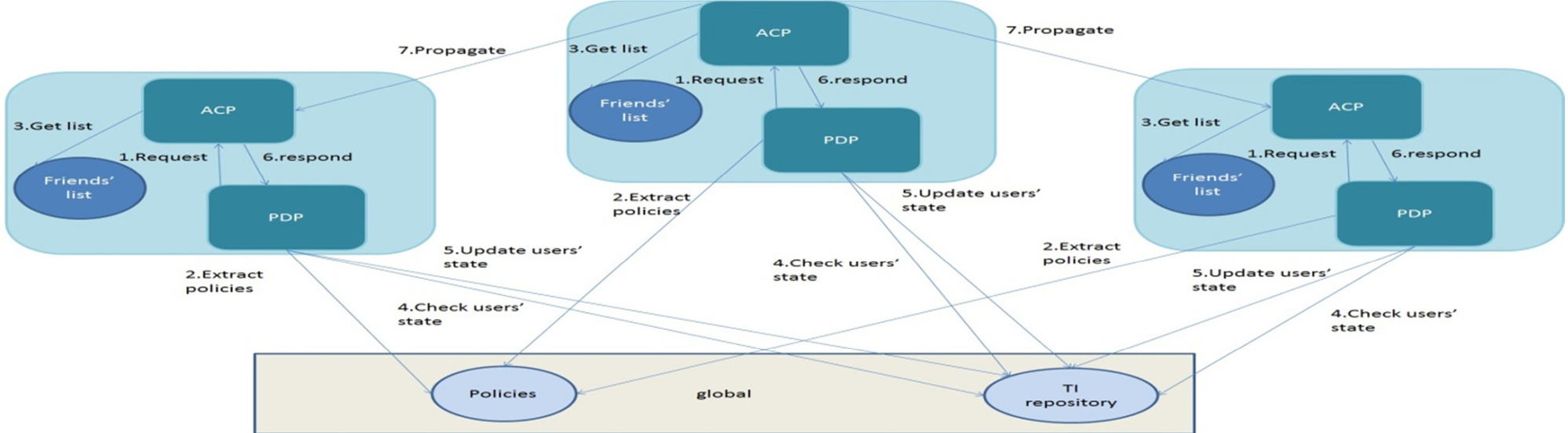 Figure 1: The system architecture showing the Policy Decision Point (PDP) and the interaction between user repositories and the trust calculation engine.
2. The Power of Six Degrees
To prevent infinite loops and excessive resource consumption, the algorithm limits the propagation to 6 hops. This is based on the "Small World" theory, which suggests that any two people on a social network are connected by an average of six links. Testing on platforms like Twitter and Facebook has shown that even 4.67 hops are often sufficient to map a user's social context.
Experimental Validation
The researchers tested the TI algorithm using real-world data from Sina Weibo, starting with high-influence seeds like real estate tycoon Pan Shiyi.
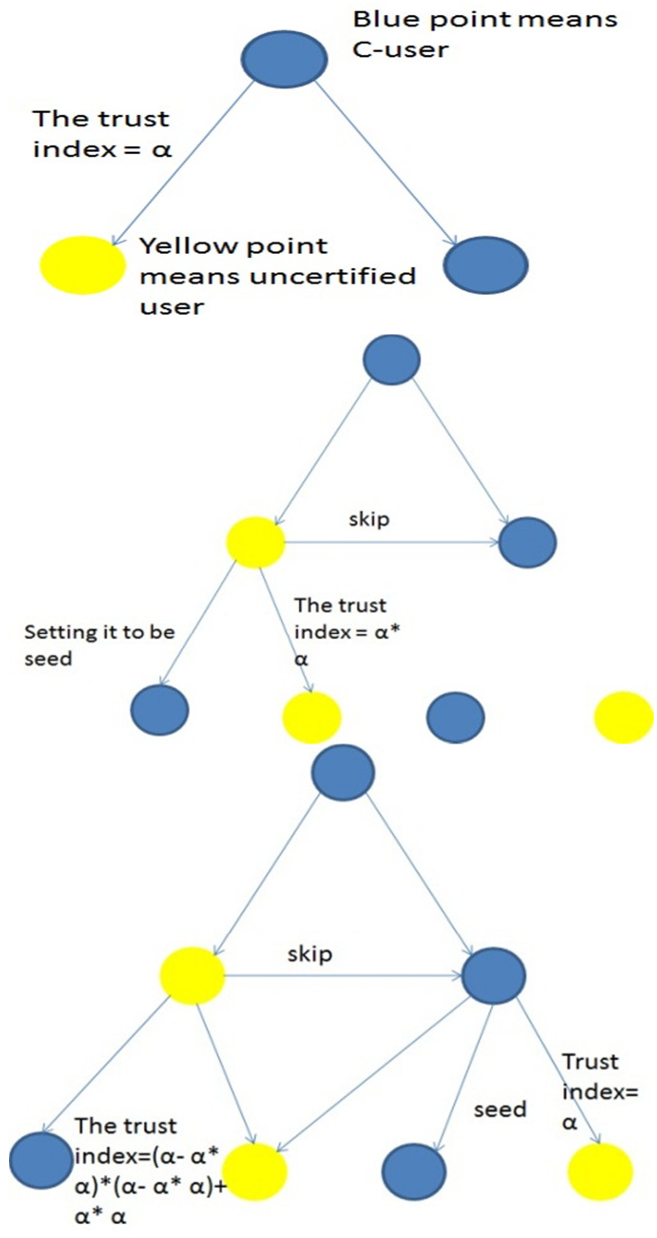 Figure 2: The execution tree illustrating how trust propagates across different layers of the social network.
Key Findings:
- Decay Visibility: TI values clearly decreased as the "hop count" increased, creating a natural gradient of trust.
- Zombie Detection: The algorithm successfully flagged accounts with TIs below a certain threshold (). These accounts were often found to have no profile photos, zero posts, and minimal followers—the hallmarks of "zombie" or bot accounts.
- Automated Verification: Unlike Google+ "Circles," which requires users to manually categorize friends, this TI system operates autonomously once the seeds are set.
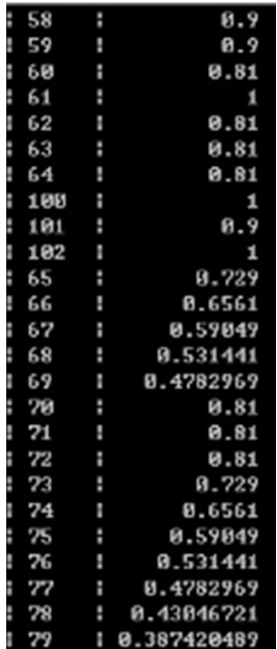 Figure 3: Data table showing various users and their calculated TI values across multiple layers.
Critical Analysis & Conclusion
The Trust Index algorithm offers a mathematically elegant solution to the problem of social network security. It successfully bridges the gap between binary "Verified/Unverified" status and the nuanced reality of social relationships.
Takeaways:
- Scalability: The hop-limited approach makes it computationally feasible for large-scale networks.
- Security Insight: It provides a pre-emptive monitoring system; users below a certain TI threshold can be flagged for extra scrutiny (e.g., checking for frequent IP changes or duplicate posts).
Limitations & Future Work:
The paper assumes that verified users are inherently "safe." However, in modern "cancel culture" or account hijacking scenarios, this might not always hold. Future iterations could benefit from incorporating temporal factors (how long a trust relationship has existed) and interaction quality (likes/comments) rather than just simple connection links.
In conclusion, the Trust Index is a significant step toward an "automated immune system" for social networks, helping users navigate a digital world where not every friend can be trusted.