
Efficiency Meets Accuracy: Scaling Task Recommendations in Crowdsourcing via Online-Updating ActivePMF
An Online-Updating Approach on Task Recommendation in Crowdsourcing Systems
The paper introduces an online-updating framework for "ActivePMF on TaskRec," a task recommendation system for crowdsourcing. It combines Probabilistic Matrix Factorization (PMF) with Active Learning to efficiently match workers with tasks while reducing model retraining time by over 90% compared to full retraining.
TL;DR
Recommending the right task to the right worker in a crowdsourcing system like Amazon Mechanical Turk is critical for quality control. However, retraining these recommendation models in real-time is a computational nightmare. This paper presents an Online-Updating ActivePMF framework that reduces update times by over 90% (from minutes to seconds) by using partial updates and batching, without sacrificing the accuracy of the recommendations.
Problem & Motivation: The Retraining Bottleneck
In crowdsourcing, requesters need high-quality results fast, and workers want tasks that match their expertise. Probabilistic Matrix Factorization (PMF) is the gold standard for this, but it faces two massive hurdles in production:
- High Latency: Standard PMF requires a full retrain of the entire worker-task matrix to incorporate a single new completed task.
- Cold Start: New workers have no history, making it impossible to recommend tasks accurately without expensive "probing."
The authors' core insight is simple yet powerful: The more we know about a worker, the less a single new task changes their profile. If a worker has completed 1,000 tasks, the 1,001st task shouldn't force us to recalculate the entire universe of data.
Methodology: Smart Updates and Active Selection
The proposed framework, ActivePMF on TaskRec, optimizes the system through three strategic pillars:
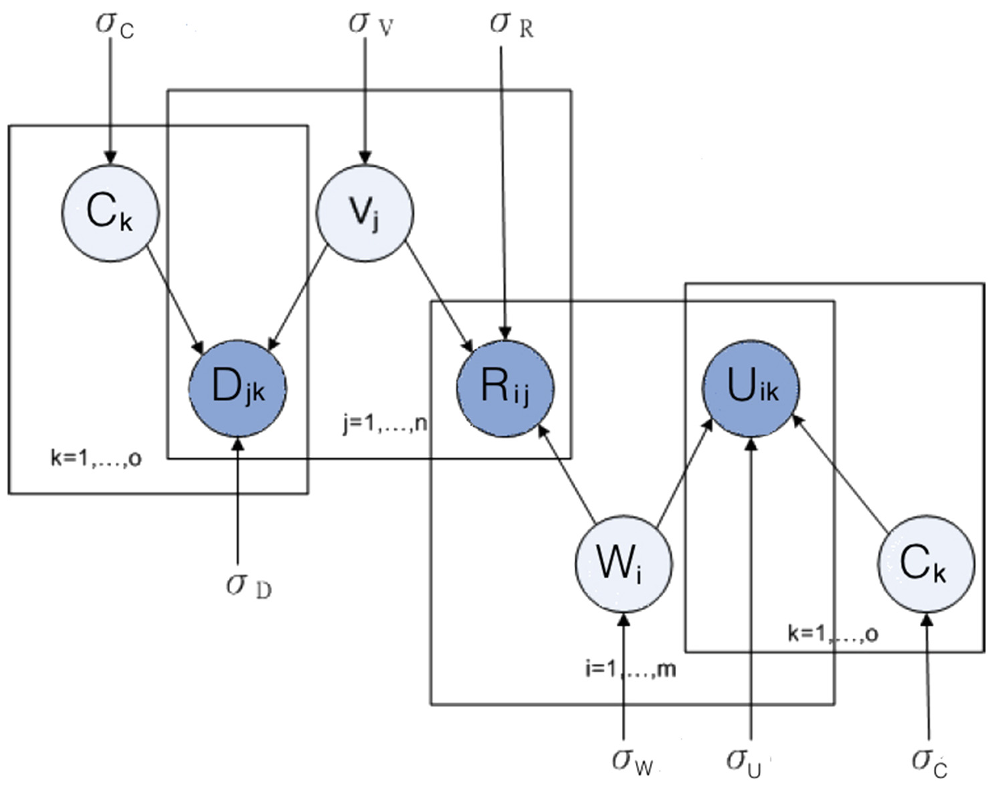
1. The Graphical Model (TaskRec)
The system maps Workers (), Tasks (), and Categories () into a shared latent feature space. By looking at how these interact, the model can predict the "rating" (preference/quality) a worker will have for a task they haven't seen yet.
2. Active Learning for Data Selection
Instead of waiting for random data, the model proactively asks:
- For New Tasks: Find the "most reliable" worker in that category to get a high-quality initial label.
- For New Workers: Identify the "most uncertain" task to quickly define the worker's latent features.
3. Partial vs. Full Updates
The "Online-Updating" magic happens here. The system checks a Threshold ():
- If a worker's profile is small (New/Active): Perform a Full Retrain to learn their features quickly.
- If a worker's profile is large (Established): Perform a Partial Update—only adjust that specific worker’s feature vector () while keeping the rest of the matrix constants.
Experiments: Breaking the Speed Barrier
The authors tested their approach using the NAACL 2010 crowdsourcing dataset (approx. 1,600 workers and 6,600 tasks).
Performance vs. Efficiency
The results reveal a dramatic trade-off. While a "Full Retrain" takes nearly 4 minutes per update, the Online-Updating approach (with a batch size of 10) cuts that to less than 1 minute, and even further down to seconds as batch sizes increase.
| Model variant | MAE (Error) | Runtime (min) |
|---|---|---|
| Full Retrain | 0.0156 | 3.839 |
| Online (Batch 10) | 0.0191 | 0.675 |
| Online (Batch 500) | 0.1022 | 0.017 |
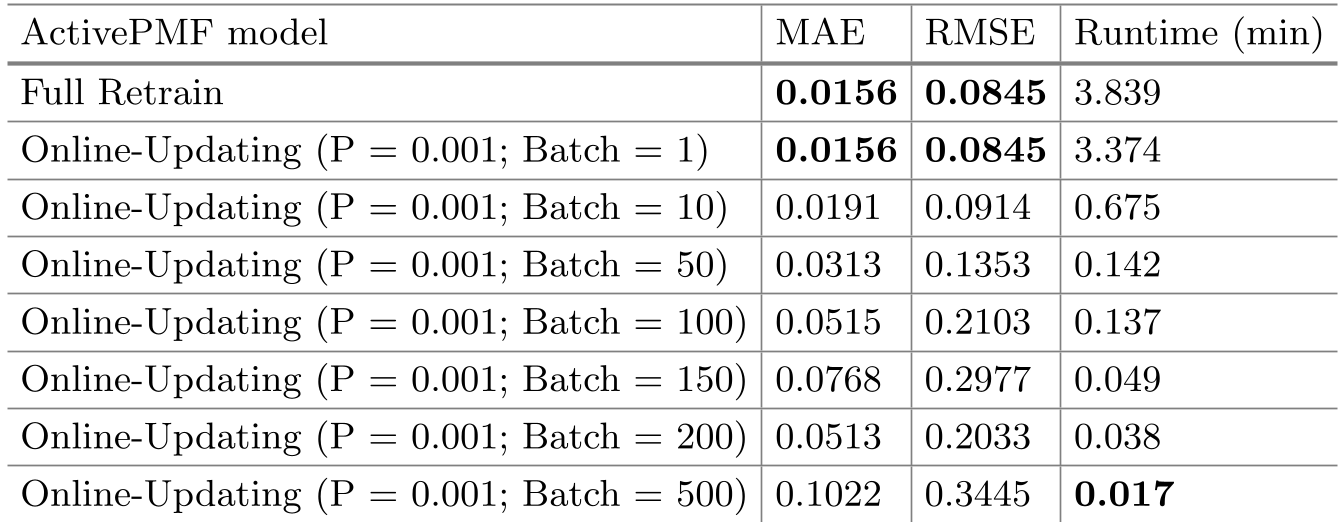
Crucially, the MAE (Mean Absolute Error) remains extremely low even with significant speedups, proving that you don't need to retrain the entire world to understand a single worker's incremental progress.
Critical Analysis & Conclusion
Takeaway
This paper is a masterclass in engineering efficiency for academic models. It moves Matrix Factorization from a "static" offline calculation to a "dynamic" online service. The 90% reduction in runtime is a game-changer for platform operators like Amazon Mechanical Turk or Upwork.
Limitations
- Threshold Sensitivity: The success of the "Partial Update" depends heavily on the chosen . A threshold too high leads to lag; too low leads to accuracy drift.
- Static Categories: The model assumes task categories are fixed, which might not reflect the evolving nature of gig-economy tasks.
Future Outlook
The next step for this research is likely the integration of Deep Learning (Neural Collaborative Filtering) into the online-updating framework to capture non-linear relationships between workers and tasks, while maintaining the same update efficiency.