
Online Urbanism: How Digital Cities Foster the Next Generation of Coders
Online Urbanism: Interest-based Subcultures as Drivers of Informal Learning in an Online Community
This study investigates the evolution of the Scratch online community, analyzing 5 years of data from 1 million users and 1.9 million projects. It proposes the concept of "Online Urbanism," where large-scale growth triggers the emergence of specialized, interest-based subcultures that drive informal programming learning.
TL;DR
By analyzing a decade-old dataset of 1 million Scratch users, researchers discovered that online communities evolve like physical cities. As they grow, they naturally fracture into specialized "interest-based subcultures" (e.g., game modding, animal art), a phenomenon termed Online Urbanism. This structural shift is what actually sustains informal learning at scale.
Academic Positioning: This work bridges urban sociology (Fischer’s Subcultural Theory) with Learning Sciences, providing a structural explanation for why heterogeneous "Online Communities of Creators" (OCOC) thrive during hyper-growth.
The "Digital Disconnect" and the Motivation for Subcultures
Traditional schooling often fails to bridge the gap between students' personal interests and technical skills. This "digital disconnect" pushes youth toward platforms like Scratch. However, a major question remains: how can a platform with millions of users remain relevant to an individual?
The authors argue that the secret lies in Homophily—the tendency of "birds of a feather to flock together." In a small town, you are forced to associate with neighbors regardless of interest; in a massive city (or a large online community), you have the "critical mass" required to find others who share your specific, niche obsession.
Methodology: Mapping the Digital Social Fabric
The research team didn't just look at what users built, but who they followed. By focusing on the "core" (users with 25+ followers), they filtered out the "long-tail" noise of inactive accounts.
1. The Clustering Approach
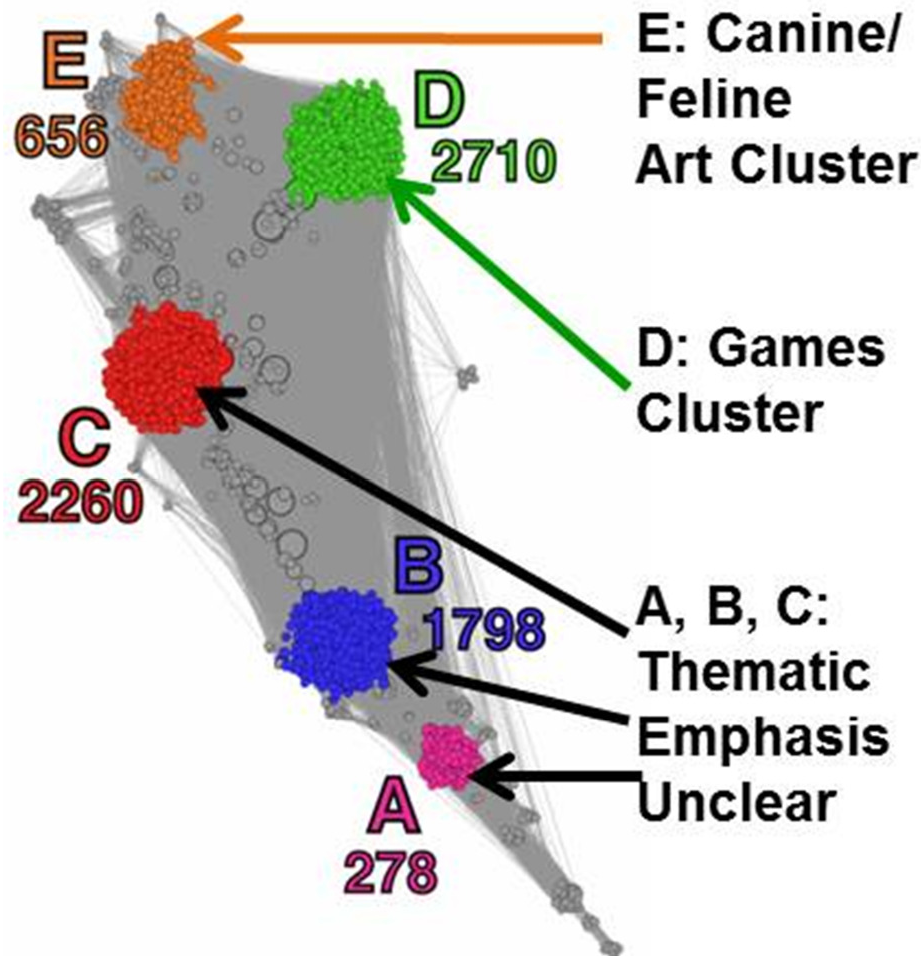
Using the OpenOrd layout (a force-directed algorithm), the researchers visualized the social distances between users. They then utilized TF-IDF (Term Frequency-Inverse Document Frequency) to analyze the language used in project titles and tags within these clusters to identify their "thematic DNA."
2. Temporal Metrics: Scratchage & Scratchend
To understand the community's evolution, they defined:
- Scratchage: How long a user has been on the platform.
- Scratchend: The "inactivity gap"—how long since the user's last project or follow action.
The Anatomy of a Digital City
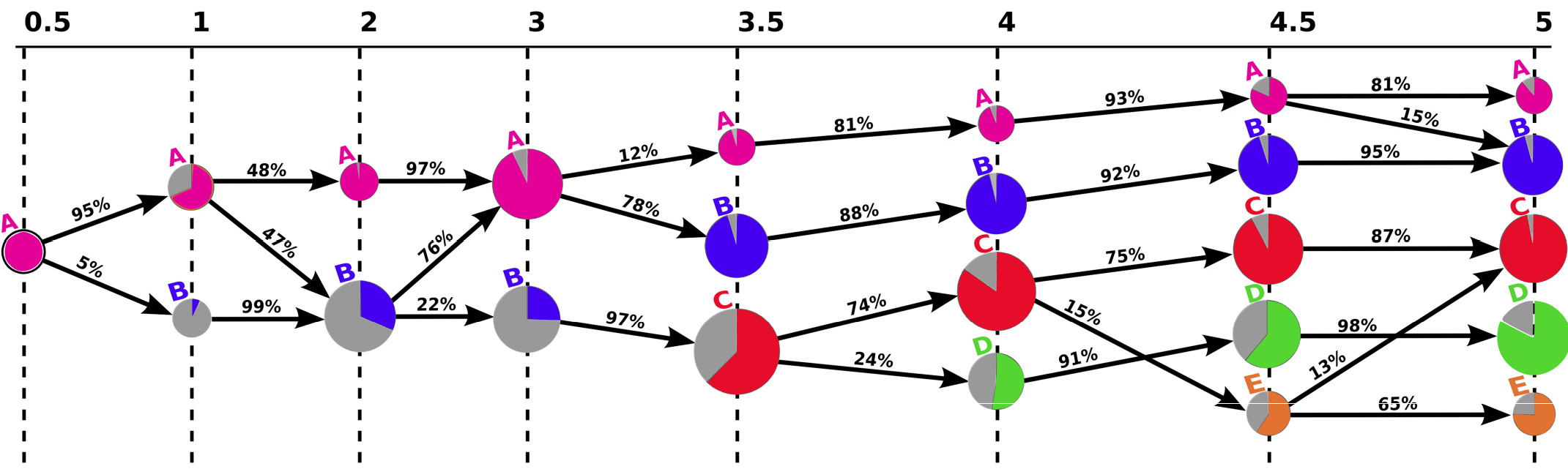
The study identified five primary clusters (A through E). The transformation is striking:
- Cluster A (The Founders): Early MIT developers and power users stretching the language's limits. High "Scratchage," but also high "Scratchend" (meaning many moved on).
- Clusters B & C (The Transition): Growing focus on generic game mechanics (Mario, Sonic).
- Clusters D & E (The Specialized Neighborhoods): These represent the "suburbanization" of Scratch. Cluster D became a dedicated gaming hub, while Cluster E emerged as a highly specific "Art Contest" niche centered around canine and feline illustrations.
Why "Urbanism" Works for Learning
The authors suggest that these subcultures provide "Lines of Practice." A child doesn't just want to "learn loops and variables"—they want to win an art contest or build a Pokemon clone.
The subculture provides:
- Identity Alignment: You see yourself as an "Artist" who happens to use code.
- Low Barrier to Entry: By seeing and "remixing" niche-specific projects, newcomers engage in Legitimate Peripheral Participation.
- Sustained Effort: Interest-driven engagement transforms fleeting curiosity into long-term personal investment.
Critical Insight & Conclusion
The study confirms that scale is a feature, not a bug. Large populations are necessary to generate the diversity of subcultures required to catch different learners' interests. However, the researchers admit a limitation: the lack of demographic data. We don't know if these clusters are also divided by age, gender, or geography.
The Takeaway for Tech Leaders: When building a community-driven product, don't try to force everyone into a single "Main Street." Instead, provide the tools (studios, tags, follow mechanisms) that allow users to build their own neighborhoods. Success isn't just growth; it's the emergence of subcultures.
Keywords: Informal Learning, Online Communities, Scratch, Online Urbanism, Subcultural Theory.