
Beyond Strings: Elevating Pharmacovigilance with ADR Ontologies
Building an ontology of adverse drug reactions for automated signal generation in pharmacovigilance
The paper introduces a novel Adverse Drug Reaction (ADR) ontology designed to enhance automated signal generation in pharmacovigilance. By mapping MedDRA terms to a formal Description Logic (SHIQ) framework, the authors enable ontological subsumption and approximate matching to group medically related conditions, significantly improving signal detection accuracy.
TL;DR
Statistical signal detection in drug safety is often hindered by "lexical fragmentation"—where the same medical condition is coded under dozens of different terms. This paper proposes a transition from the "first-generation" MedDRA terminology to a formal ADR ontology using Description Logics. By allowing the system to "understand" that Cytolytic Hepatitis and Cholestatic Hepatitis are both forms of Hepatitis, the authors achieved a dramatic increase in signal detection performance (AUC 0.908 vs. 0.599).
The "First-Generation" Bottleneck
In pharmacovigilance, a "signal" is a potential causal relationship between a drug and an adverse event. Traditionally, experts manually review cases, but the explosion of reporting data necessitates automation.
The industry standard, MedDRA (Medical Dictionary for Regulatory Activities), is essentially a collection of strings organized in a rigid hierarchy. It suffers from two fatal flaws:
- No Formal Definitions: The computer doesn't know what a "Preferred Term" (PT) actually means medically.
- Limited Multi-axiality: A term like Cholestatic Hepatitis might be buried under a single organ class, ignoring its functional nature as a biliary disorder.
Because statistical methods (like Bayesian Neural Networks) count occurrences of specific terms, a "true" signal can be missed if it is diluted across ten different, but medically similar, MedDRA terms.
Methodology: Engineering Medical Intuition
The authors didn't just re-sort the list; they built a Knowledge Model using Description Logics (SHIQ).
1. Building the TBox (Terminological Box)
They categorized 390 primitive concepts (e.g., "Inflammation," "Liver") and 42 types of relations (e.g., isStructuralDisorderOf). They then defined 530 complex MedDRA PTs.
Example logic:
Hepatitis ≡ (isStructuralDisorderOf some HepaticStructuralLevels) AND (hasTypeOfDisorder some InflammationTypes)
2. The Power of Inferences
The system uses the RACER inference engine to perform three types of reasoning:
- Taxonomic Subsumption: Following the existing MedDRA tree.
- Ontological Subsumption: Automatically discovering that a specific condition belongs to a broader class because its definition meets the criteria.
- Approximate Matching: This is the "secret sauce." It allows the system to group "High ALAT/ASAT" laboratory results with "Hepatitis" clinical diagnoses, capturing cases that would otherwise be categorized as mere "lab abnormalities."
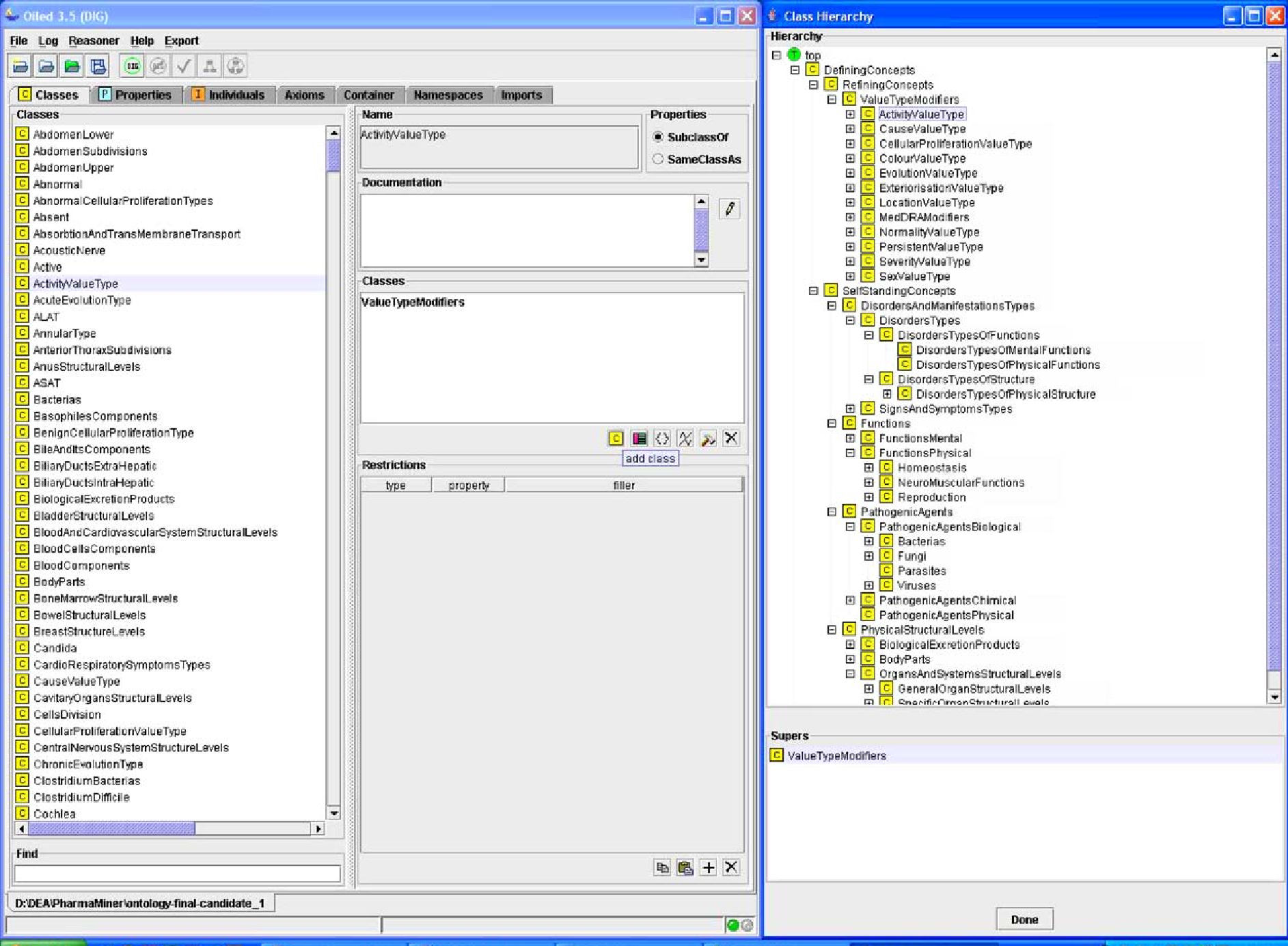 Figure: The functional architecture of the system integrating the RACER engine for terminological reasoning.
Experimental Results: A Performance Leap
Testing on the French national database (over 230,000 drug-ADR combinations), the authors compared the WHO Bayesian signal detection method across different levels of "semantic intelligence."
| Method | AUC (Signal Accuracy) |
|---|---|
| MedDRA (Standard) | 0.599 |
| MedDRA + Taxonomic Reasoning | 0.815 |
| Ontology + TR & Approximate Matching | 0.908 |
The jump from 0.599 to 0.908 is massive. It suggests that the primary weakness of current automated signal detection isn't the statistical math—it's the quality of the data representation.
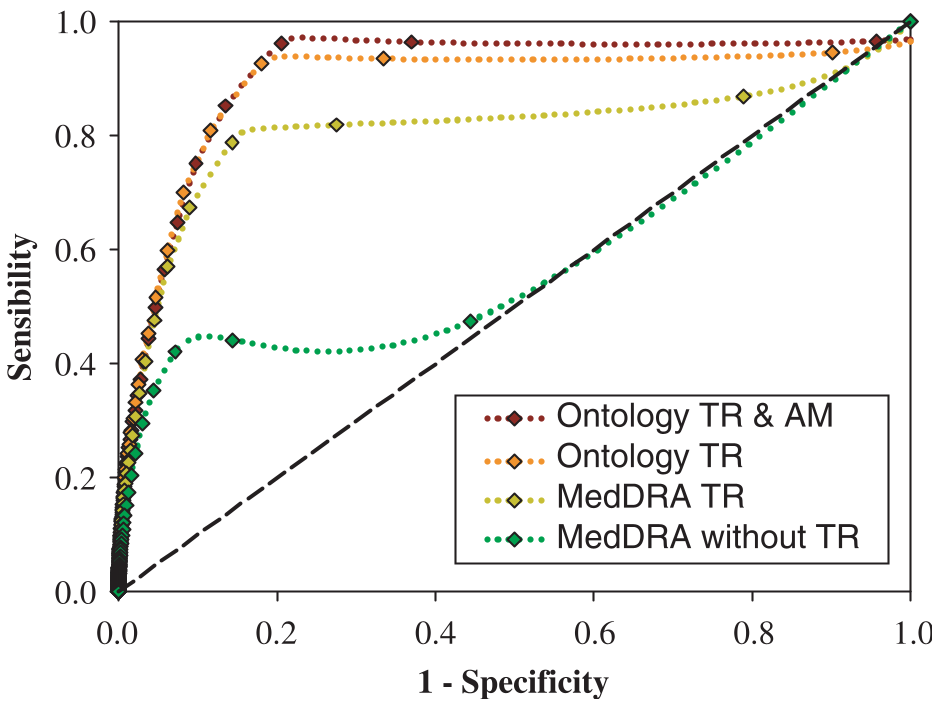 Figure: ROC curves showing the significant gain in signal detection when moving from raw MedDRA to Ontological Reasoning.
Critical Analysis & Future Outlook
While the results are stellar, the authors admit a significant hurdle: Modeling Effort. It took 300 man-hours to model just 530 terms. Scaling this to the full 15,000+ MedDRA PTs would take years for a single expert.
Takeaways for the Industry:
- Hybrid Systems: Even simple taxonomic subsumption (MedDRA TR) yielded high significance (AUC 0.815), suggesting that even "cheap" semantic improvements are worth implementing immediately.
- The Future of Coding: We should move toward "coding at the source" using ontologies, rather than manually mapping text to strings which then have to be "re-semanticized" for analysis.
Conclusion: This work serves as a foundational proof-of-concept for Semantic Pharmacovigilance. In an era where data volume is no longer the issue, the focus must shift to data depth—ensuring our algorithms understand the medicine, not just the words.