
OBCA: Bridging the Gap Between Semantic Web and Data Mining
An ontology-based cluster analysis framework
The paper introduces OBCA (Ontology-Based Cluster Analysis), a universal and extensible framework designed to perform clustering on data described by OWL ontologies. It moves beyond "flat" data analysis by integrating three dimensions of similarity—taxonomy, relationships, and attributes—into a unified hierarchical clustering workflow.
TL;DR
The OBCA (Ontology-Based Cluster Analysis) framework presents a specialized methodology for clustering complex objects represented in OWL (Web Ontology Language). Instead of treating data as simple rows and columns, it evaluates similarity across taxonomy, relationships, and metadata attributes, enabling more nuanced Business Intelligence and knowledge discovery.
Background & Motivation
In classical data mining, we often assume a "flat" perspective: every object is a point in a multi-dimensional Euclidean space. However, real-world knowledge is rarely flat. Objects belong to hierarchies, they have intricate links to other entities, and their attributes can range from simple scales to complex natural language.
The authors argue that traditional clustering overlooks the context provided by ontologies. For instance, in business intelligence, merging two companies isn't just about matching their revenue numbers; it's about understanding if they operate in semantically related trades within a global industry taxonomy.
Methodology: The Three Dimensions of Similarity
The core of the OBCA framework is the decomposition of similarity into three distinct components, which are then fused into a single metric for hierarchical clustering.
1. Taxonomy Similarity (TS)
This measures how close two objects reside within the class hierarchy. The framework supports multiple methods:
- Path-based: Using the Wu and Palmer measure to calculate distance based on the number of edges to a common ancestor.
- Set-based: Upward Cotopic similarity, which uses the Jaccard index on the sets of superclasses.
- Information Theory: Utilizing Information Content (IC) to weigh the specificity of the shared category.
2. Relationship Similarity (RS)
Unlike flat data, ontology instances "know" about each other. RS posits that similar objects should have relationships with objects that are themselves similar. This recursive definition allows the framework to detect structural clusters.
3. Attribute Similarity (AS)
Since attributes can be diverse, the framework provides a library of comparison logic:
- Numeric: Normalized differences.
- Strings: Edit Distance (Levenshtein), Jaro, and Jaro-Winkler for typo-resilient matching.
- Texts: Vector space models and TF-IDF weighted representations.
The Amalgamation Formula
The final similarity is calculated via an aggregation function (): This weighted average allows domain experts to tune the importance of structure versus raw data values.
System Architecture
The implementation utilizes the Java programming language and the Jena package for OWL processing. Its design is strictly modular, using interfaces for Querying, Similarity calculation, and Aggregation to ensure it remains "open" to new algorithms.
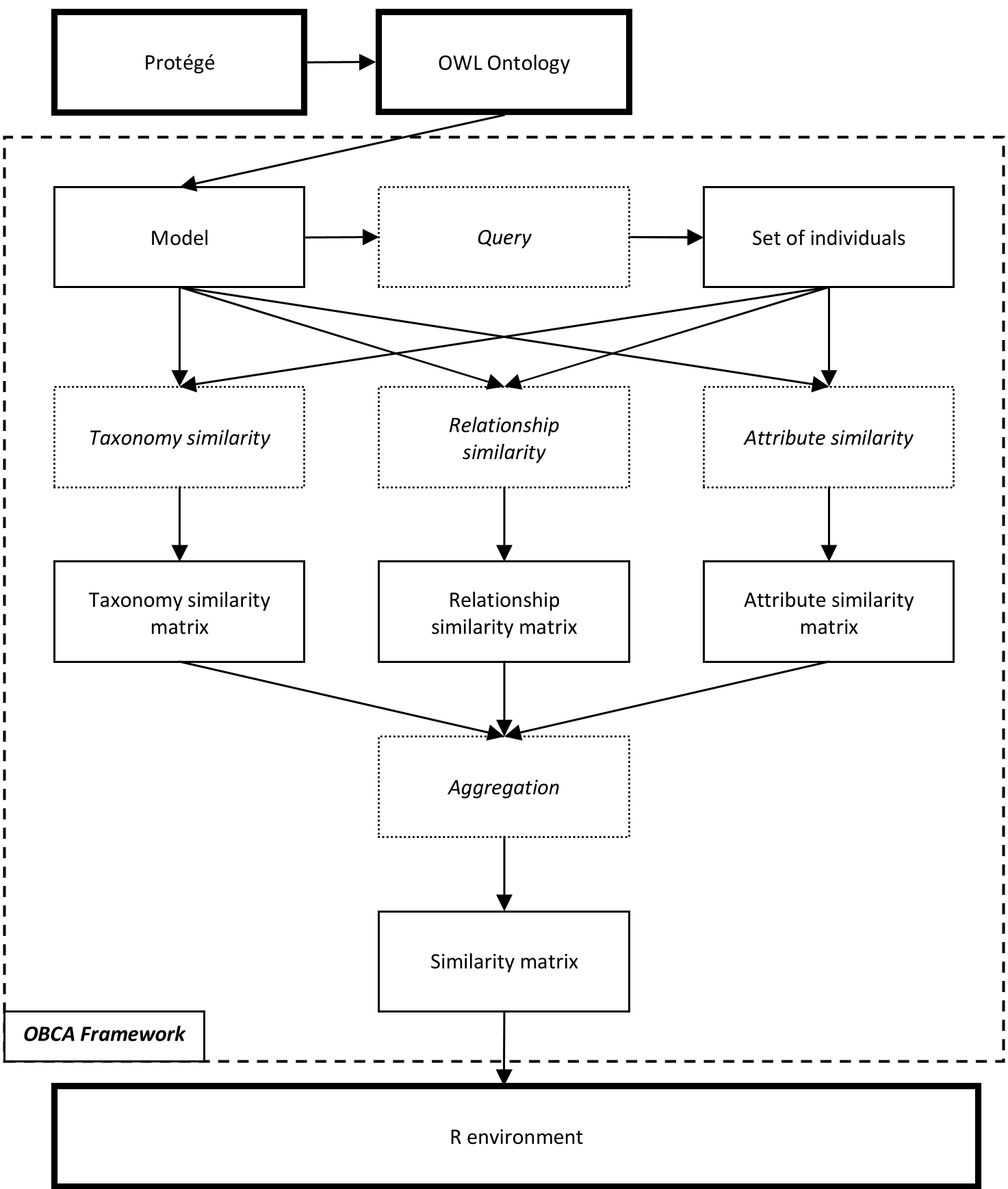 Figure 1: The modular components of the OBCA framework, showing the flow from OWL input to similarity matrix generation.
Experiments and Insights
The paper demonstrates that by adjusting the weights (), the framework can produce significantly different clustering results (dendrograms).
- Ablation View: By setting and , the system acts as a pure taxonomic classifier.
- Comprehensive View: Integrating all three dimensions provides a "semantic" grouping that more closely aligns with human expert intuition in fields like investment risk estimation and corporate profile matching.
Critical Analysis & Conclusion
The OBCA framework is a significant step toward Semantic Data Mining. Its greatest strength is its extensibility; by defining clear interfaces, it allows researchers to swap out distance measures without rebuilding the entire pipeline.
Limitations:
- Subjectivity: The choice of weights () remains somewhat subjective, requiring expert intervention or a labeled training set.
- Scalability: Calculating relationship similarity recursively can be computationally expensive for massive ontologies.
Future Outlook: The authors suggest integrating the framework with the R statistical package for more advanced visualization and exploring neural network techniques to automatically learn the optimal aggregation parameters.