
OnCES: Tackling Information Overload in Co-creation Communities via Semantic Web Mining
An Ontology-based Co-creation Enhancing System for Idea Recommendation in an Online Community
This paper introduces the Ontology-based Co-creation Enhancing System (OnCES), a framework designed to manage and filter customer-generated ideas in online communities. By integrating a specialized Co-Creation Idea Ontology (CCIO) with semantic web mining and machine learning, it achieves superior performance in predicting idea adoptability and providing recommendation services.
Executive Summary
In the era of open innovation, companies like Starbucks gather thousands of ideas weekly from their customers. However, this "wisdom of the crowd" often leads to a massive information overload, where valuable gems are buried under a mountain of noise.
OnCES (Ontology-based Co-creation Enhancing System) is a sophisticated framework that bridges the gap between unstructured human creativity and structured machine intelligence. By leveraging a custom ontology and hybrid machine learning models, OnCES doesn't just store ideas—it understands their context, predicts their potential for adoption, and recommends the most promising ones to decision-makers. It represents a significant shift from simple data collection to Semantic Knowledge Management.
The Problem: The High Cost of Too Many Ideas
While co-creation communities increase the probability of finding "breakthrough" ideas, they create an inherent selection crisis. Manual evaluation is slow, expensive, and prone to bias. Prior systems treated ideas as isolated text snippets, failing to capture the relational context (who suggested it? how did others respond? what is the emotional sentiment?). Without a structured way to handle these relationships, the effectiveness of co-creation plateaus as volume increases.
Methodology: The Core Architecture
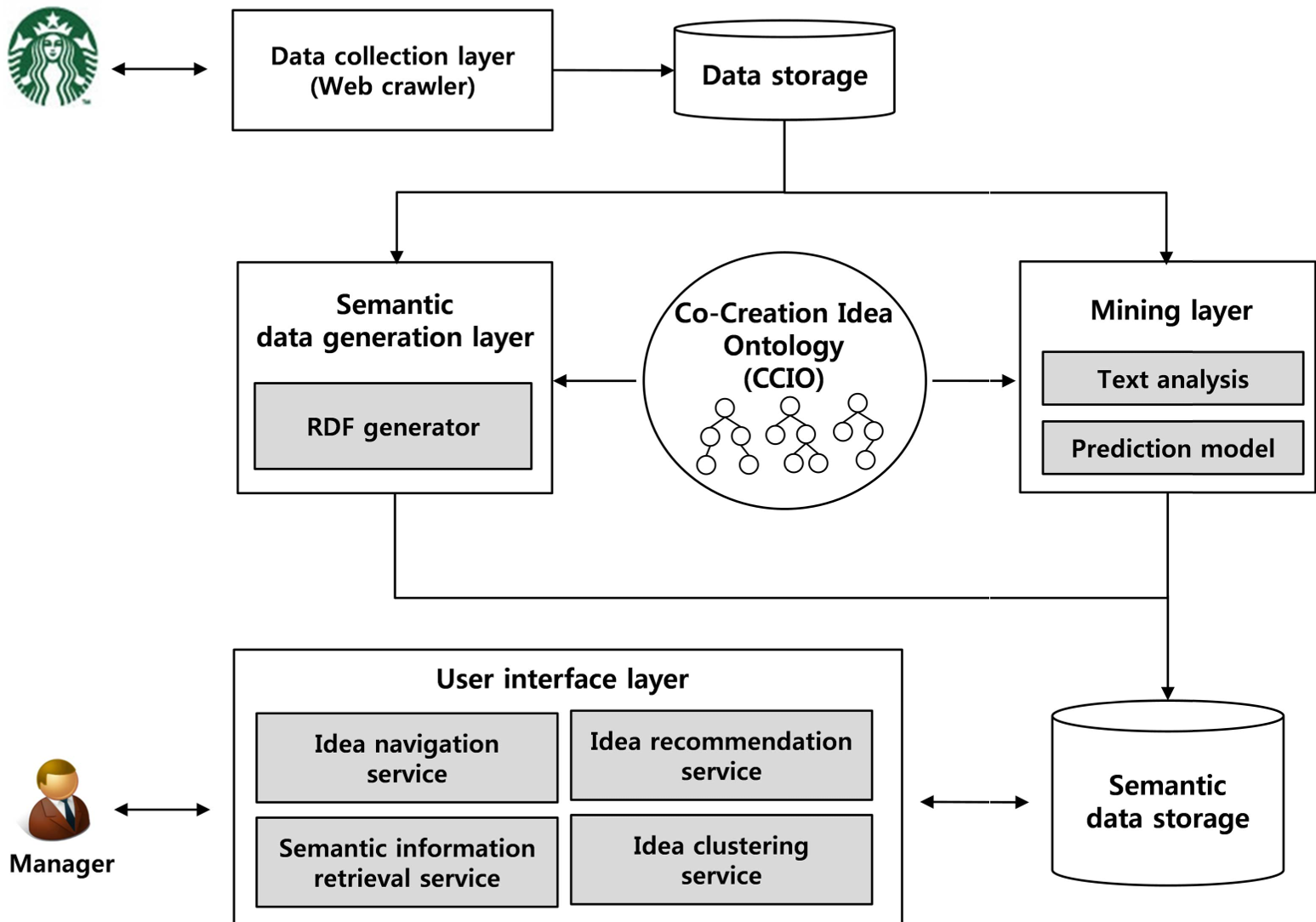
The authors developed a five-layer architecture to transform raw community data into actionable insights:
- CCIO (Co-creation Idea Ontology): This is the system's "brain," defining classes like Idea, Comment, and Customer, and their interlinking properties.
- Semantic Data Generation: Crawled data is converted into RDF Triples (Subject-Predicate-Object), making the data machine-understandable.
- Hybrid Mining Layer: This is the engine. It extracts two types of features:
- Term Features: Using TF-IDF to identify technical keywords.
- Non-Term Features: Using SentiWordNet to calculate sentiment scores and incorporating user demographic/activity data.
The Adoptability Prediction Model
The system uses a weighted hybrid formula to predict if an idea will be adopted: Where is the term-based prediction and is the non-term (sentiment/meta) prediction. This ensures that the system looks at what is being said as well as how the community is reacting.
Experimental Results & Evidence
The researchers tested OnCES on 84,918 ideas from MyStarbucksIdea.com.
Key findings include:
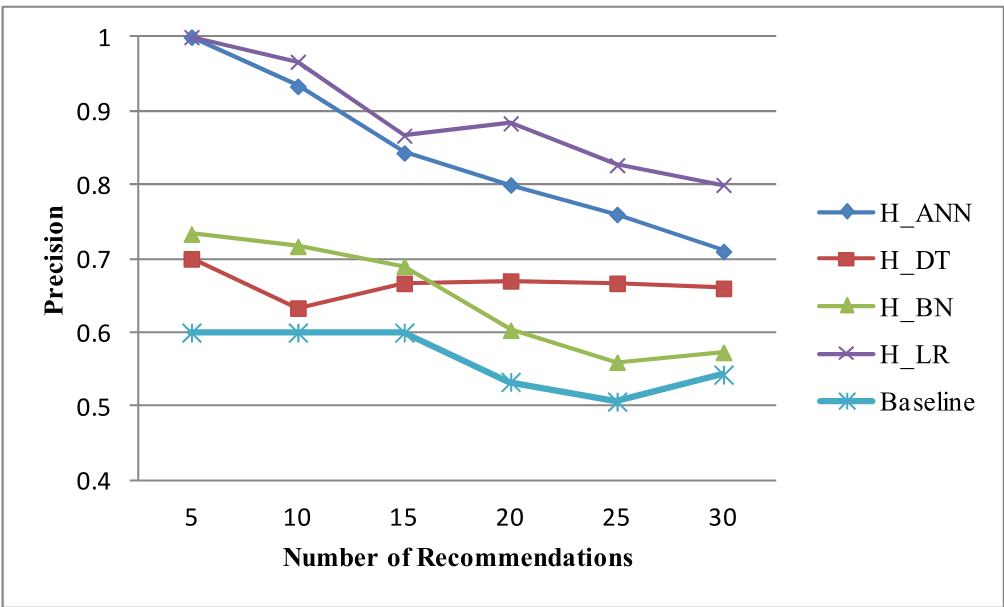
- Hybrid Superiority: In nearly all tests (ANN, DT, LR), the hybrid model outperformed models that used only text or only metadata.
- Performance Metrics: The Logistic Regression (LR) model showed the most robust performance across Precision, Recall, and F1 measures.
- User Benefits: The system provides a 3D-like "Idea Navigation" tool that allows managers to explore clusters of similar ideas visually, significantly reducing search time.
Deep Insight & Conclusion
The true value of OnCES lies in its Inductive Bias—the assumption that an idea's worth is found at the intersection of linguistic content and social validation. While many modern AI systems rely on "black-box" deep learning, OnCES uses an Ontology-driven approach which offers better transparency and specific query capabilities via SPARQL.
Limitations & Future Work
- Ontology Complexity: The current CCIO is relatively simple. Future iterations could include more complex reasoning rules (e.g., "If Idea X is similar to rejected Idea Y, then lower priority").
- Real-time Processing: The current study used a static batch of data; moving toward real-time semantic streaming would be the next logical step.
Final Takeaway: OnCES proves that for open innovation to scale, we must move beyond keyword searches and embrace semantic networks that can "rank" human creativity.