
Bridging the Semantic Gap: Ontology-Based Context Awareness in Mobile Social Networks
Ontology-Based Context-Aware Social Networks
The paper presents a comprehensive approach for an "Ontology-Based Context-Aware Mobile Social Network." It explores a survey of current context-aware mobile platforms and proposes a 5-step framework to assist mobile users in information retrieval by combining ontologies with dynamic contextual parameters (location, user profile) to overcome the semantic limitations of traditional graph-based social networks.
TL;DR
The paper addresses the limitation of social networks in handling the "mobility aspect" of users. While social networks contain vast amounts of data, they often lack formal semantics. The authors propose a 5-step methodology that extracts knowledge from social profiles and tags, transforms it into a machine-readable Ontology, and applies dynamic context parameters (like location) to optimize information retrieval for mobile users.
Problem & Motivation (The "Why")
Why is social networking on a smartphone different from a desktop? Context.
A mobile user’s environment changes rapidly. Current social platforms use graphs to represent connections, which are excellent for visualization but poor for "understanding" the actual meaning of data. Prior works (like graph-pattern matching) fail to formalize information or handle conflicting data. The authors argue that without an Ontology, systems cannot "reason" about the user's current situation—such as distinguishing between a professional need at the office and a social need at home.
Methodology: The 5-Step Contextualization Framework
The researchers move beyond simple data fetching, proposing a pipeline to turn "raw data" into "contextual intelligence":
- Extraction: Pulling explicit and implicit data via APIs (Facebook, LinkedIn).
- Processing: Cleaning the noise—keeping only the metadata relevant to the specific user task.
- Modeling: This is the heart of the paper. Data is mapped to ontologies (semantic models) that include entities, relationships, and Axioms that control the structure.
- Comparison: Using reasoning algorithms to match the mobile user's dynamic context (GPS, time, activity) against these enriched profiles.
- Assistance: Outputting results tailored for mobile constraints (memory and screen size).
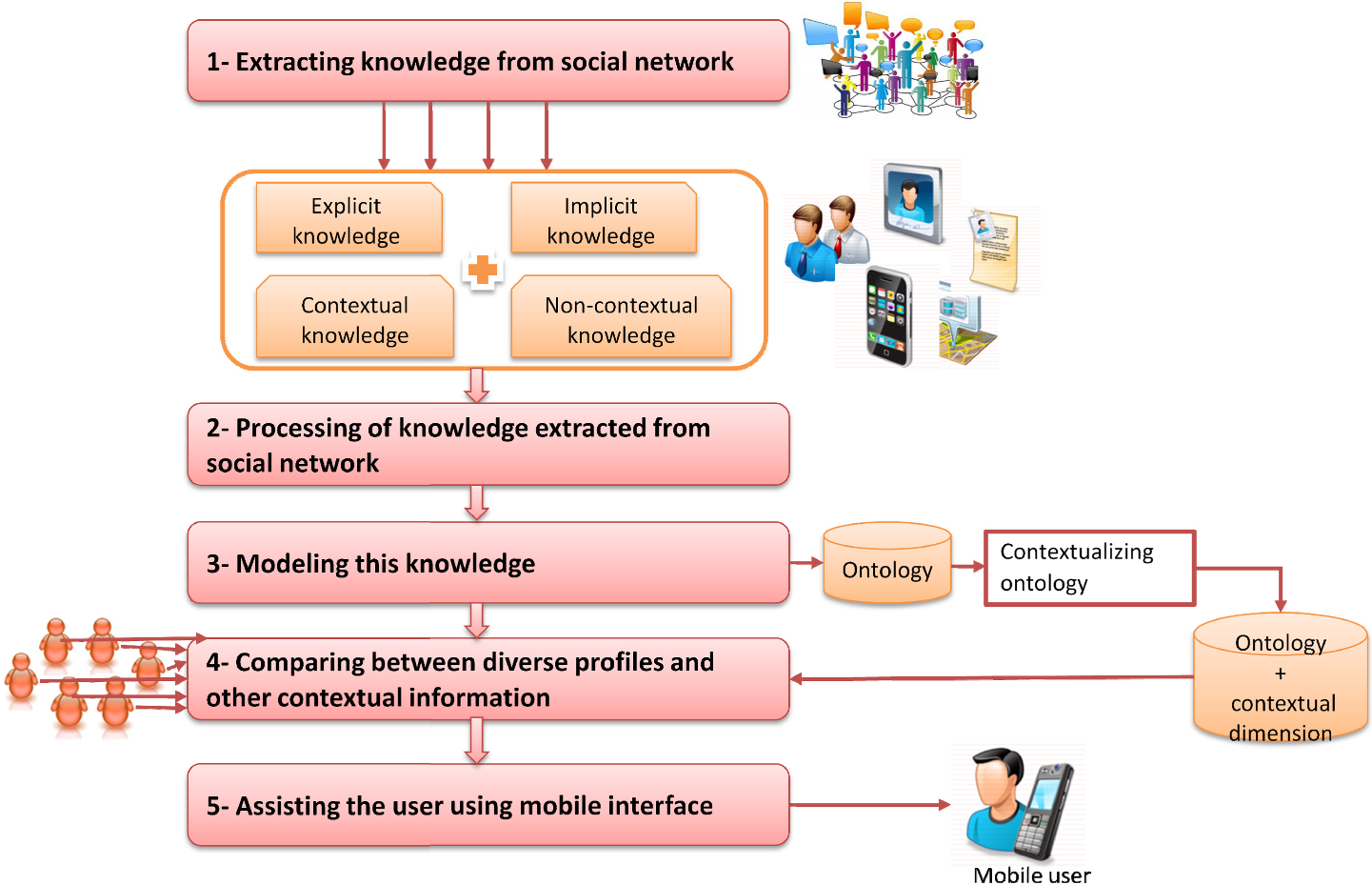 Figure 1: The proposed 5-step approach to build a context-aware mobile social network.
Literature Insights & Comparison
The paper categorizes the "state-of-the-art" into two schools of thought for knowledge extraction:
Category 1: Profile-Based Extraction
Focuses on static user data. Methods like ATRAP or Social Graph API extract data from Facebook or LinkedIn to infer implicit relationships using existing ontologies like FOAF (Friend of a Friend) and SIOC (Semantically Interlinked Online Community).
Category 2: Tag-Based Extraction
Focuses on user behavior (folksonomies). By analyzing how users tag content on sites like Delicious or Flickr, systems can enrich ontologies with "emergent" semantics—what people actually care about right now.
| Method | Ontology Source | Goal |
|---|---|---|
| Whitsitt [31] | From Graphs | Infer implicit links |
| Monachesi [22] | Dbpedia + MOAT | Support informal learning |
SOTA Comparison & Results
The authors highlight that graph-based models (like those from Mika or Fan) lack the Inference Mechanisms that ontologies provide. By using the ContextOntoMR prototype, the authors demonstrate that adding "Location" and "User" parameters as ontological dimensions allows for "Requirement Detection"—the system doesn't just find what you asked for; it finds what you need based on where you are.
Critical Analysis & Conclusion
The Takeaway
The shift from "Social Networks" to "Semantic Social Networks" is inevitable. The integration of mobile context ensures that the information retrieved is not just relevant to the query, but relevant to the user's current reality.
Limitations & Future Work
While the paper provides a robust theoretical framework and survey, it recognizes that conflicting information (e.g., inconsistent user data across Facebook and LinkedIn) remains a challenge for ontologies. The authors' future work focuses on "contextualizing" the ontology further—essentially making the semantic model itself dynamic rather than static.
For developers building AI agents today, this paper serves as a reminder: Your RAG pipeline shouldn't just look for "similar vectors"; it should look for semantic entities within the user's specific location-aware context.