
S.O.S. GeM: Bridging the Semantic Gap in Genomic Metadata Search
Ontology-Based Search of Genomic Metadata
S.O.S. GeM is a semantic search system designed to browse and retrieve genomic metadata from the ENCODE project. By integrating the Unified Medical Language System (UMLS) with state-of-the-art indexing, it achieves superior retrieval recall compared to traditional keyword-based systems.
TL;DR
The Encyclopedia of DNA Elements (ENCODE) is a treasure trove of genomic data, but its searchability has been hampered by a "syntax-only" wall. S.O.S. GeM (Sapienza Ontology-based Search of Genomic Metadata) breaks this wall by leveraging the Unified Medical Language System (UMLS) and OWL 2 QL reasoning to provide a semantic search engine that understands biological synonyms and hierarchical relationships, resulting in a nearly 100% precision/recall accuracy in expert tests.
Problem & Motivation: The "Hidden" Knowledge in Metadata
In the era of Next-Generation Sequencing (NGS), we are drowning in data but starving for discovery. The ENCODE project hosts over 25,000 data files, yet finding the right experiment is surprisingly difficult.
Current systems like the UCSC Genome Browser rely on syntactic matching—if you type "Cachectin" but the metadata says "TNF-alpha," you get zero results, even though they refer to the same protein. This limitation stems from:
- Inconsistent Labeling: Different labs use different naming conventions for the same cell lines or antibodies.
- Lack of Hierarchy: Traditional search engines don't know that a "myocyte" is a type of "muscle cell."
- Textual Fragility: Minor spelling variants or synonyms break the search pipeline.
Methodology: Building the Semantic Knowledge Base (SKB)
The authors proposed a multi-stage pipeline to transform "flat" metadata into a rich, navigable graph of knowledge.
1. Conceptual Extraction
Using MetaMap, the system scans every attribute-value pair in the ENCODE metadata. It identifies "Atoms" (specific terms) and maps them to "Concepts" (unique IDs in the UMLS Metathesaurus).
2. Semantic Closure & Reasoning
This is the "secret sauce." Using the OWL 2 QL profile, the system performs a semantic closure. If a sample is labeled "H1-hESC," the system automatically infers that it is also an "Embryonic Stem Cell," a "Stem Cell," and a "Cell."
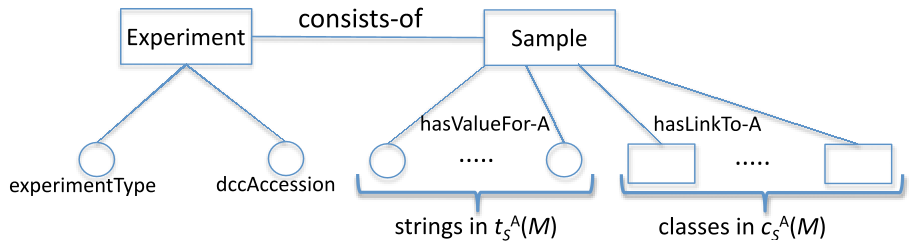 Fig 1: The S.O.S. GeM Ontology structure, illustrating the link between Experiments, Samples, and the inherited UMLS concepts.
3. Practical Implementation: Lucene + SPARQL
To keep the system performant (essential for "Big Data"), the authors used Apache Lucene/Solr to index both the raw tokens and the inferred semantic concepts. This allows the system to resolve queries in milliseconds despite the complexity of the underlying ontology.
Experiments & Results: Putting Semantics to the Test
The system was evaluated against the standard ENCODE Project Portal (ENCODE-PP) and UCSC Genome Bioinformatics (UCSC-GB).
- Synonym Retrieval: When searching for "Cachectin," S.O.S. GeM found 159 samples. The other systems found zero.
- Hierarchical Retrieval: A search for "white blood cell" yielded 3,627 samples in S.O.S. GeM by traversing the IS_A relationship hierarchy. Competitors failed entirely because the specific term "white blood cell" didn't appear literally in the metadata.
- Accuracy: Expert biologists verified the results, giving S.O.S. GeM a staggering 98.90% correctness score.
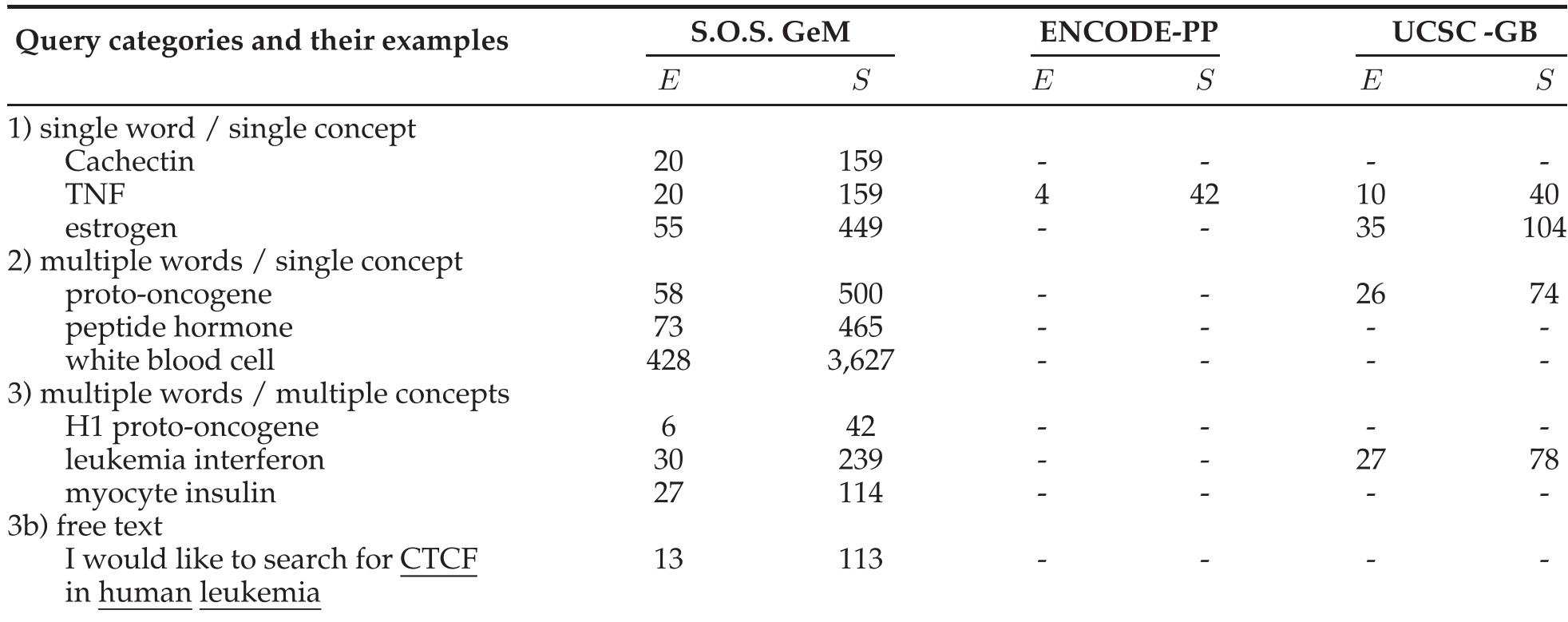 Table 1: Comparative analysis showing S.O.S. GeM's ability to find significantly more relevant experiments (E) and samples (S) across various query types.
Critical Analysis & Conclusion
S.O.S. GeM represents a significant shift from "Search" to "Discovery." By mathematically proving the soundness and completeness of their query answering algorithm, the authors provide a reliable foundation for data-driven genomics.
Takeaway: The future of genomic research isn't just about faster sequencing; it's about smarter indexing. S.O.S. GeM proves that by adding a thin layer of "semantic intelligence" over existing repositories, we can unlock thousands of overlooked experimental results.
Limitations: Currently, the system requires an offline process for semantic completion, which takes about 2 hours. While sufficient for repositories like ENCODE (updated periodically), real-time "streaming" metadata integration would require further optimization of the forward-chaining mechanism.