
Beyond Schemas: Unleashing Data Potential through Ontology-Based Integration
Ontology-based integration of data sources
This paper explores "Ontology-Based Data Integration" (OBDI), a method to unify heterogeneous data sources using ontologies rather than traditional schema matching. It proposes a local-to-global mapping architecture that enhances semantic interoperability across distributed information systems.
TL;DR
This research tackles the "Semantic Gap" in data integration. While traditional database systems struggle with manual schema matching, Michel Gagnon proposes a framework that uses Ontologies—explicit specifications of conceptualizations—to bridge heterogeneous data sources. By mapping local data to a global semantic layer, the methodology enables more intelligent data fusion and decision-making.
The "Invisible" Wall: Semantic Heterogeneity
In the world of data mining and information fusion, the biggest hurdle isn't just connecting two different databases; it's understanding what the data actually means. The author identifies three critical "Semantic Conflicts" that break traditional integration:
- Confounding Conflicts: Items seem the same but differ (e.g., temporal contexts).
- Scaling Conflicts: Different reference systems (e.g., currency or units).
- Naming Conflicts: The classic synonym/homonym problem.
Standard relational models (UML or ER diagrams) only capture structure. They are "blind" to the hidden context that an expert takes for granted, making manual integration a tedious and expensive operational bottleneck.
Methodology: The Local-to-Global Ascent
The paper advocates for a transition from static federated schemas to dynamic Ontology Mapping. The core approach follows a three-stage architectural flow:
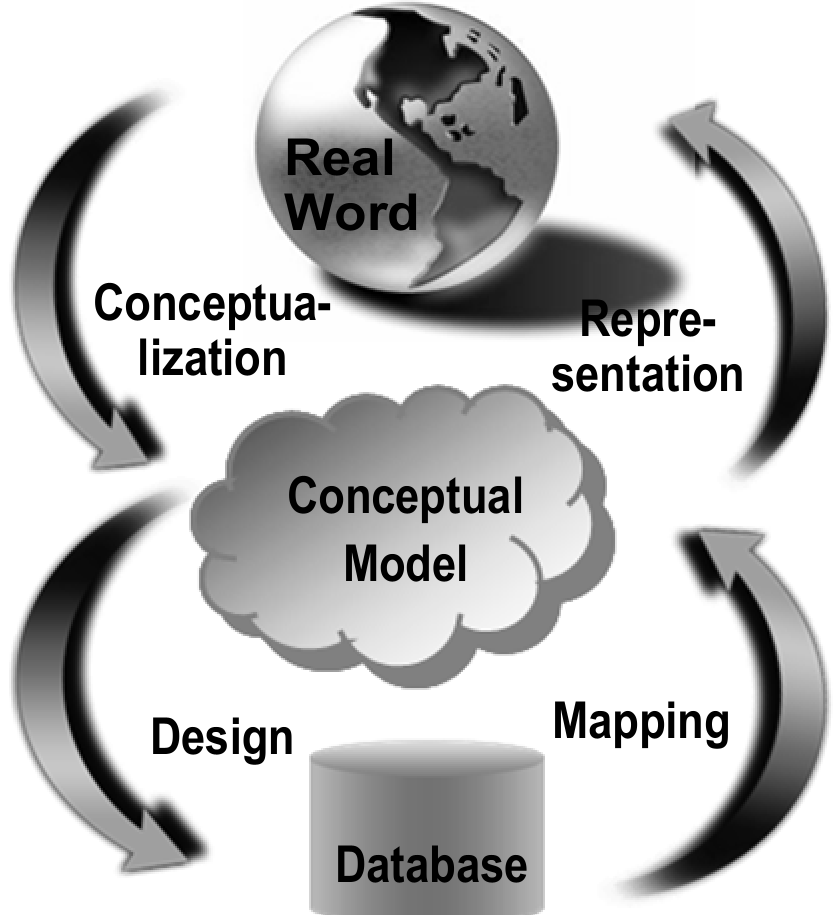
1. The Design Hierarchy
The author places ontologies at the top of the design food chain. Before a physical database is even considered, a conceptualization process creates an ontology to elicit implicit knowledge.
2. Implementation Architectures
The paper compares three styles of ontology integration:
- Single Global Ontology: High effort; requires a "god-view" expert.
- Multiple Ontologies: Localized but requires complex peer-to-peer mapping.
- Hybrid Approach: The "Golden Mean." Local ontologies map to a shared vocabulary, combining local flexibility with global query capabilities.
3. The Proposed Architecture
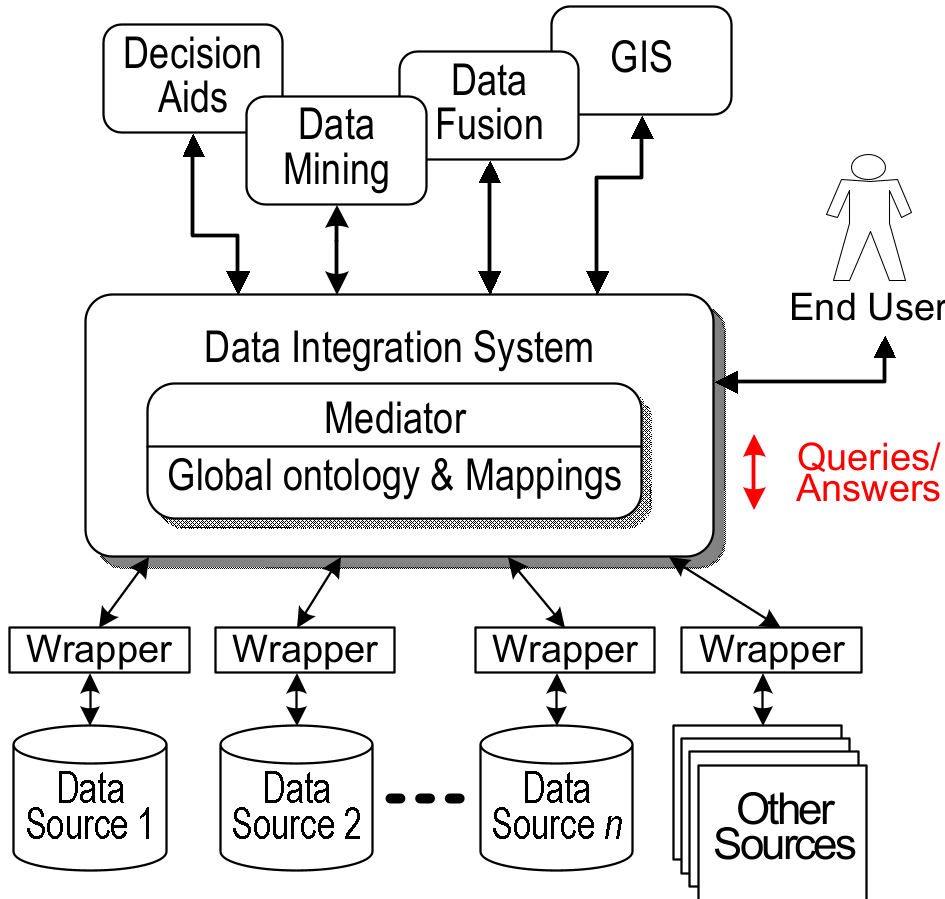
The proposed "Ontology-Based Data Integration Architecture" uses Mediators and Wrappers. Unlike a Data Warehouse which physically moves data, this is a virtualized system where the Global Ontology acts as the interface for end-users, translating semantic queries into source-specific requests.
Critical Insight: Why This Works
The genius of this method is its Ascending Construction. By building the global view from local concepts using formal axioms (), we ensure that any interpretation satisfying the global ontology also satisfies the local ones. This mathematical rigor allows for more automated reconciliation of synonyms and hierarchical relations than traditional schema matching.
Evaluation and Limitations
While the paper proves that ontologies provide the "richer semantics" needed for interoperability, it admits a hard truth: The human factor remains. In the absence of unique concept identifiers across the Web, the integration process is "semi-automatic," still requiring domain experts to validate axioms and align roles.
Summary and Future Outlook
Michel Gagnon's work serves as a blueprint for the "Information Knowledge Level" era. As we move toward 2026 and beyond, the integration of standards like OWL (Ontology Web Language) and Web Services (SOAP/WSDL) is no longer optional—it is the prerequisite for intelligent information agents.
Takeaway for Tech Leaders: Don't just map your tables; map your meanings. Investing in a local-to-global ontology layer is the only way to scale data fusion in a world of ever-changing, heterogeneous data sources.
Editor's Note: This paper remains a cornerstone for understanding the transition from structural data handling to semantic knowledge management in high-stakes fields like defense and intelligence.