
Deciphering Knowledge Networks: Moving Beyond Arbitrary Thresholds in Tie Formation
Assessment of ontology-based knowledge network formation by Vector-Space Model
This study introduces a systematic framework for determining network tie formation in ontology-based knowledge networks using the Vector-Space Model (VSM). By comparing co-keyword standard networks with "pseudo-networks" generated at varying thresholds, the authors identify optimal cut-off values for four distinct sci-tech policy research domains.
TL;DR
In social network analysis, deciding whether two documents are "connected" often feels like guesswork. This paper introduces a robust methodology using the Vector-Space Model (VSM) to transform subjective threshold selection into an objective optimization problem. By benchmarking simulated networks against keyword-based standards, the authors identify precise "cut-off" values (ranging from 0.35 to 0.49) that define the architecture of sci-tech knowledge domains.
The Subjectivity Trap in Network Science
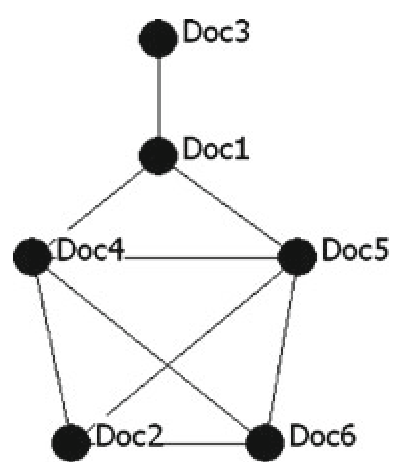
Constructing a knowledge network—where nodes represent papers or projects—requires a binary decision: To link or not to link?
While we can calculate similarity scores (0.0 to 1.0) between documents based on abstracts, we must eventually apply a cut-off value to create a discrete adjacency matrix. Traditionally, this is done via "trial and error." Set the threshold too low, and your network is a cluttered "hairball"; set it too high, and you lose critical structural insights. This study targets this specific pain point: the lack of a standardized, objective mechanism for determining network formation.
Methodology: The VSM Optimization Loop
The researchers propose a three-step workflow to move from raw data to an optimized network:
- Standard Construction: Create a "Standard Network" using co-keyword analysis, assuming that shared author keywords represent a ground-truth knowledge overlap.
- Vector-Space Modeling: Represent each document as a vector in a high-dimensional space defined by standardized keywords. Calculate the Cosine Similarity between these vectors.
- Threshold Simulation: Generate 100 "pseudo-networks" by varying the cut-off threshold from 0.01 to 1.0.
The "winner" is the threshold that maximizes the Simple Match Coefficient, which accounts for both the presence and absence of ties compared to the standard.
Empirical Evidence from Four Domains
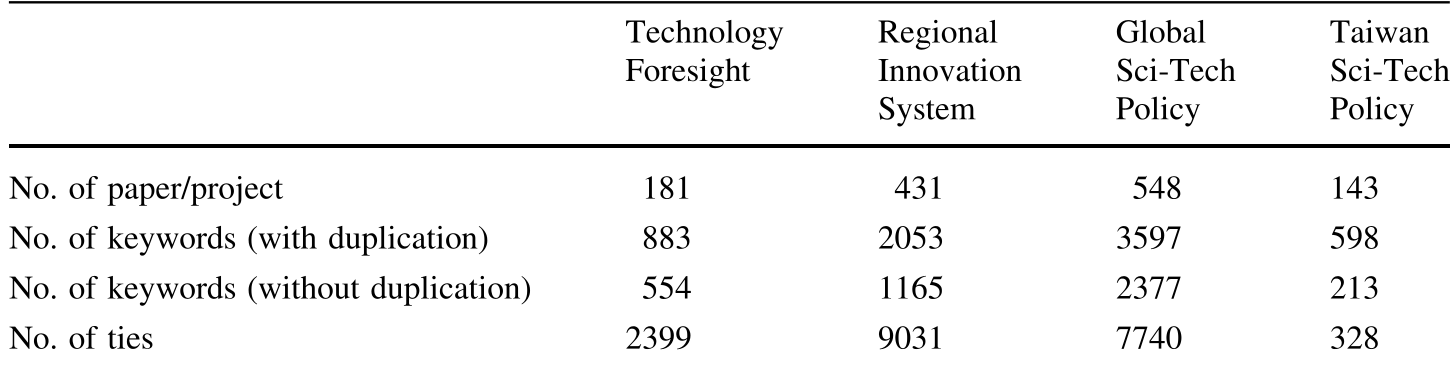
The authors tested their model on four significant datasets, ranging from Global Sci-Tech Policy to Taiwan’s research projects.
Key Observations:
- The Power of Abstracts: Using abstracts instead of full texts prevents bias caused by document length.
- Keyword Standardization: Consolidating terms (e.g., "Technique" to "Technology") is vital for reducing noise in the VSM.
- Curve Characteristics: For most journal-based networks, the match percentage followed an exponential trend, plateauing at high thresholds. In contrast, the government project database showed a hump-shaped curve, providing a clearly defined "peak" for the optimal threshold.
Deep Insight: Is there a Universal Constant?
One might hope for a "magic number" (e.g., 0.4) for all networks. However, the authors conclude that thresholds are case-dependent.
Factors such as data source (journal vs. project report) and language (English vs. Chinese) significantly shift the optimal cut-off. For instance, the Technology Foresight network peaked at 0.49, while Taiwan's Sci-Tech Policy network was optimized at 0.35.
Critical Analysis & Future Directions
Value for Industry
This isn't just academic; it has massive implications for Expert Recommendation Systems and Competitor Analysis. By applying these optimized thresholds, organizations can identify "hidden" collaborators—researchers who are working on highly similar concepts but haven't formally co-authored a paper yet.
Limitations
- Static Nature: The study admits knowledge is dynamic, yet the thresholds are calculated as static snapshots.
- Semantic Nuance: VSM relies on keyword overlap. Future iterations should incorporate Latent Semantic Analysis (LSA) or Graph Neural Networks (GNNs) to capture ties where researchers use different terminology for the same underlying concept.
Conclusion
By grounding network formation in the mathematical rigor of the Vector-Space Model, Lee and Su provide a bridge between qualitative bibliometrics and quantitative network science. The "cut-off" is no longer a matter of researcher intuition—it is a measurable reflection of the domain's inherent conceptual density.