
Bridging the Semantic Gap: An Ontology-Based Approach to Object Recognition and Image Retrieval
Ontology based object learning and recognition: application to image retrieval
The paper introduces a novel object categorization and image retrieval framework that integrates a visual concept ontology with machine learning. By utilizing an intermediate layer of 103 visual concepts (including spatial, color, and texture attributes), the method bridges the semantic gap between high-level domain knowledge and low-level image processing, enabling linguistic-based indexing without query images.
TL;DR
The "semantic gap" between what humans see (objects, textures, colors) and what computers process (pixels, gradients) remains a fundamental hurdle in computer vision. This paper proposes a hybrid architecture that uses a Visual Concept Ontology to act as a translator. By training dedicated neural detectors for 103 distinct visual concepts, the system allows for linguistic-enabled image retrieval and explainable object categorization.
Background: The Limits of Appearance-Based Vision
Historically, image retrieval has leaned heavily on "appearance"—treating images as collections of colored pixels through global statistics like color coherence vectors. While computationally efficient, these methods fail to understand what is in the image. Conversely, early knowledge-based systems required experts to write complex rules for every object, which is unscalable.
The authors argue for an intermediate path: Use expert knowledge to structure the domain (the "What") but use Machine Learning to handle the visual recognition (the "How").
Methodology: The Augmented Knowledge Base
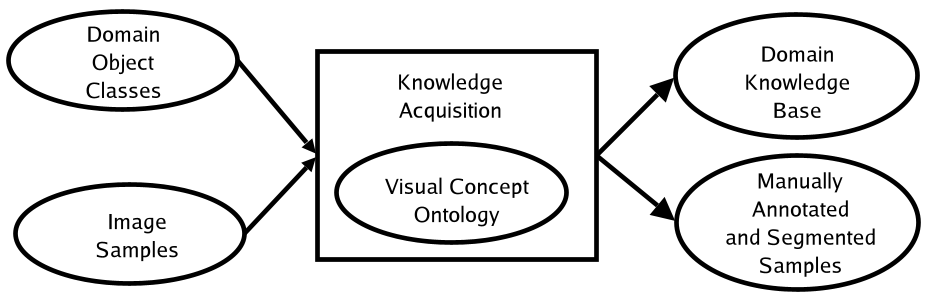
The framework operates in three distinct phases: Knowledge Acquisition, Learning, and Categorization.
1. The Visual Concept Ontology
At the heart of the system is an ontology containing 103 concepts. This is the "shared vocabulary" between human experts and the machine.
- Spatial Concepts: Shape, size, orientation.
- Color Concepts: Hue, saturation, brightness.
- Texture Concepts: Contrast, repartiton, patterns.
2. Learning via Symbol Grounding
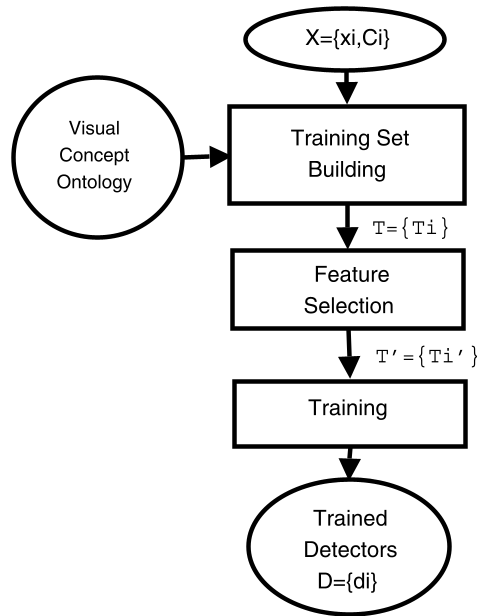
To solve the symbol grounding problem, the authors map numerical features (like Gabor filters for texture or histograms for color) to these ontological concepts using Multi-Layer Perceptrons (MLPs).
The learning process is hierarchical. For instance, if an expert defines a "Pollen Grain" as having a "Granulated Texture," the system builds a detector for that specific texture concept by selecting the most relevant features using Sequential Forward Floating Selection (SFFS).
Real-World Application: Image Indexing
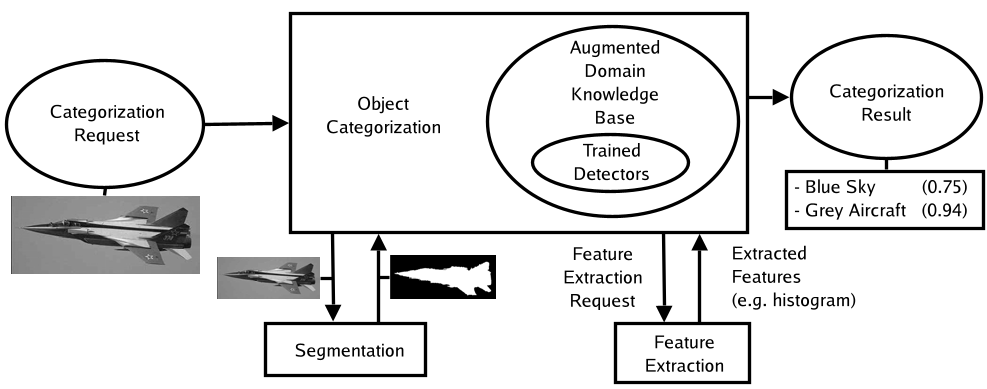
The system was tested on diverse datasets including French TV news and aircraft/ship imagery. Unlike "query-by-example" systems where you provide an image to find similar ones, this system allows for linguistic indexing. You search for "Aircraft" or "Ship," and the system uses its hierarchy of visual concepts to find matches.
Performance and Explainability
One of the standout features is the Symbolic Explanation. Instead of a black-box "90% Aircraft" result, the system can explain that it identified an object with a specific "Aircraft Shape" and "Grey Hue."
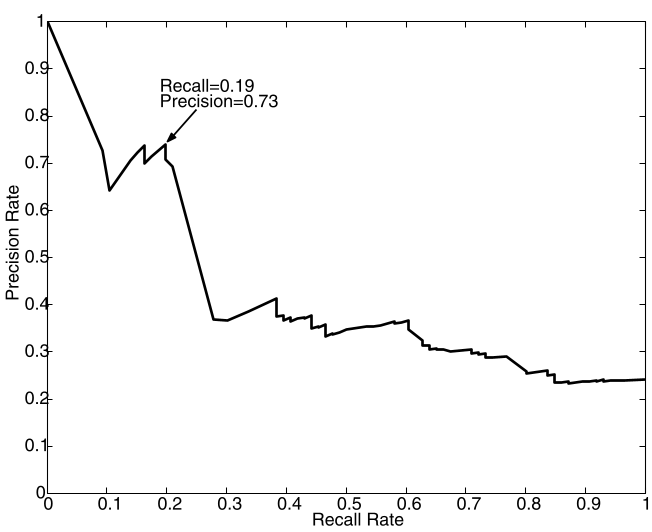
In terms of quantitative results, the system prioritizes Precision (the accuracy of what is retrieved) over Recall (finding every possible match), which is often preferred by professional end-users in domains like biology or maritime surveillance.
Critical Insight
The brilliance of this work lies in its modularity. Because the high-level ontology is decoupled from the low-level detectors, one could theoretically replace the MLPs with more modern architectures (like Vision Transformers) without needing to rebuild the entire domain knowledge base.
However, the system’s primary weakness is its dependency on initial segmentation. If the "region growing" algorithm fails to isolate the object properly, the visual detectors receive "noisy" data, leading to misclassification.
Conclusion
This paper represents a significant step toward "Cognitive Vision." By moving away from purely statistical appearance models and toward structured, ontological learning, it provides a blueprint for systems that can not only "see" but also "describe" and "categorize" the world in human-readable terms.