
Ontology-Based Photo Annotation: Beyond the Limitations of Keywords
Ontology-based photo annotation
This paper presents a framework for "Ontology-Based Photo Annotation" that utilizes RDFS and domain-specific ontologies to facilitate intelligent image indexing and retrieval. The authors developed a specialized tool that generates annotation interfaces from RDFS specifications, significantly outperforming traditional keyword-based search engines in precision and semantic query handling.
TL;DR
In the early days of the Semantic Web, finding the "perfect photo" was a needle-in-a-haystack problem. This seminal work from the University of Amsterdam introduces an ontology-driven framework for photo annotation. By moving away from flat keywords and toward structured RDFS-based descriptions, the authors demonstrate how machine-understandable background knowledge can drastically improve the precision and recall of multimedia retrieval.
The Semantic Gap: Why Keywords Fail
Imagine searching for a "great ape." A standard keyword engine might return a "gorilla" or an "orangutan," but only if those specific words are tagged. If the tagger used "chimpanzee" but not the category "great ape," a traditional system fails. Furthermore, keywords are "unrelated atoms." In a tag set like {large, chimpanzee, tree}, does "large" describe the ape, the tree, or the resolution of the image?
The authors identify this lack of structural and hierarchical context as the primary bottleneck in multimedia databases.
Methodology: Architecture of Knowledge
The core innovation lies in the separation of the how of an annotation from the what of the subject matter.
1. The Dual-Ontology Model
The system uses two distinct RDFS (Resource Description Framework Schema) layers:
- Photo Annotation Ontology: A template specifying three viewpoints:
- Subject Matter: What is depicted (e.g., a gorilla eating).
- Photograph Feature: Technical circumstances (e.g., vantage point, photographer).
- Medium Feature: Storage metadata (e.g., JPEG, resolution).
- Subject Matter Ontology: Detailed domain knowledge. In this case, a biological phylum hierarchy for animals, allowing the system to understand that a Gorilla is a type of Great Ape.
2. Structured Annotation Template
To avoid the ambiguity of flat tags, the authors adopted a template consisting of an Agent, Action, Object, and Setting. This ensures that modifiers (like "orange") are explicitly linked to the correct entity (the "orangutan").
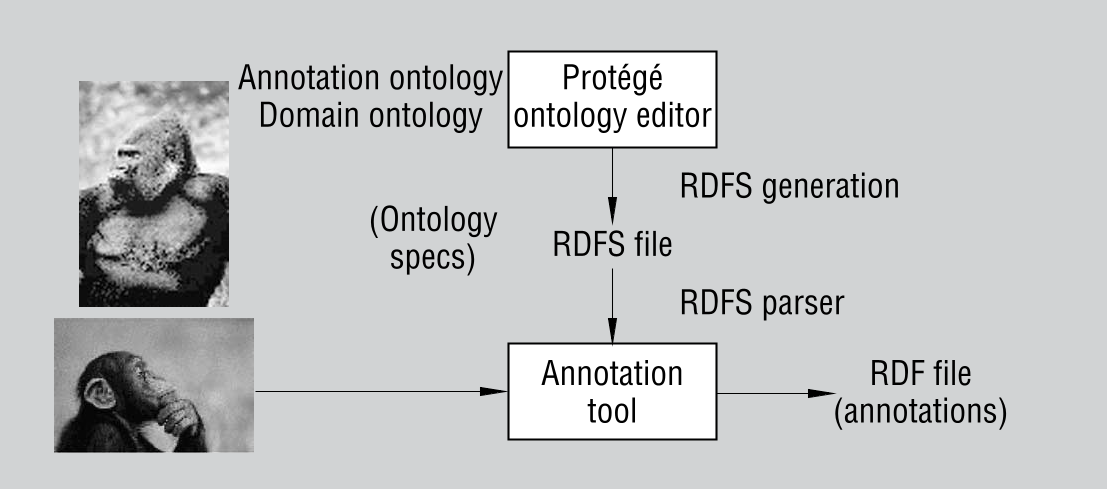 Figure 1: The system architecture using Protégé-2000 for ontology construction and SWI-Prolog for parsing and querying.
Experimental Results: Precision Matters
The authors compared their tool against contemporary giants: Alta Vista (automated indexing) and gettyone.com (manual keyword indexing).
- Hierarchical Reasoning: When searching for "great ape," the ontology tool achieved 100% recall because it "knew" belongingness. Gettyone failed entirely on that specific generalized term despite having the images.
- Complex Relations: Queries like "animal scratching its head" were easily handled by the tool’s structure. In keyword systems, users had to guess various combinations like "animal hand" and "head in hands," leading to unpredictable results.
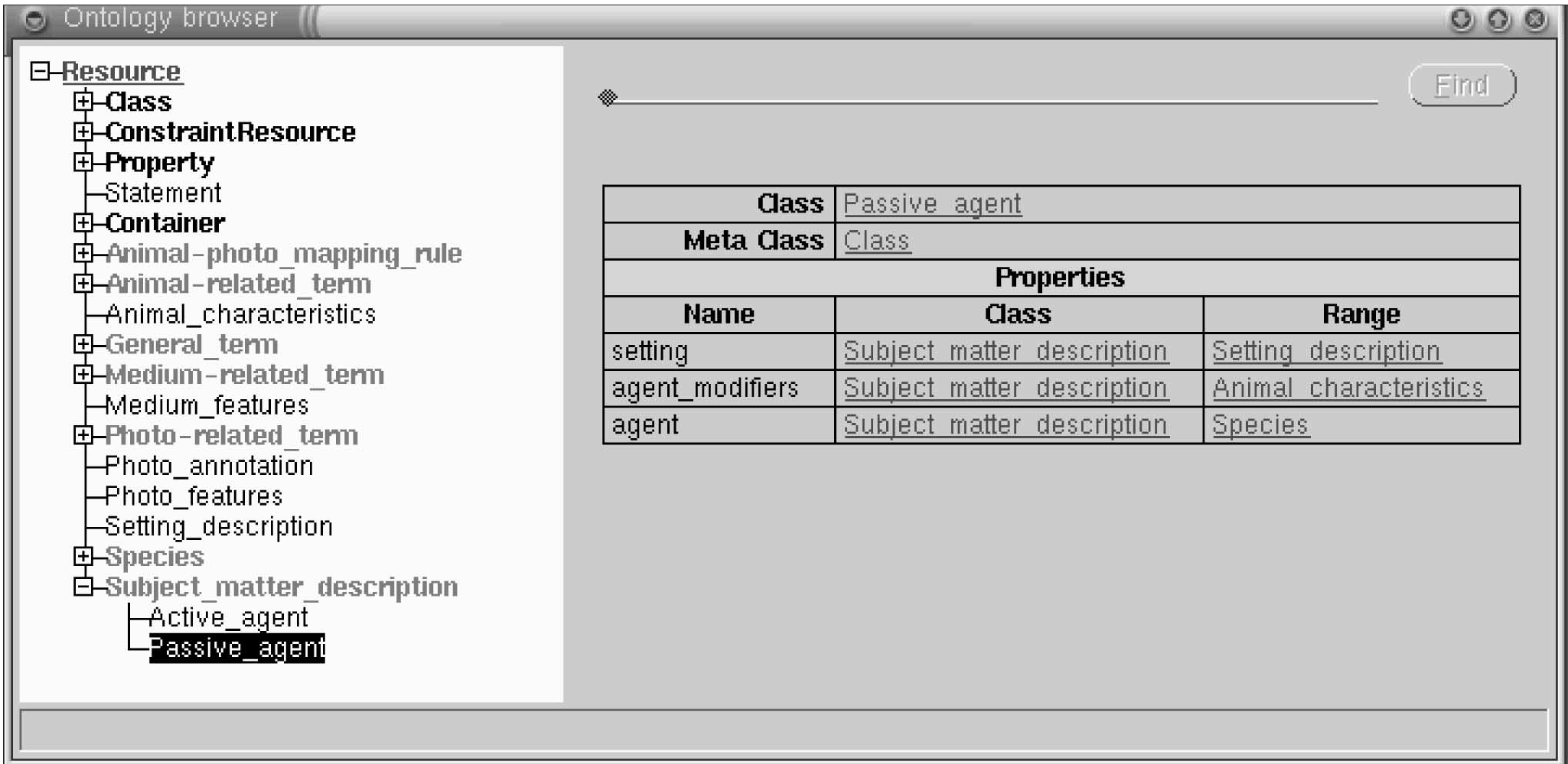 Figure 2: Snapshot of the RDFS browser showing the mapping between subject matter and the domain ontology.
Critical Insights & Future Outlook
The paper highlights a crucial evolution in the Semantic Web: the shift from machine-readable (XML) to machine-understandable (RDFS/OWL).
Key Takeaways:
- Inheritance is Powerful: Using a subsumption hierarchy allows users to "widen" or "narrow" a search effortlessly.
- Defaults and Heuristics: The authors suggest using "default knowledge" (e.g., "Orangutans are typically orange") to aid search even when specific tags are missing.
- Limitations: The manual effort required for high-quality annotation remains a hurdle. The authors suggest that future systems should use Natural Language Processing (NLP) to "pre-process" existing free-text tags into these structured ontologies.
Conclusion
This work serves as a foundational blueprint for modern Knowledge Graphs. While we now use embeddings and neural networks to "understand" images, the logic of structured metadata and hierarchical vocabularies remains central to how professional archives and high-end DAM (Digital Asset Management) systems function today.