
PASER: Bridging the Semantic Web and AI Planning for Automated E-Course Generation
An ontology-based planning system for e-course generation
This paper introduces PASER (Planner for the Automatic Synthesis of Educational Resources), an intelligent e-learning framework that automatically generates personalized curricula. It synergizes Semantic Web technologies (RDF/Ontologies) with AI Planning (HAPEDU) to create optimal learning paths from disjoint learning objects.
TL;DR
PASER is a sophisticated e-learning architecture that automates the creation of personalized curricula. By combining an Ontology-based Knowledge Base with a State-Space Planner (HAPEDU), the system transforms a learner's goals and current knowledge into a sequence of specific learning objects, effectively solving the "needle in a haystack" problem of finding relevant educational material online.
Problem & Motivation: The Curriculum Bottleneck
Despite the wealth of educational material available on the web, finding content that matches a specific learner's profile, prerequisites, and goals remains a manual, labor-intensive task. Current Semantic Web efforts provide metadata (like LOM), but they lack the dynamic reasoning to "stitch" separate resources into a coherent path.
The authors identify a critical gap: Static relations. Most existing systems require learning objects to be explicitly linked. If Object A doesn't "know" it is a prerequisite for Object B in the metadata, the system fails. PASER’s intuition is to treat the domain as a Compentency Map, allowing an AI planner to discover these links dynamically.
Methodology: The Core Engine
The PASER architecture is a multi-layered pipeline consisting of three primary pillars:
- The Competencies Ontology: Built on the SKOS (Simple Knowledge Organization System) model, it organizes 310 AI-related concepts into a hierarchy. This allows the system to understand that a student who knows "Heuristic Search" may already have partial knowledge of "Hill-Climbing."
- R-DEVICE Reasoning: This deductive rules engine filters the massive repository of Learning Object Metadata (LOM) to keep only objects relevant to the user's specific request and constraints.
- HAPEDU Planner: This is the "brain." It treats the course generation as a STRIPS planning problem where:
- Initial State: The learner's current knowledge (LIP profile).
- Goal: The desired competencies.
- Actions: "Consuming" a learning object, which has prerequisites (preconditions) and learning outcomes (add effects).
System Architecture
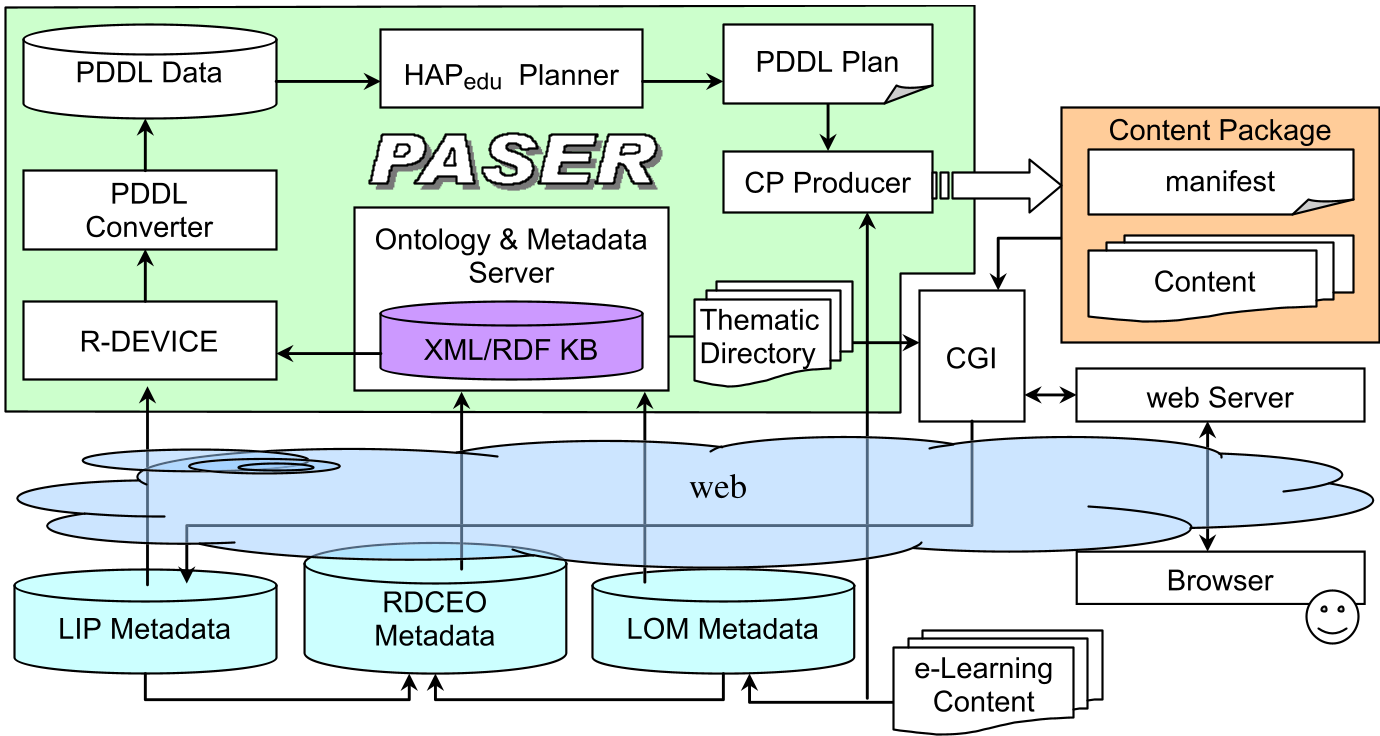 The interaction between the PDDL converter, the HAPEDU planner, and the metadata repositories.
Handling Abstraction
One of PASER's most significant contributions is its ability to handle levels of abstraction. Using three distinct operators—Consume, Analyze, and Synthesize—the planner can break down a high-level goal (e.g., "Master AI") into sub-goals (e.g., "Learn Prolog") based on the ontology's hierarchical structure.
Experiments & Results: A Case Study in AI Education
The authors validated PASER through a case study in the domain of Artificial Intelligence. By mapping the hierarchy (shown below), the system demonstrated it could generate valid sequences of PDFs, web pages, and PDFs for complex subjects.
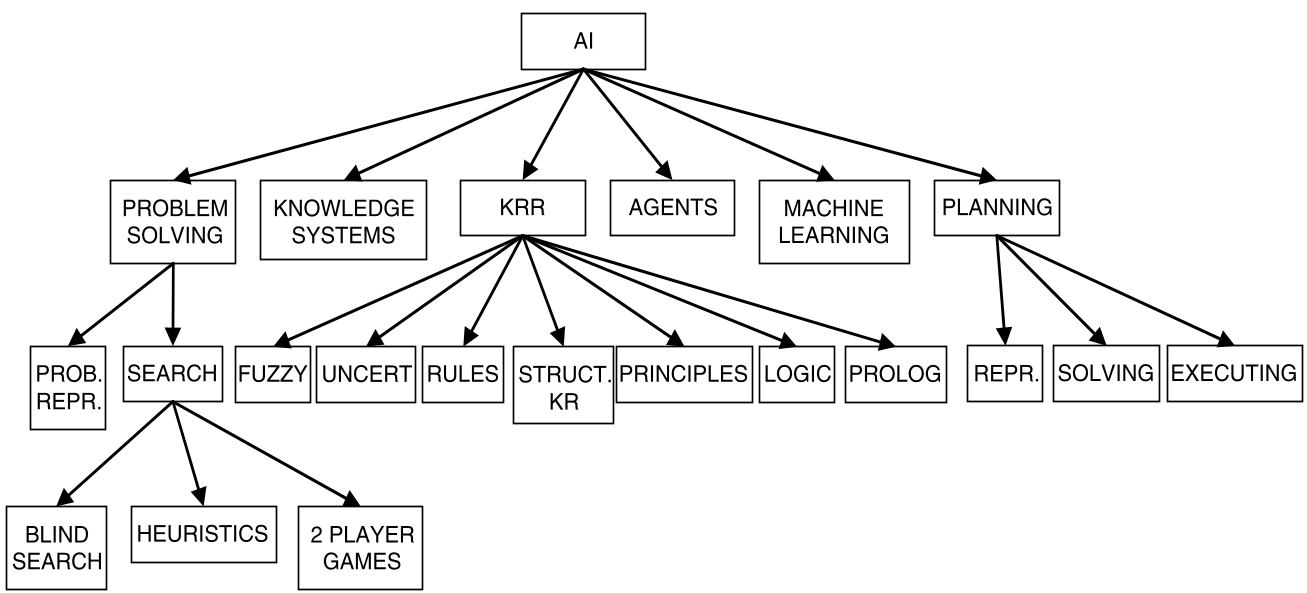 The hierarchical decomposition of the Artificial Intelligence domain used by PASER.
In the experimental scenario, a learner requesting knowledge in "Prolog" was served a strictly sequenced Content Package. The HAPEDU planner ensured that "Unification" was presented before "Rule and Goal Order," simulating the logic of a human instructor.
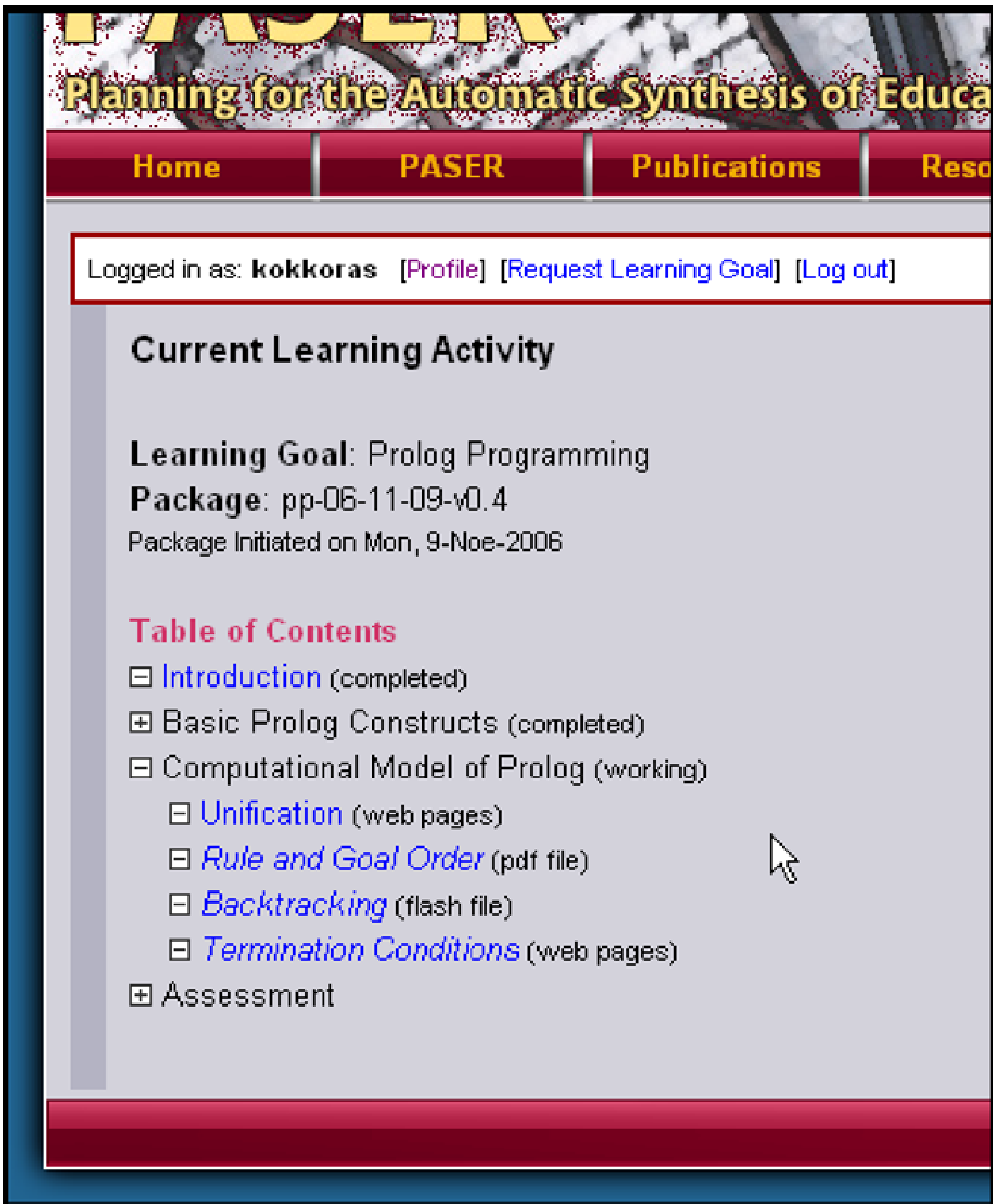 The final generated course structure presented to the learner.
Critical Analysis & Conclusion
Takeaway
PASER demonstrates that AI Planning is a natural fit for Education. By formalizing "learning" as a transition between states of knowledge, we can leverage 40+ years of planning research to solve personalized education at scale.
Limitations
- Manual Annotation: The system still relies on experts to check metadata before entry, which is a significant bottleneck.
- Static Profile: Currently, the learner's profile is updated via simple verification forms rather than through active assessment or performance tracking.
Future Outlook
The authors' next step—integrating a Text Classification System (TCS)—is crucial. If NLP can automate the mapping of raw educational text to RDCEO competency terms, systems like PASER could autonomously index the entire web's educational content.