
Beyond Latent Semantics: Hierarchical Prioritization in Gene Function Prediction
Ontology-Based Prediction and Prioritization of Gene Functional Annotations
The paper introduces a computational pipeline for predicting and prioritizing gene functional annotations using Gene Ontology (GO). It proposes semantically improved variants of Truncated Singular Value Decomposition (tSVD), namely SIM1 and SIM2, achieving high validation rates in Homo sapiens, Mus musculus, and Danio rerio datasets.
TL;DR
Predicting what genes do is a cornerstone of modern drug discovery, yet biological databases remain patchy. This paper presents a sophisticated pipeline using Semantically Improved tSVD (SIM1 & SIM2) to predict missing Gene Ontology (GO) annotations. By introducing a "Prioritization Rule" based on ontology hierarchy (AllParents), the authors significantly increased the reliability of computational predictions, validating them against real-world database updates.
The Bottleneck: Data Incompleteness and Curation Lag
In the era of high-throughput sequencing, our ability to identify genes has outpaced our understanding of their functions. Current Gene Ontology (GO) annotations act as the "ground truth," but they are either:
- Computationally inferred (IEA): Often noisy and unreviewed.
- Manually curated: Highly reliable but incredibly time-consuming to produce.
Previous attempts at "Latent Semantic Indexing" (LSI/tSVD) treated gene-term associations like words in a document. However, biology is not a flat dictionary; it is a nested hierarchy.
Methodology: Adding Depth to Latent Semantics
The authors evolve the standard Truncated Singular Value Decomposition (tSVD) through two key innovations:
1. SIM1 & SIM2: Local Context and Semantic Weighting
Instead of a global SVD that treats all genes the same, SIM1 performs gene clustering. It calculates distinct correlation matrices for different functional clusters, ensuring that a "nervous system gene" isn't being regularized by the patterns of a "metabolic gene." SIM2 goes further by integrating the Resnik Similarity, weighting the matrix based on the "Information Content" of ontology terms.
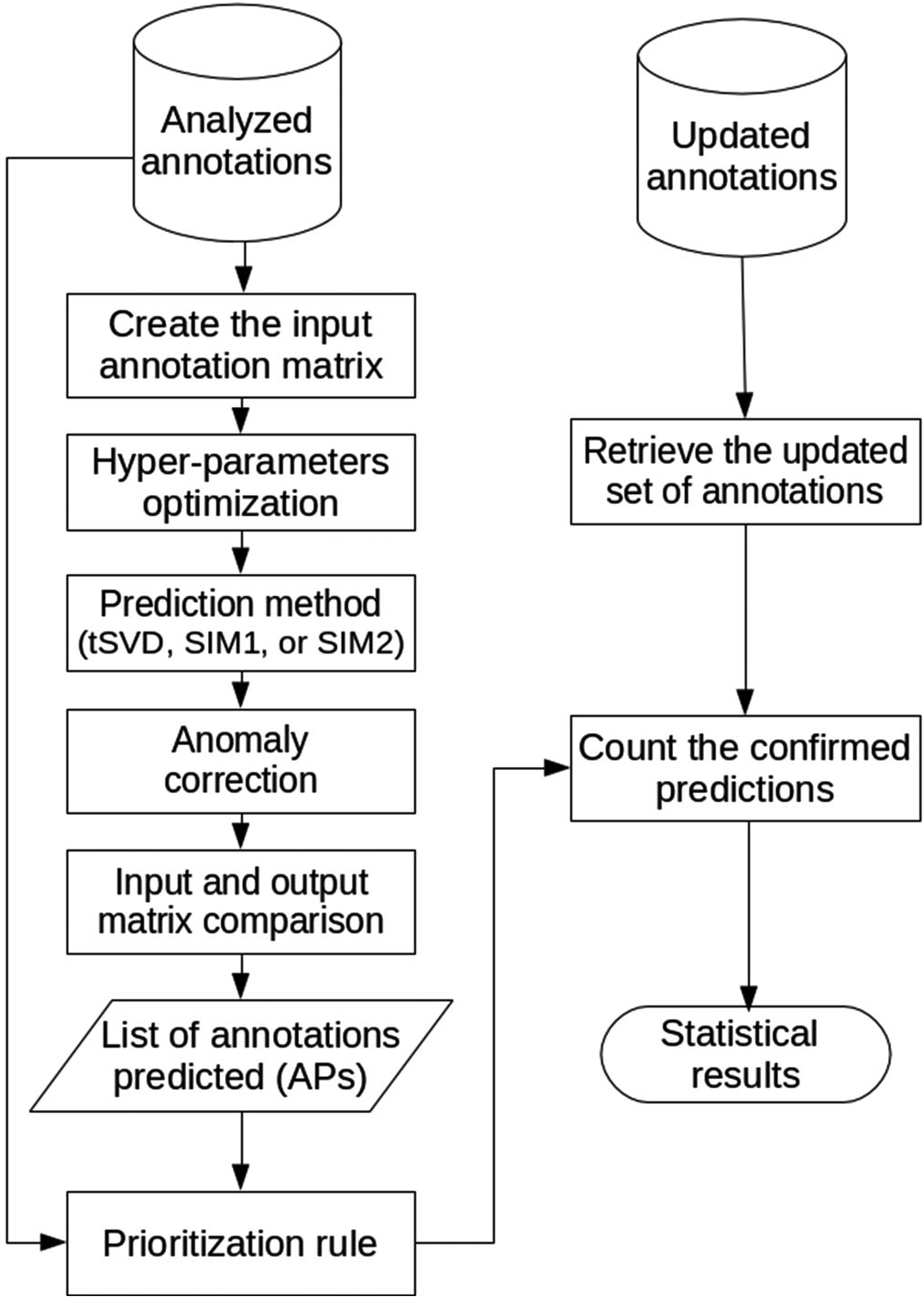 Figure 1: The comprehensive pipeline from data retrieval in GPDW to final prioritized predicted annotations.
2. The AllParents Prioritization Rule
The paper's most intuitive yet powerful "Why" is the prioritization rule. They hypothesize that a prediction for a specific term (e.g., "Cell-matrix adhesion") is much more likely to be correct if the gene is already known to participate in all its parent processes (e.g., "Biological adhesion").
Experimental Results and SOTA Comparison
The authors didn't just use standard cross-validation; they used a temporal "back-testing" approach. They trained their model on 2009 data and verified it against the 2013 database release.
- Effectiveness: The AllParents category consistently outperformed others. In Danio rerio (Zebrafish), the confirmation rate jumped from a baseline to 47.87% when the prioritization rule was applied.
- Reliability: Human gene predictions in the AllParents category were more often confirmed by non-computational (hard evidence) data compared to lower-tier categories.
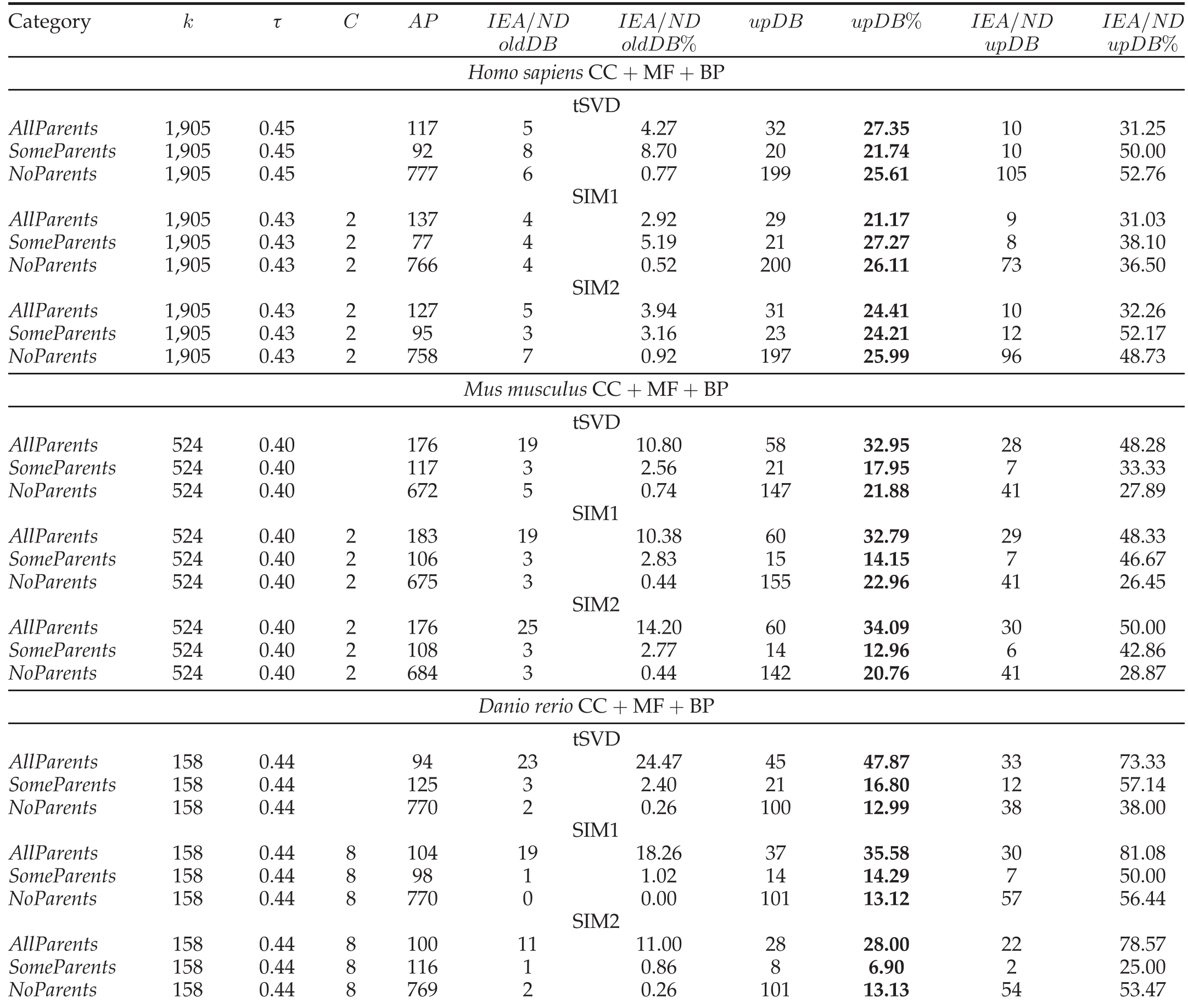 Table 2: Quantitative assessment across species. Note how the 'upDB%' (Updated Database confirmed %) peaks in the AllParents category.
Critical Insight: Why Topology Matters
The fundamental takeaway of this work is that Semantics + Topology > Pure Machine Learning. By enforcing that a gene must "walk before it can run" (satisfying parent terms before child terms), we filter out the statistical noise inherent in high-dimensional matrix decomposition.
Limitations & Future Outlook
While tSVD is powerful, it is a linear model. The authors acknowledge that modern non-linear approaches like Deep Autoencoders and Probabilistic LSA are the next frontiers. Furthermore, the reliance on the existing ontology structure means the system is only as good as the hierarchy defined by human curators.
Conclusion
This study bridges the gap between pure data-driven discovery and biological logic. By treating the Gene Ontology as a structured graph rather than a flat feature set, the researchers have created a tool that doesn't just "guess" function, but "prioritizes" it for the biological curators of tomorrow.