
O3R: Bridging the Semantic Gap in Web Usage Mining via Ontology Rummaging
Ontology-Based Rummaging Mechanisms for the Interpretation of Web Usage Patterns
The paper introduces O3R (Ontology-based Rules Retrieval and Rummaging), a novel framework for Web Usage Mining (WUM) that utilizes domain ontologies to interpret sequential navigation patterns. It bridges the gap between raw URLs and user intent by mapping web resources to conceptual entities, enabling interactive exploration of usage data.
TL;DR
Web Usage Mining (WUM) often leaves analysts drowning in a sea of meaningless URLs. This paper presents O3R, a tool that uses domain ontologies to transform raw navigation logs into intuitive, conceptual patterns. By allowing users to "rummage" through data—drilling up to see general trends or down into specific actions—it turns cryptic server logs into actionable insights for site optimization and user behavior analysis.
The "URL Problem": Why We Can't Understand Web Logs
In the world of Web Usage Mining, we apply algorithms to extract sequences of user clicks. However, we face two massive hurdles:
- The Semantic Gap: A log entry like
/cgi-bin/form?id=102is syntactically clear but semantically opaque. Was the user submitting an assignment or checking a grade? - Pattern Explosion: Sequential mining often generates thousands of rules. Without a way to group or abstract them, they are useless to human decision-makers.
Most older solutions tried to fix this during pre-processing by hard-coding meanings to URLs. This paper argues that such a static approach is too rigid. Instead, we need a way to explore these meanings interactively.
Methodology: The O3R Framework
O3R (Ontology-based Rules Retrieval and Rummaging) shifts the intelligence to the analysis phase.
1. The Dual-Dimension Mapping
The core innovation lies in mapping URLs to a domain ontology across two axes: Service (what the user is doing, e.g., "Chat") and Content (what the user is looking at, e.g., "Distance Education").
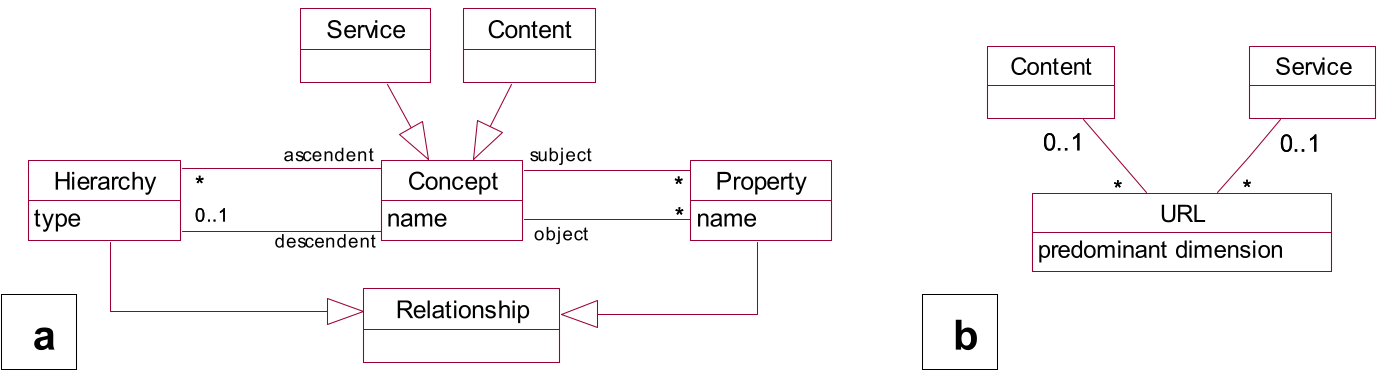 Fig 1: The ontology structure mapping physical URLs to conceptual Services and Content.
2. Interactive Rummaging
"Rummaging" is the paper's term for active exploration. Rather than looking at a static list:
- Drill-up/Drill-down: If a user sees a pattern involving "Gmail," they can drill up to see it as "Communication Tool."
- Filtering by Similarity: Using a taxonomic similarity function, O3R can find patterns that are conceptually similar (e.g., finding "Forum" patterns when searching for "Chat" because both are "Communication").
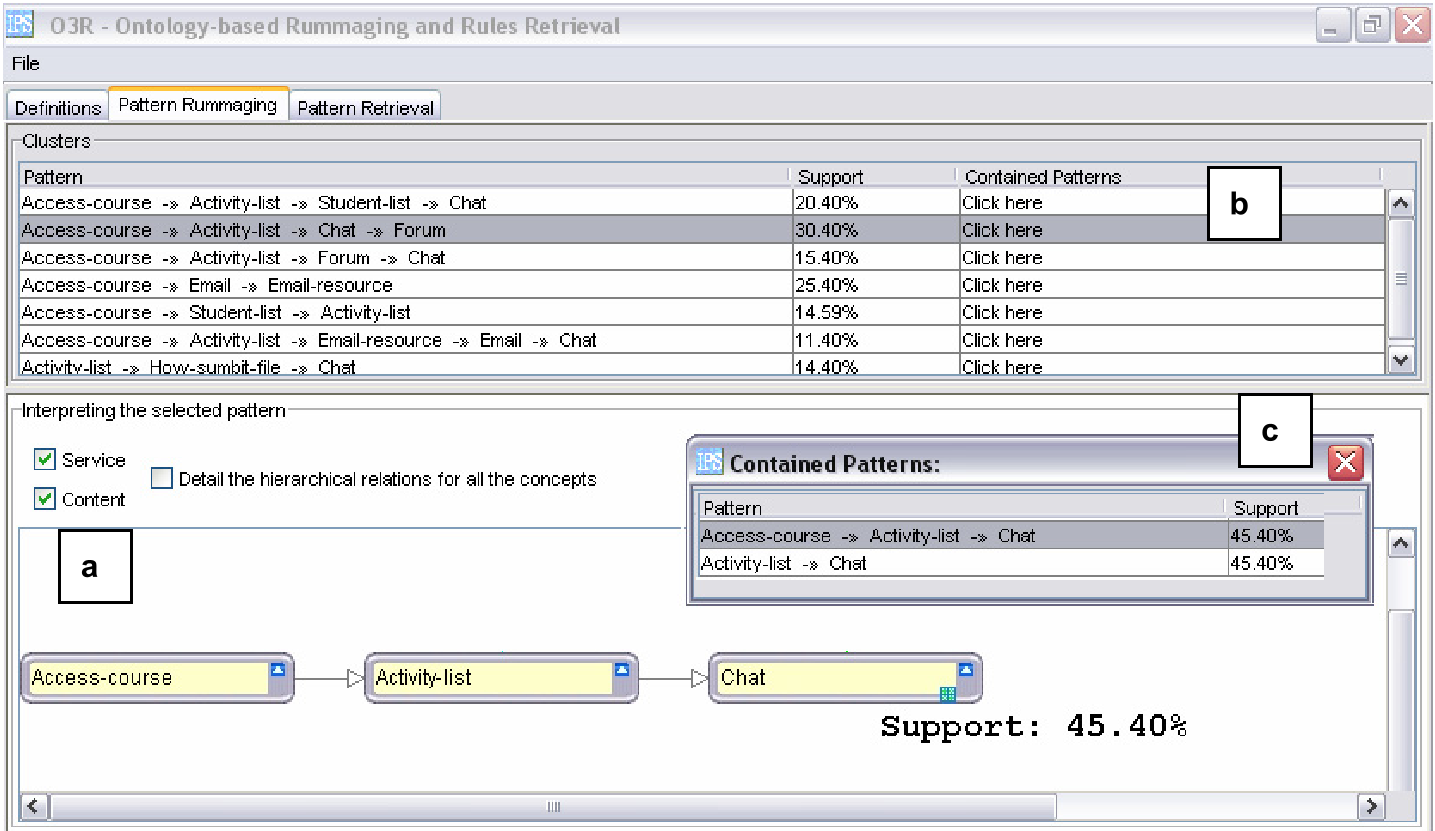 Fig 2: The O3R interface showing how conceptual patterns are visualized and manipulated.
Experiments: Real-World Learning Environments
The authors tested O3R on logs from PUCRS-Virtual, a distance learning site. In the past, an expert spent 18 months trying to decode student behavior using standard tools. With O3R, the same expert was able to:
- Instantly identify that students were using "Chat" to discuss "File Submission."
- Filter out redundant patterns to focus on "Expected vs. Real" navigation paths.
Performance Metrics
In a controlled study with 12 subjects, the "problem-solving" capability was significantly enhanced:
- Task Accuracy: Over 50% of users achieved a perfect score in identifying site structural problems using the tool.
- Usability: Users rated the intuitiveness of the ontology-driven approach at 4.3/5.
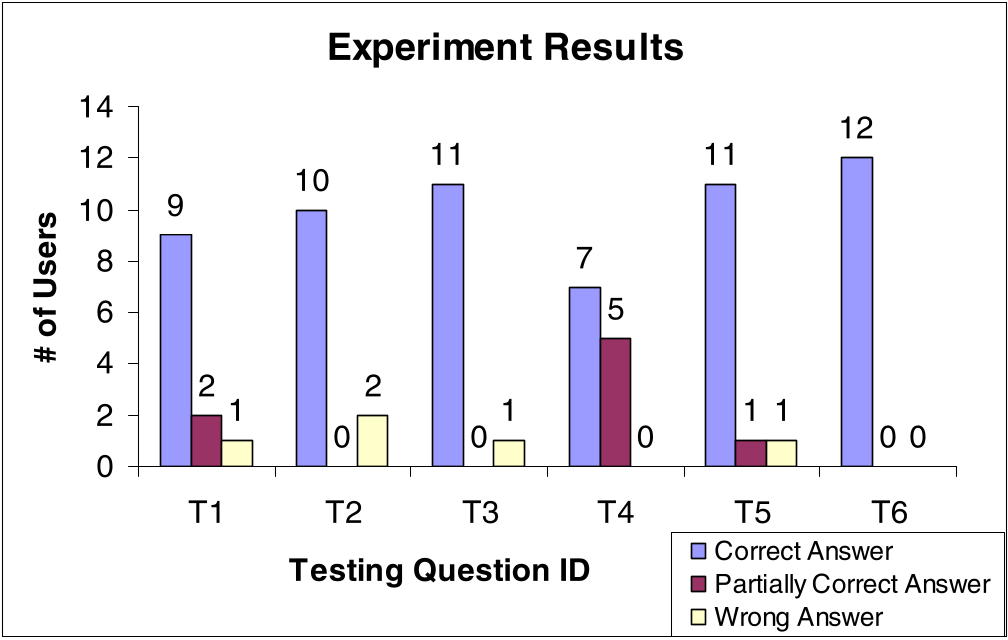 Fig 3: Success rates of users solving site-structure and behavior questions using O3R.
Critical Insight: The Power of Inductive Bias
The true value of O3R isn't just the visualization—it's the Inductive Bias provided by the ontology. By forcing the data into a hierarchical structure, the system allows the analyst's prior knowledge to guide the discovery process. This proves that in "Small Data" scenarios (like a specific university course), a well-defined human-made ontology can be more powerful than purely "Black Box" mining algorithms.
Conclusion & Future Look
O3R demonstrates that the future of web analytics isn't just about collecting more data; it's about providing the right abstraction layers.
Limitations: The system still requires a domain expert to manually create the initial ontology and map URLs. Future Work: The next step is likely the automatic generation of these ontologies using LLMs or web scraping, which would remove the final manual bottleneck in the O3R pipeline.