
PSM: Bridging Data Islands via Ontology-Based Social Network Mashups
Social network mashup: Ontology-based social network integration for statistic learning
This paper proposes an ontology-based framework to integrate heterogeneous social networks (like LinkedIn and DBLP) and introduces a Probabilistic Semantic Model (PSM) for statistical learning. The method achieves a 67% average precision in predicting Collaborative Colleague Relations (CCR) by merging multi-domain social data.
TL;DR
Social networks today are siloed, with LinkedIn holding your professional bio and DBLP holding your academic record. This paper introduces a Social Network Mashup approach using Semantic Web technologies to fuse these "data islands." By learning a Probabilistic Semantic Model (PSM), the authors can predict complex social ties, such as "Collaborative Colleague Relations," with significantly higher accuracy than using isolated datasets.
Problem & Motivation: The "Data Isolated Island" Phenomenon
In the mid-2000s, the explosion of social platforms created a unique challenge: people exist in multiple domains simultaneously. However, because these platforms lack a universal data representation, researchers face several hurdles:
- Incomplete Profiles: One network only describes one aspect of a person.
- Semantic Loss: Traditional statistical methods often "flatten" social data into simple tables, stripping away the rich, hierarchical relationships inherent in human networks.
- Entity Resolution: Identifying that "Chuny Zhou" on LinkedIn is the same "Chunying Zhou" on DBLP is technically non-trivial.
The authors argue that to truly understand social dynamics, we need a method that integrates these sources without losing the Inductive Bias provided by their semantic structures.
Methodology - The Core
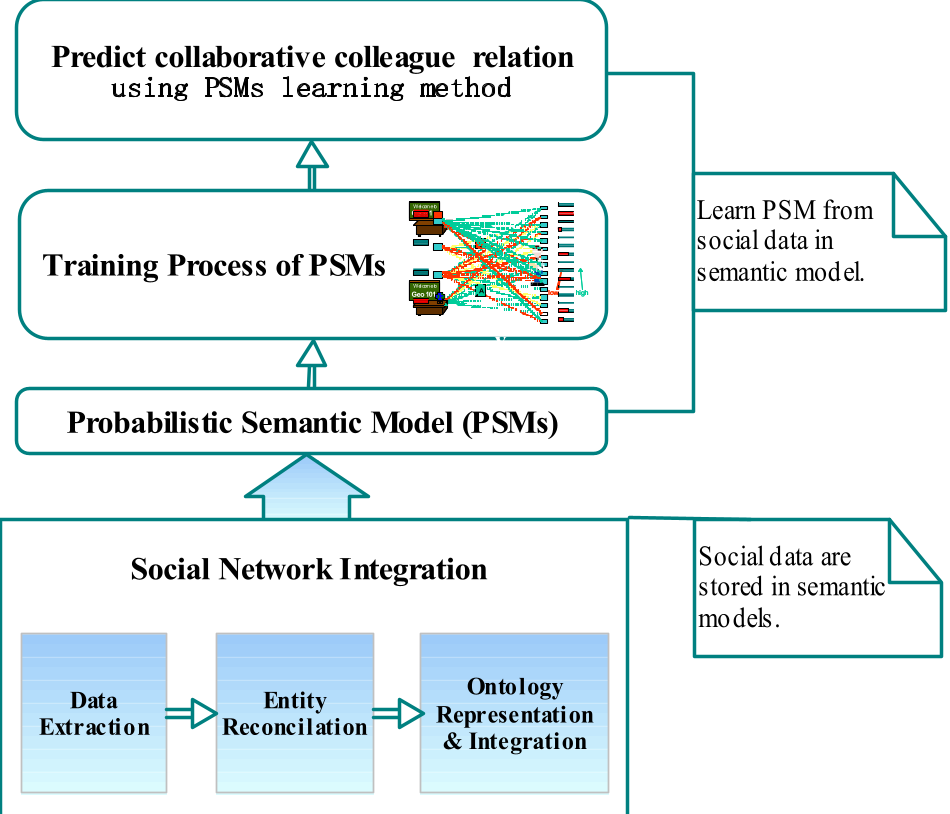
The proposed framework consists of two main stages: Mashup and Learning.
1. Social Network Mashup
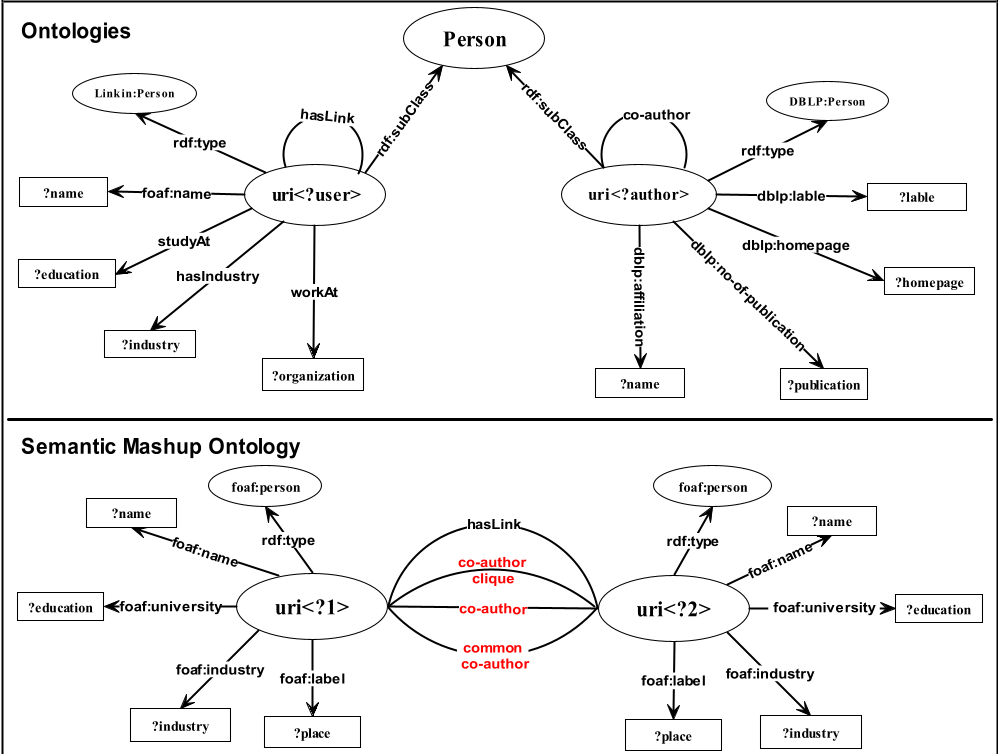
The system uses an Ontology-based approach. Instead of simple database joining, it maps disparate data into a universal RDF-based ontology.
- Entity Reconciliation: To merge nodes, the authors use a reference reconciliation algorithm. This isn't just string matching; it uses a Decision Dependency Graph. For instance, the decision to merge two "Person" entities depends on the similarity of their names and the similarity of their friends list.
2. Probabilistic Semantic Model (PSM)
The PSM is arguably the paper's most significant contribution. It extends standard attribute Bayesian networks to handle the complex graph structures of the Semantic Web.
- Conditional Probability Distributions (CPD): Each property in the ontology is treated as a node in a probabilistic dependency structure.
- Reasoning under Uncertainty: The model quantifies how much "direct influence" one property (e.g., being in the same lab) has on another property (e.g., co-authoring a paper).
Experiments & Results
The authors tested their framework by combining LinkedIn and DBLP data to predict Collaborative Colleague Relations (CCR)—a "stronger" social bond than simple co-authorship.
Key Performance Indicators:
- Reconciliation Success: The entity merging step achieved 83% Precision and 100% Recall, proving that semantic-based reconciliation is highly robust.
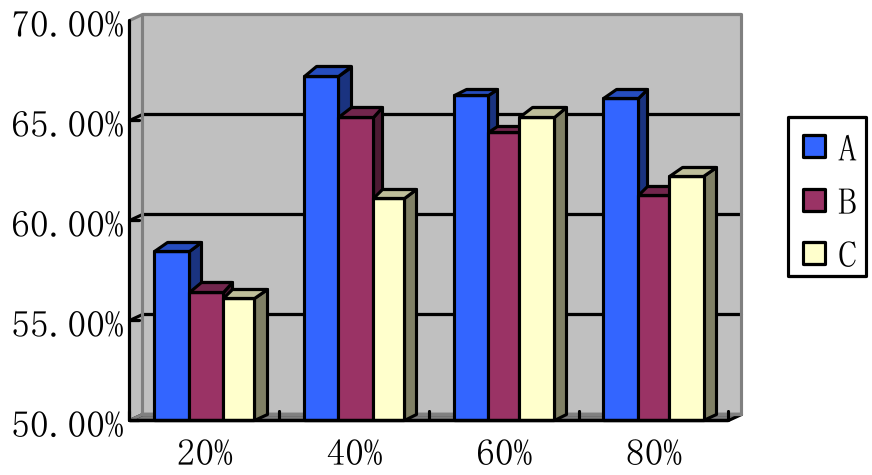
- Predictive Power: The PSM achieved an average precision of 67% in predicting CCR.
- Data Synergy: As shown in the results graph, using Integrated Data (A) yielded the best results, followed by DBLP-only (B), with LinkedIn-only (C) performing the worst. This proves that academic publication history (DBLP) is a better predictor of professional collaboration than simple professional networking profiles (LinkedIn).
Critical Analysis & Conclusion
Takeaway
The integration of heterogeneous social data via ontologies is not just a data-cleaning exercise; it is a prerequisite for high-fidelity social mining. The PSM framework shows that we can perform statistical learning directly on semantic structures without resorting to "lossy" data flattening.
Limitations & Future Work
While the numerical reconciliation is strong, it relies heavily on thresholds. The authors plan to implement Logical Entity Reconciliation to handle more complex edge cases. Furthermore, as social networks scale, the computational overhead of high-dimensional Bayesian structures in the PSM will need to be addressed—likely through sparser attention-like mechanisms or more efficient belief propagation.
This research serves as a foundational blueprint for modern Knowledge Graphs and Cross-Platform User Profiling.