
Fusing Social Graphs with Medical Ontologies: A New Frontier in Context-Aware Health Support
An ontology based system for social networking for health application support
The paper introduces an ontology-based system that integrates social network data (Facebook) with real-time physiological sensor data to support context-aware medical applications. By combining the CONON high-level ontology with domain-specific medical concepts and Facebook's profile data, the authors enable sophisticated high-level context reasoning for patient monitoring.
TL;DR
Mobile health is evolving beyond simple step counters. This research presents a system that doesn't just look at your heart rate, but understands who you are by linking your medical sensors to your Facebook profile. By building a unified ontology, the system can distinguish between a "normal" fever and a critical medical event based on personalized context, providing a rigorous framework for smarter, automated healthcare.
Background: The Gap in Context Aware Systems
Most current context-aware systems operate in a vacuum—they see raw data but lack the "wisdom" to interpret it. While your phone might know your blood glucose levels, it often ignores the rich contextual data already stored in your social media profiles, such as your age, habits, and scheduled activities. This paper bridges the gap between Social Context and Biomedical Context.
The Architecture of Intelligence
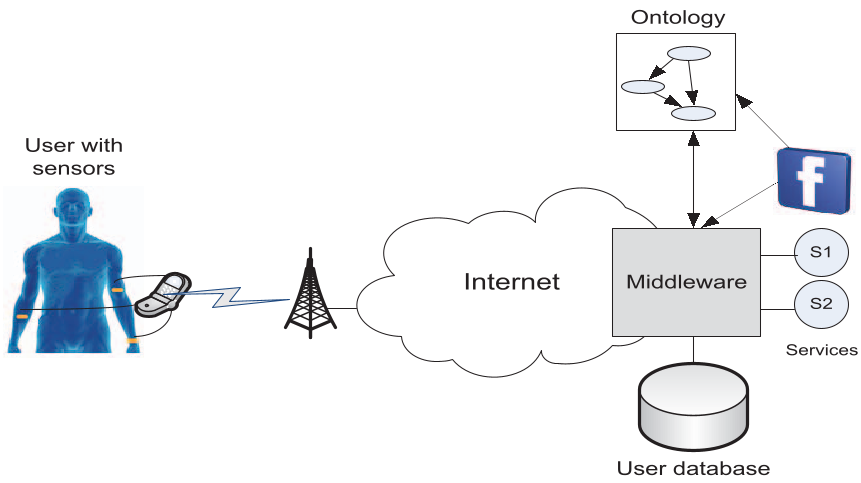
The authors propose a three-layer infrastructure designed to turn raw bits into clinical insights:
- Sensor Layer: Combines physical body sensors (via ZigBee/Bluetooth) with virtual sensors (Social Media APIs).
- Middleware Layer: The "brain" of the operation, featuring a sophisticated inference module.
- Service Layer: The end-user application that reacts to the inferred context.
Methodology: Building the "Super-Ontology"
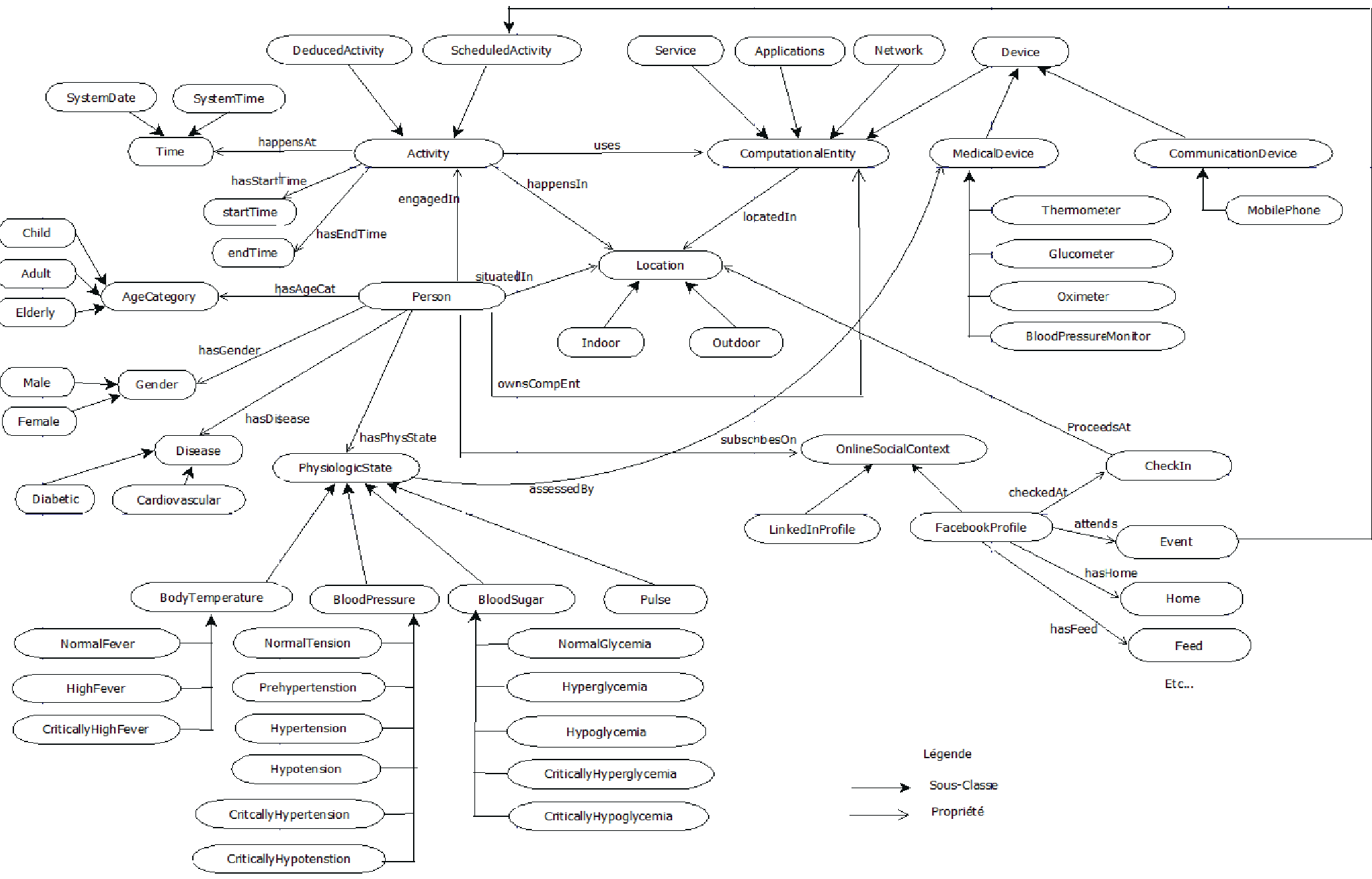
The core innovation lies in the integration of three distinct ontologies:
- CONON (O1): A high-level generic context ontology.
- Medical Extension (O2): Adds concepts like "Physiological State" and "Medical Devices."
- Facebook Ontology (O3): Maps objects like
Check-ins,Events, andRelationshipsusing the Facebook Graph API.
By merging these into a single coherent model (O4), the system can perform cross-domain reasoning. For example, a Facebook Event is mapped as a subclass of ScheduledActivity, allowing the system to understand if a high heart rate is due to a planned exercise session or a medical emergency.
From Raw Data to Medical Reasoning
The system uses SWRL (Semantic Web Rule Language) to define medical logic. Unlike hard-coded "if-else" statements, ontological reasoning allows for dynamic classification.
For instance, the system evaluates body temperature not as a flat number, but as a state:
Temperature > 39°CCriticallyHighFever38°C < Temperature < 39°CHighFever
This becomes even more powerful for blood sugar levels, where the reasoning engine can adjust its thresholds based on the user's age category (Child vs. Elderly) or gender, data points seamlessly pulled from the Facebook profile.
Experimental Validation: The "Ahmed" Simulation
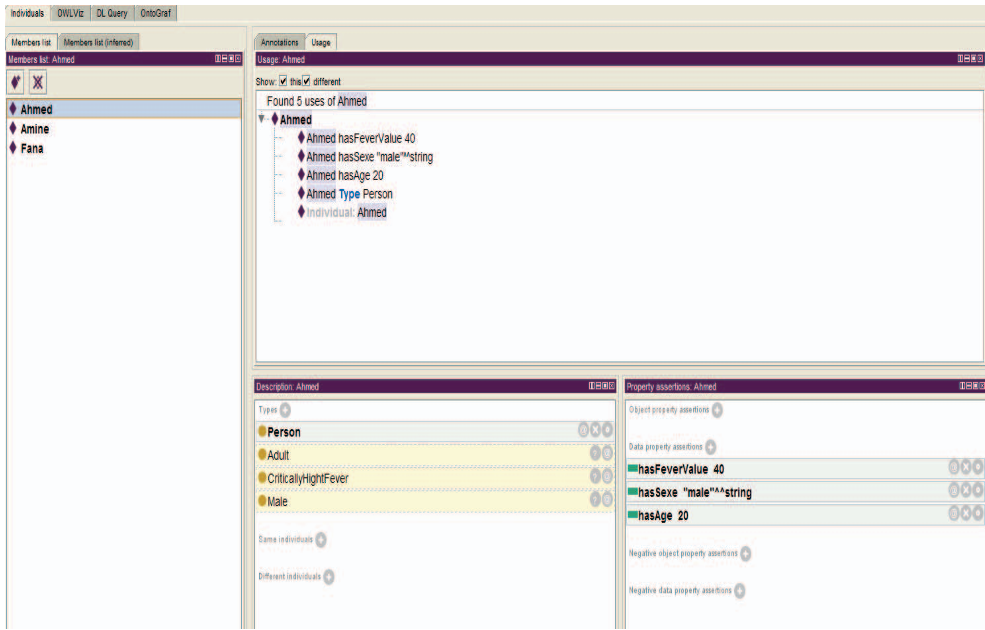
To test the system, the authors simulated an individual named "Ahmed" (20 years old, Male) with a body temperature of 40°C. Using the RacerPro inference engine, the system successfully automatically classified Ahmed into the "Adult" and "CriticallyHighFever" categories, proving the logic's consistency.
Critical Insights & Future Outlook
The value of this work is its Inductive Bias toward structured knowledge. By formalizing human health and social life into a machine-readable format, the authors move us closer to truly autonomous health assistants.
Limitations:
- Manual Integration: The mapping between Facebook data and medical concepts currently requires manual intervention.
- Privacy: Connecting sensitive physiological data to a social media platform like Facebook presents massive security and ethical hurdles that need further exploration.
Future Work: The next step in this research lineage is likely the inclusion of more diverse social platforms (like LinkedIn or Twitter) to capture professional or emotional context, and moving from rule-based reasoning to probabilistic graphical models to handle sensor noise more gracefully.