
Bridging the Utility Gap: How Ontology-Based Mining Transforms Web Information Gathering
Ontology Based Web Mining for Information Gathering
This paper introduces an Ontology-Based Web Mining framework designed to enhance Web information gathering. It proposes two distinct structural models—the Pattern Taxonomy Model (PTM) and the Ontology Mining Model (utilizing granule mining)—to bridge the gap between raw data mining and effective knowledge application.
Executive Summary
TL;DR: This seminal work addresses the "Information Overload" and "Mismatch" problems of the early web era. By transforming raw, noisy data mining patterns into structured Ontologies, the authors provide a framework that doesn't just find data but understands the semantic hierarchy of user interests through Pattern Taxonomy and Granule Mining.
Background Positioning: This paper sits at the intersection of Web Intelligence (WI) and Knowledge Engineering. It moves beyond traditional Information Retrieval (IR) by introducing an AI-driven "Reasoning" layer that maintains and evolves knowledge based on user feedback.
Problem & Motivation: The Noise in the Machine
In the early 2000s, the web was growing faster than our ability to filter it. The authors identify a critical gap: data mining could find "patterns," but those patterns were often:
- Obsessive: Too many patterns were generated for a single query.
- Noisy: Many were redundant or statistically insignificant.
- Uncertain: Ambiguity in terms (synonymy/hyponymy) led to poor precision.
The motivation is clear: we need a way to describe what users want using a conceptual model (Ontology) that can evolve when the user provides feedback.
Methodology: From Patterns to Granules
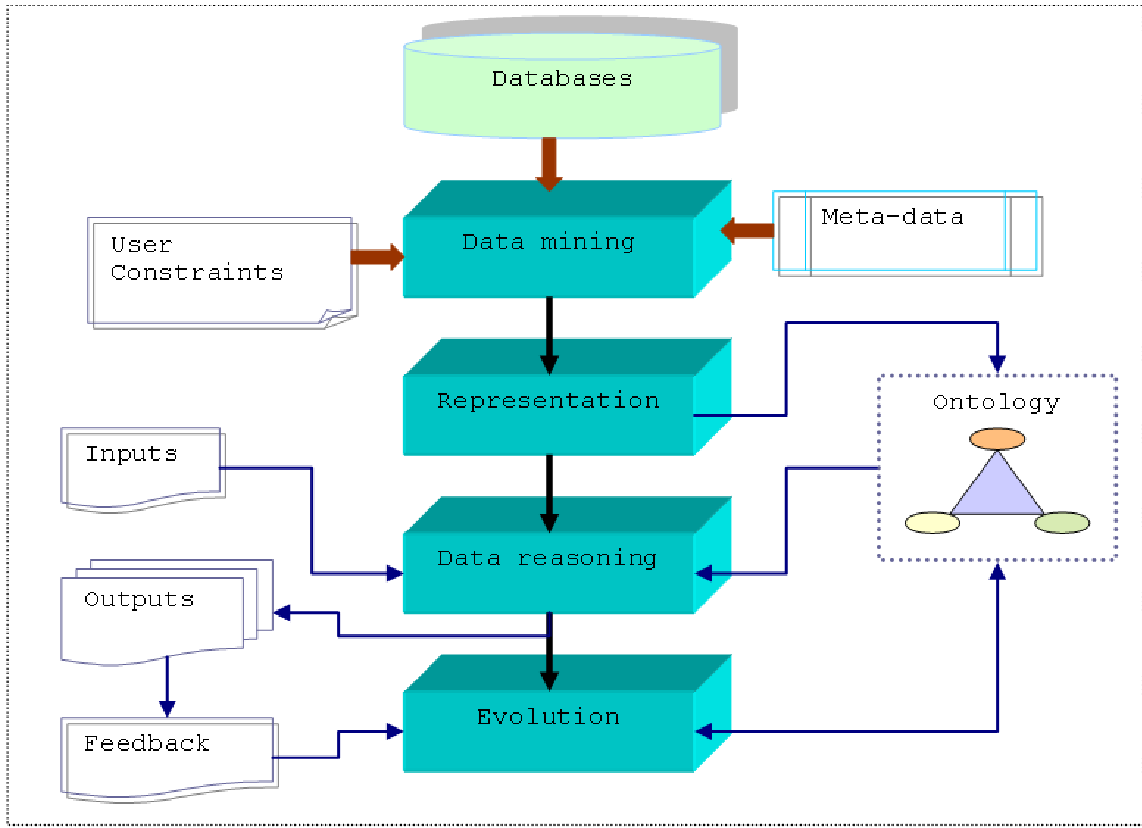
The paper introduces a four-phase architecture: Data Mining → Representation → Data Reasoning → Knowledge Evolution.
1. Pattern Taxonomy Model (PTM)
PTM assumes that patterns carry more semantic weight than words. It builds a tree-like hierarchy to represent the "is a" relationship. Crucially, it uses the concept of Closed Patterns—pruning any pattern that doesn't provide additional information over its sub-patterns—to dramatically reduce noise.
2. Granule Mining and Rough Association
Unlike standard mining, Granule Mining groups documents into "equivalence classes" based on shared features.
- Composition (⊕): A unique mathematical operation used to combine patterns with the same termset into a single, weighted representation.
- Rough Association Rules: These rules map condition granules (what is found in the text) to decision granules (whether it matches user interest).
Experiments & Results
The authors compared their structured approach against traditional word-based models.
- Specificity vs. Exhaustivity: The reasoning model proved adept at balancing broad "exhaustive" patterns with narrow, "specific" patterns.
- Weight Distribution: By using the Pattern Deploying Method (PDM), the authors successfully mapped discovered patterns into a term-weight vector space, allowing for more precise document relevance scoring.

Knowledge Evolution: The Feedback Loop
One of the most powerful aspects of this work is Algorithm 2. When a system identifies an "Interesting Negative" (a document the model thought was relevant but the user rejected), it identifies the "Offender" rules. It then reshuffles term weights or reduces support for those rules, effectively teaching the ontology to avoid future mistakes.
Critical Analysis & Conclusion
Takeaway
The core contribution is the realization that discovered knowledge is static until structured. By using ontologies to house patterns and granules, we create a system that acts more like a human expert than a simple keyword matcher.
Limitations
The model relies heavily on a "training set" of positive and negative documents, which requires initial user effort—a challenge the authors acknowledge. Furthermore, the computational cost of maintaining massive ontologies in real-time was a significant hurdle in the pre-LLM era.
Future Outlook
While this research predates the modern era of Large Language Models (LLMs), the logic of Pattern Taxonomy and Knowledge Evolution is more relevant than ever. Today’s RAG (Retrieval-Augmented Generation) systems essentially perform a modern version of this: structuring external knowledge to reduce the noise and hallucinations of raw data.