
Structured Ontology Construction: Bridging the Gap Between Data Clustering and Pattern Mining
A structured ontology construction by using data clustering and pattern tree mining
This paper introduces an automated system for structured ontology construction using a hybrid approach of Latent Semantic Analysis (LSA), K-means clustering, and Sequence Pattern Mining. The method transforms unstructured document sets into integrated, hierarchical ontology trees, significantly reducing the manual effort typically required by domain experts.
TL;DR
Constructing a domain ontology has traditionally been a choice between high-quality manual labor or efficient but "messy" machine automation. This paper proposes a middle ground: an automated pipeline that uses Latent Semantic Analysis (LSA) to cluster documents and Sequence Pattern Mining to weave individual concept trees into a robust, balanced ontology. By clustering data before analyzing concepts, the authors ensure the resulting structure is logically hierarchical rather than skewed.
Problem & Motivation: The "Skewed Topology" Trap
In the realm of Knowledge Engineering, ontologies are the backbone of semantic search and data sharing. However, we face a persistent dilemma:
- Manual Construction: Expert-driven but suffers from massive development time.
- Automated Construction: Fast, but prone to imbalanced topologies. Standard statistical methods often create "flat" or "skewed" structures where specific categories dominate, making concept retrieval inefficient.
The authors' insight is grounded in a "divide and conquer" strategy. They argue that the complexity of a broad domain can be managed by first clustering similar documents and then extracting patterns that are frequent across these sub-groups to form a global skeleton.
Methodology: The Core Pipeline
The system architecture is divided into two sophisticated modules: Document Clustering and Ontology Construction.
1. Document Clustering (Semantic Pre-processing)
The system doesn't just look for keyword overlaps. It employs Latent Semantic Analysis (LSA) to project documents into a latent space, capturing the underlying "context" of words.
- Formulaic Insight: By using Singular Value Decomposition (SVD), the system reduces noise and identifies the true semantic vectors of documents.
- K-means: These vectors are then grouped to ensure that the subsequent ontology generation happens within "thematically pure" buckets.
2. Ontology Construction & Synthesis
This is where the structured magic happens. For each cluster:
- Formal Concept Analysis (FCA): Creates a concept lattice based on document-keyword matrices.
- Tree Pruning: Empty nodes are removed to transform the lattice into a readable Concept Tree.
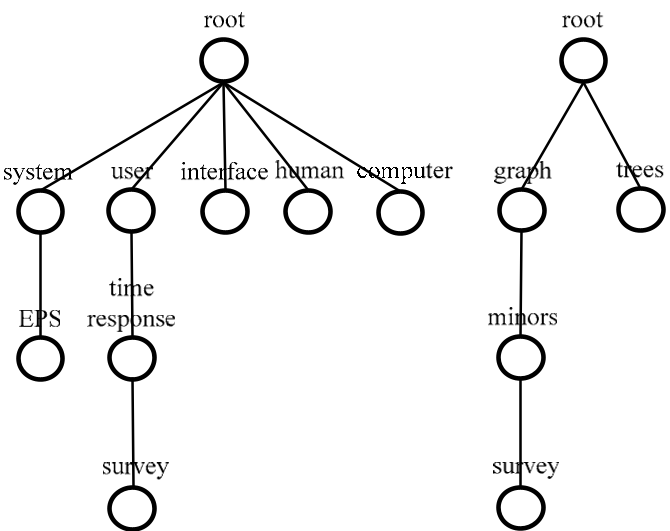
3. Integration via Sequence Pattern Mining
To merge these individual trees, the authors treat paths from root-to-leaf as sequences. They mine Frequent Concept Items to find the "skeleton" of the domain.
- Skeleton Growth: The longest and most frequent pattern becomes the backbone.
- WordNet Alignment: To ensure the ontology isn't just a collection of keywords, the system uses WordNet to find common hypernyms (e.g., linking "Sunny" and "Rainy" under "Weather Condition"), providing a linguistically sound hierarchy.
Experiments: The Weather News Case Study
The authors tested their system on a dataset of 365 weather reports. The experiment demonstrated that the system could take raw daily reports and successfully categorize them into a hierarchy involving temperatures, fronts, and atmospheric conditions.
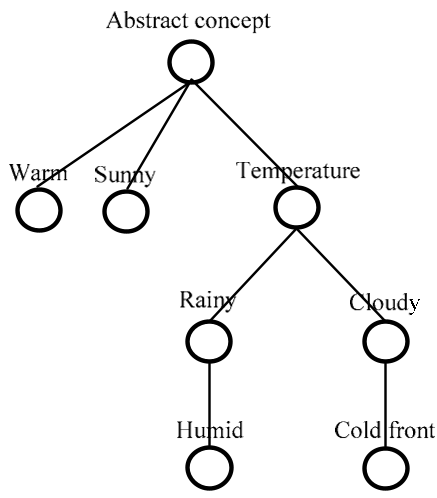
The figure above illustrates the final synthesized ontology, showing how disparate weather concepts are successfully nested under broader categories.
Critical Analysis & Conclusion
The "Clustering-First" Advantage
The standout contribution of this work is the verification that clustering is a prerequisite for quality. By grouping documents first, the FCA algorithm doesn't get overwhelmed by cross-domain noise, resulting in much cleaner concept relations.
Limitations
While the system is robust, it relies on WordNet for its top-level hierarchy. This introduces a dependency: if the domain-specific terms are not well-represented in WordNet (e.g., highly technical medical or legal jargon), the system might struggle to find appropriate hypernyms for the root nodes.
Future Outlook
As we move into the era of LLMs, this "structured" approach remains vital. While LLMs can generate text, they often struggle with maintaining a consistent, verifiable knowledge graph. Integrating this paper's Sequence Pattern Mining with LLM-based entity extraction could be the key to the next generation of "Self-Evolving Knowledge Bases."