
Beyond Strings: Elevating Instance Matching with Ontology Logic
Integration of Ontology Data through Learning Instance Matching
The paper proposes an instance matching method for data-level ontology integration using a Support Vector Machine (SVM) classifier. By incorporating ontology-specific features like concept hierarchy and object property contexts, the approach significantly outperforms traditional string-based matching algorithms.
TL;DR
Integrating decentralized data on the Semantic Web requires more than just matching text—it requires understanding the underlying structure. This paper introduces a machine learning approach that uses Ontology Features (Hierarchy and Object Properties) to train an SVM classifier, achieving significantly higher precision in entity resolution compared to legacy string-matching methods like Edit Distance and TF-IDF.
The Missing Link in Information Integration
The current landscape of ontology research is heavily skewed toward schema-level matching—deciding if "Staff" in one database is the same as "Employee" in another. However, even with a perfectly mapped schema, the data-level (instances) remains messy.
In a decentralized environment, different sources provide different "facets" of the same real-world entity. Prior works often treated these instances as mere strings. But strings are deceptive: "John Smith" at a university could be a Professor or a Student—two distinct entities that a simple string comparison would mistakenly merge.
Methodology: Infusing Semantics into Machine Learning
The authors argue that the Backbone Ontology provides critical "Inductive Bias" that should guide the matching process. They propose a feature vector for an SVM classifier that includes:
1. Concept Distance (CD)
Instead of just checking if names match, the system checks if the categories match.
- If two instances are "Student" and "GraduateStudent", they are taxonomically close.
- If they are "Student" and "Professor" (defined as disjoint concepts), the distance is infinite, and they should never match.
2. Context Similarity (CS)
This explores the "Object Properties" (relationships) of an instance. The system uses reasoning to handle inverse properties. For example, if Source A says Paper1 writtenBy AuthorA and Source B says AuthorA wrote Paper1, the system recognizes these are the same semantic link, increasing the confidence of a match.
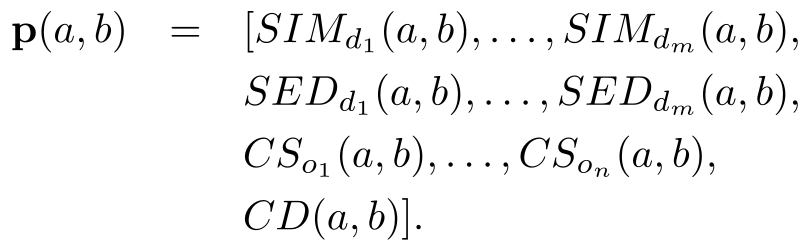 The feature vector combines TF-IDF (SIM), String Edit Distance (SED), Context Similarity (CS), and Concept Distance (CD).
Experimental Validation
The authors tested their method on a dataset of 453 instances from the university domain. The results were clear: while traditional metrics like SED (String Edit Distance) perform well at low recall, their precision collapses as you try to find more matches (high recall).
Performance Comparison
| Recall Level | SIM (TF-IDF) | SED (String) | +ONTO (Proposed) |
|---|---|---|---|
| 0.2 | 0.883 | 0.939 | 0.959 |
| 0.6 | 0.930 | 0.970 | 0.984 |
| 0.8 | 0.927 | 0.453 | 0.968 |
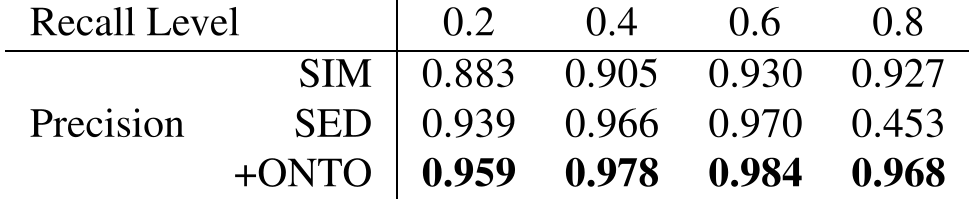
The +ONTO method maintains a precision above 96% even when the recall is high, proving that ontology features act as a powerful filter against "false positive" string matches.
Critical Insight & Future Outlook
The core contribution here is the realization that Data is Context. In a Knowledge Graph era, an entity is defined not just by its name, but by its position in the hierarchy and its relationships with others.
Limitations: The method assumes a "backbone ontology" is already present. In many real-world scenarios, the schema is as fragmented as the data, requiring simultaneous schema and instance matching.
Future Work: Moving forward, the integration of these features into deep learning architectures (like Graph Attention Networks) could further automate the discovery of these semantic relations without manual feature engineering.
Conclusion
By moving from "String Matching" to "Semantic Matching," this research provides a vital bridge for the Semantic Web, allowing autonomous agents to synthesize a complete picture of an entity from fragmented, decentralized data sources.