
Ontology-Driven Semantic Dependency: Breaking the XPath Bottleneck in XML Privacy
Ontology Dependence Closure based on Privacy Association
This paper introduces an <strong>Ontology Dependence Closure</strong> framework designed to resolve the limitations of structural and numerical dependencies in XML data. By redefining semantic constraints through Subject and Entity Primary Keys, the authors establish a formal system of inference rules that generate a semantic dependency closure set for improved data privacy and access authorization.
TL;DR
As big data grows, the hierarchical nature of XML (standardized by XPath) has become a performance anchor, causing "engine crashes" in deep document trees. This paper proposes a transition from structural dependence to semantic dependence, using ontology-based closure sets to streamline data associations. By focusing on what the data represents (Subject/Entity keys) rather than where it is located in a tree, the authors provide a more robust framework for access control and privacy preservation.
The Bottleneck: Why Path-Based Logic is Failing
XML’s self-describing tree structure was its greatest strength, but in the era of Big Data, it has become a liability. The authors identify three critical pain points:
- XPath Rigidity: Everything relies on the unique path from the root. If the tree is deep, the computational cost to reach a leaf node is astronomical.
- Structural Redundancy: The same data (e.g., a Student ID) might appear in multiple paths (e.g.,
school.studentvsschool.course.class.student). Traditional systems treat these differently, leading to data inconsistency. - Access Control Over-Protection: Hierarchical "negative priority" principles often lead to excessive data locking, where hardware energy is wasted on complex conditional judgments.
Methodology: Redefining the "Key" to XML
The core of this work is the re-definition of keys from a semantic perspective, rather than a structural one.
1. Subject and Entity Keys
The authors categorize primary keys into:
- Subject Primary Key (UK): Represents a user entity (e.g., a Student ID).
- Entity Primary Key (EK): Represents a non-user object (e.g., a Course Code).
By making this distinction, the system can determine privacy rules based on who is accessing what, independent of the path used to find them.
2. The Logic of Semantic Dependency (SD)
The paper formalizes Semantic Dependency (SD) as an association where one node's value is functionally or semantically dependent on another, regardless of their location in the DTD.
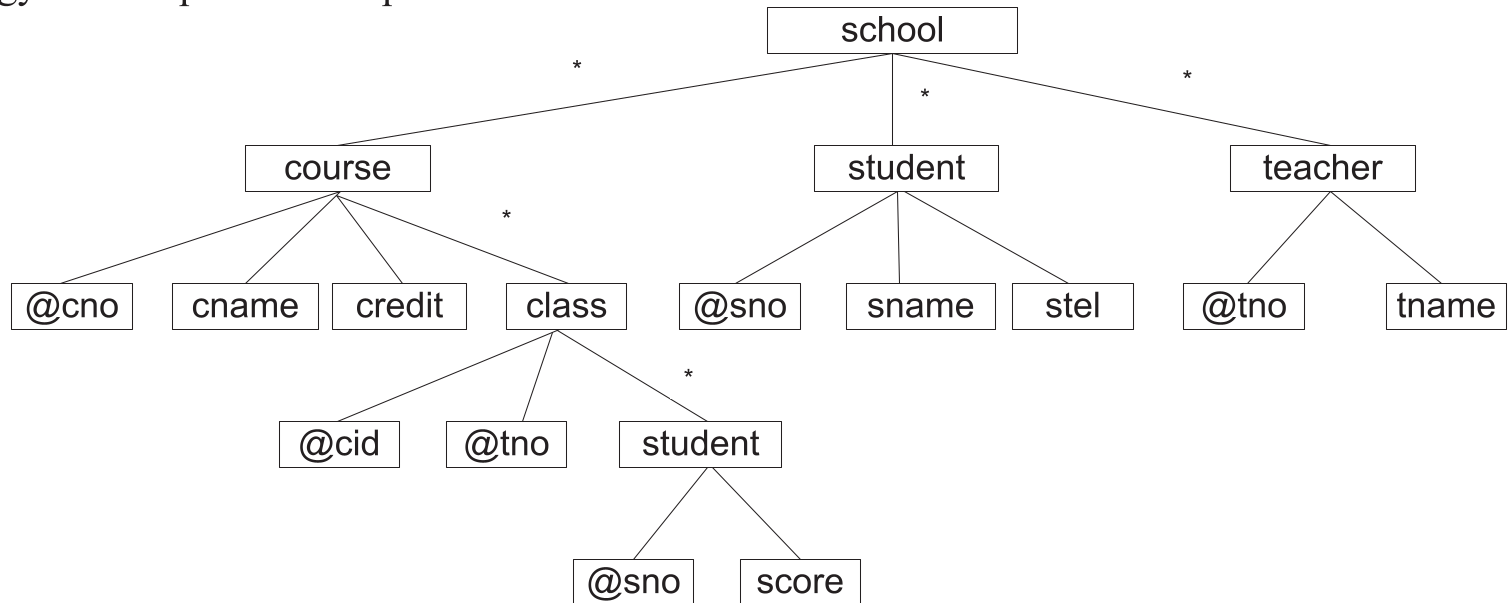 Figure 1: Traditional hierarchical DTD which creates path redundancy.
3. Inference Rules and Closure Sets
To make the system operational, the authors developed six inference rules. These rules allow the system to "infer" new dependencies. For example, if a student ID identifies a name, and a student ID is linked to a course number, the system can derive a closure set—a complete map of all logical connections.
Experiments: Validating the Theory
The authors applied their theory to an elective course management scenario. By utilizing their inference rules, they transformed a complex tree into a Semantic Dependency Closure Set (Table 1 and 2 in the paper).
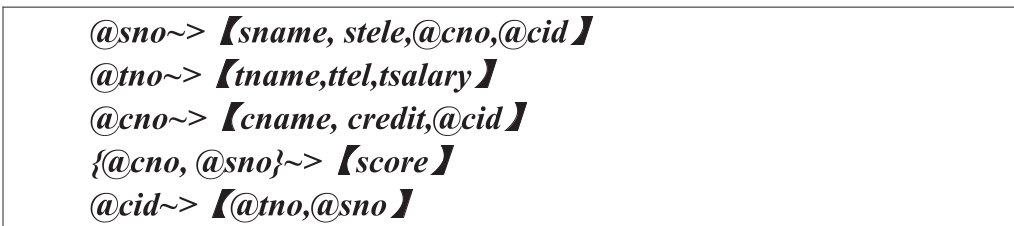 Figure 2: The final closure set, simplified into equivalence classes for direct access authorization.
The mathematical proof provided in the paper confirms two critical properties:
- Validity: Every derived dependency is logically sound.
- Completeness: The rules are sufficient to find all possible semantic dependencies within the defined schema.
Critical Insight: The Future of Data Privacy
The most striking takeaway from this research is the argument that privacy is not a property of data structure, but of data semantics.
In an access control scenario, if a student (ID: S03) logs in, the semantic dependency S03 ~> @cid (Course ID) immediately grants the necessary permissions across the entire database, without requiring the system to traverse every branch of the XML tree to check for school/course/class/student predicates.
Limitations & Outlook
While the theoretical framework is sound, the paper primarily discusses it within the context of DTDs. Future work needs to explore how these semantic closure sets perform in multi-source data fusion environments, such as heterogeneous big data lakes where schemas are not as well-defined as a DTD. Additionally, integrating this with Blockchain technology (as hinted in the acknowledgments) could provide a decentralized way to manage these semantic identity keys.
Conclusion
This paper provides a vital bridge between the rigid world of hierarchical XML and the flexible requirements of modern big data privacy. By focusing on ontology and semantic closure, we can build data systems that are not just faster, but also more intelligent in how they protect sensitive information.