
MARMO: Harmonizing Ontologies and MapReduce to Solve the Big Data Association Rule Deluge
An Ontology-driven MapReduce Framework for Association Rules Mining in Massive Data
This paper introduces MARMO, an ontology-driven MapReduce framework designed for mining Association Rules (ARs) in massive datasets. By integrating semantic pruning into the distributed Maximal Frequent Itemsets (MFI) mining process, the framework significantly reduces the number of redundant rules and improves computational efficiency over traditional parallel AR mining methods.
TL;DR
The paper introduces MARMO, a novel framework that bridges the gap between semantic knowledge and distributed computing. By injecting ontology-driven "semantic pruning" directly into the MapReduce lifecycle, the authors managed to cut down the noise of redundant association rules by over 30%, while simultaneously boosting processing speed compared to standard parallel Apriori implementations.
The Problem: Too Much Data, Too Little Meaning
Association Rule Mining (ARM) has been a staple of data science since the 1990s (the classic "Beer and Diapers" example). However, when applied to Big Data, ARM breaks in two ways:
- Computational Explosion: Algorithms like Apriori require multiple passes over the data, which is devastating for performance in a distributed environment.
- The Rule Deluge: A standard run on a large dataset can generate millions of rules. Most are "redundant"—they convey information already implicit in the data hierarchy or domain knowledge.
Earlier attempts at "semantic filtering" usually happened after the heavy lifting was done. The authors of this paper argue that this is a waste of resources. Why generate a million rules just to delete 700,000 of them?
Methodology: Pruning with a Brain
The core innovation is the Semantic Pruning phase, integrated into the Map and Reduce tasks. Instead of treating items as just "strings" or "IDs," the system consults an Ontology (a formal representation of domain knowledge).
The Two-Stage Pruning
- Phase 1 (In the Mapper): While generating Maximal Frequent Itemsets (MFI), the algorithm checks the ontology. If two items are semantically redundant (e.g., they belong to the same level in a concept hierarchy), they are pruned early. This reduces the search space before data even hits the shuffle phase.
- Phase 2 (In the Reducer): After aggregating results, a second semantic check ensures the final rules generated are non-redundant and high-value.
 Figure 1: The overarching architecture showing the integration of Ontologies into the MapReduce cycle.
Experiments and Results
The authors compared MARMO against MR-Apriori using the Adult and STULONG datasets.
Key Findings:
- Efficiency: As the support threshold decreases (making the task harder), MARMO’s runtime remains significantly lower than MR-Apriori.
- Noise Reduction: In the Adult dataset, for instance, MARMO eliminated 1,079 redundant rules out of 2,924, resulting in a 36.9% precision gain.
- Scalability: The "Time vs. Number of Transactions" curve shows that MARMO handles growth much more gracefully than traditional parallel methods.
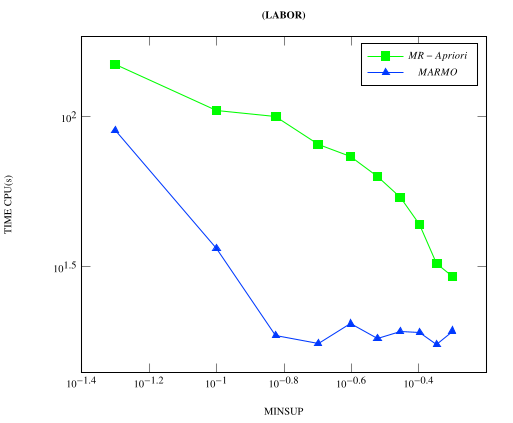 Figure 2: Runtime analysis showing MARMO outperforming MR-Apriori across varying support levels.
Critical Insight: Why This Matters
The real value of this work is the shift from Quantitative reduction (just counting supports) to Qualitative reduction (understanding what the items mean). In a business setting, a manager doesn't need to know that "People who buy 2% milk also buy dairy products"—that's a semantic tautology. By using ontologies to "mute" these obvious rules during the actual mining process, we save both CPU cycles and the end-user's cognitive load.
Conclusion
MARMO proves that Big Data mining isn't just about "bigger hammers" (more nodes); it's about "smarter filters." By making the MapReduce nodes "aware" of the domain they are mining, we can transform a flood of redundant data into a stream of actionable intelligence.
Future Outlook: The next logical step is moving this framework to Lambda Architectures and Spark Streaming to handle high-velocity data, potentially using real-time Knowledge Graph updates to refine the pruning logic on the fly.