
Beyond the Centralized Silo: Ontology-Enabled Privacy in the di.me Ecosystem
Ontology-Enabled Access Control and Privacy Recommendations
The paper presents the di.me project, a decentralized social networking system that utilizes an ontology-based framework to provide user-controlled access control and privacy recommendations. By leveraging semantic technologies and NLP, it detects identity linkability and warns users about unintended information disclosure in live streams.
TL;DR
The di.me project introduces a decentralized "userware" that replaces centralized social networks with a semantic-driven personal server. By integrating multiple online identities into a single Personal Information Model (PIM), it uses Natural Language Processing (NLP) and weighted semantic matching to warn users about identity linkability risks and accidental data leaks in their status updates.
The Linkability Crisis in Modern OSNs
In our current digital landscape, we maintain fragmented identities across LinkedIn, Facebook, and Twitter. While we might attempt to keep a "private" persona separate from a "professional" one, research shows that re-identification rates remain alarmingly high—often exceeding 88%.
The core problem is the lack of semantic awareness. Most platforms treat data as isolated strings; they don't understand that a pseudonym on Flickr and a real name on Twitter both point to the same physical entity. Furthermore, users often post "LivePosts" (microblogs) that contain sensitive context—like tagging a friend who is supposed to be at work—without realizing the privacy implications for others.
Methodology: The Semantic Core
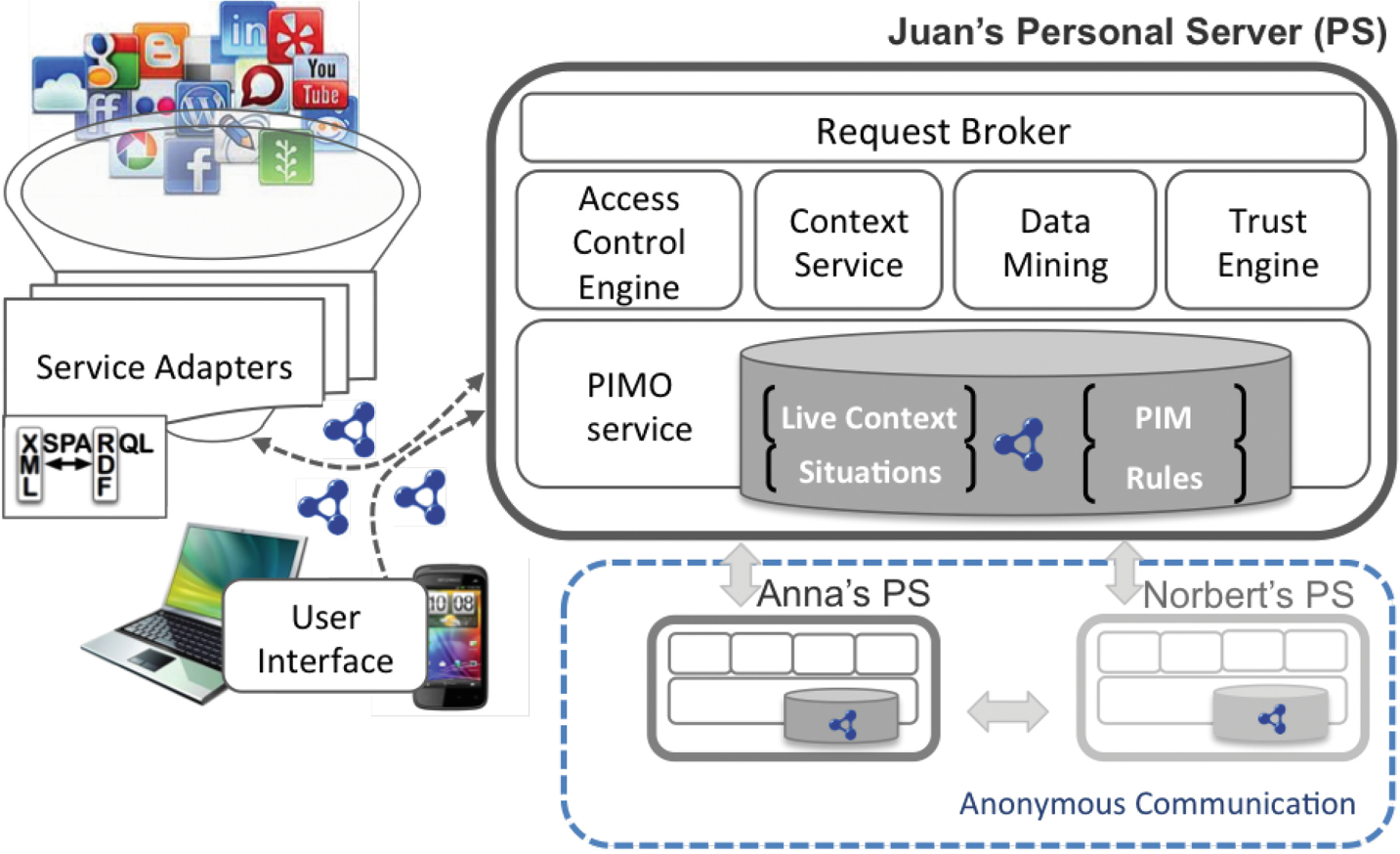
The di.me architecture is built on a two-layer control mechanism that decouples the semantic core from the hosting environment. This ensures that even if you migrate your data to a new server, your privacy rules stay with the data.
1. Semantic Equivalence Detection
To solve the linkability issue, di.me employs a four-step matching pipeline:
- Linguistic Analysis: Breaking down complex strings (e.g., extracting "Bonn" from a full address).
- Syntactic Matching: Using Monge and Elkan recursive algorithms to find string similarities.
- Semantic Expansion: Linking extracted entities (like a company name) to Global Knowledge Bases like DBPedia or the user's private PIM.
- Weighted Scoring: Assigning higher importance to "Inverse Functional Properties" like email addresses over generic attributes like "Country."
2. Privacy-Aware NLP for Live Streams
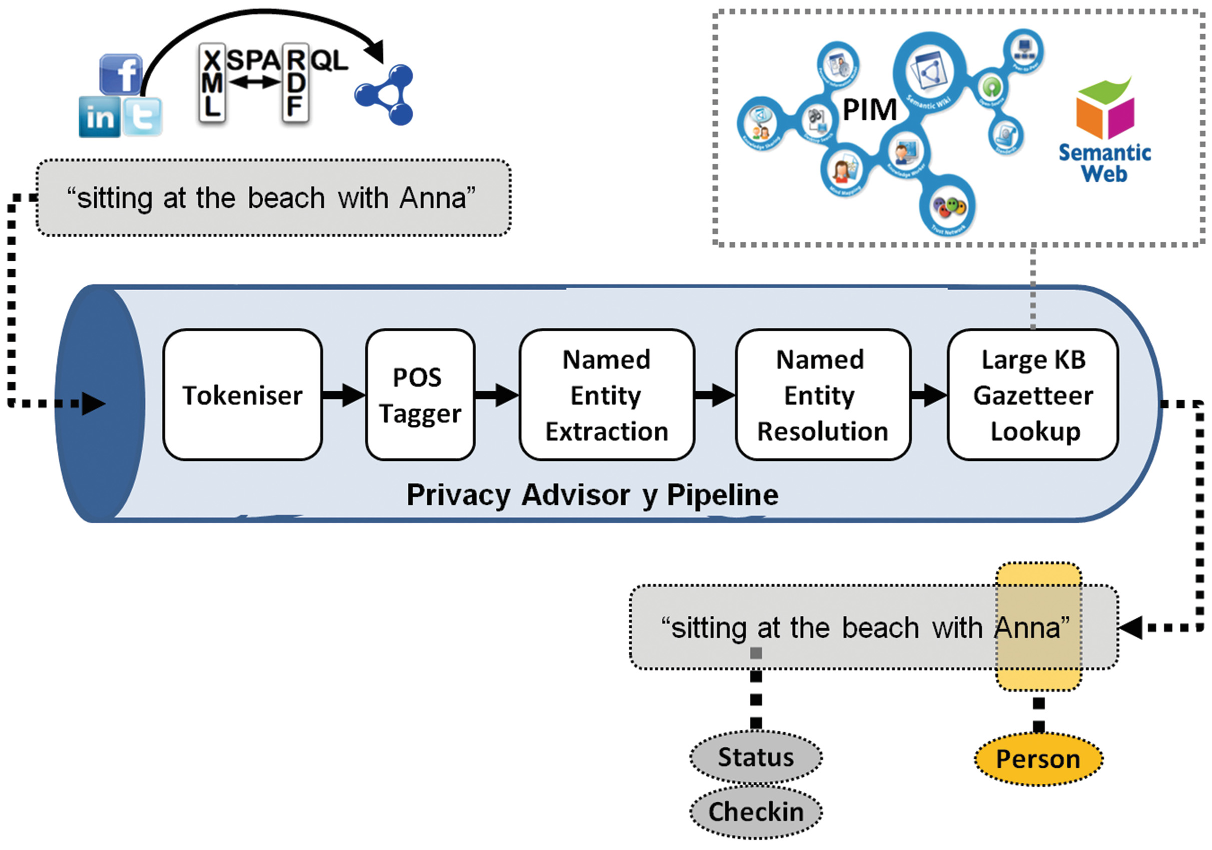
The system doesn't just look at profile settings; it "reads" your posts before they go live. Using the Live Post Ontology (DLPO), the system decomposes a post into its constituent parts: Image, Check-In, and Status.
If the NLP engine detects that you are mentioning a contact ("Anna") alongside a location ("Beach") that contradicts Anna's known private schedule, the system triggers a Privacy Recommendation.
Experimental Validation
The system was validated through large-scale user trials. Key findings include:
- Precision: The semantic matching reached 82% accuracy in identifying equivalent profiles across different networks.
- User Acceptance: 81% of users found the privacy recommendations valuable, highlighting a strong market demand for "Privacy Advisors" in the CRM and Social sectors.
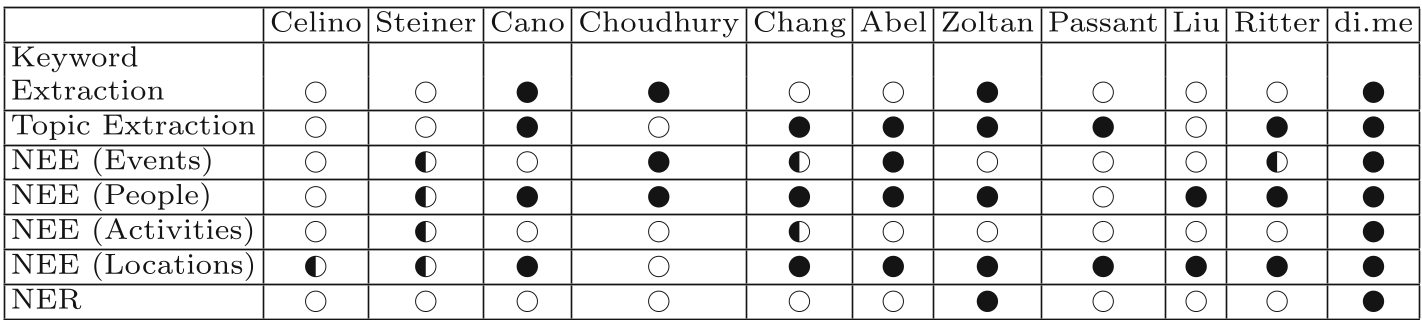
The comparison with other Information Extraction (IE) techniques shows that di.me is one of the few systems that targets all four major named entities (People, Events, Activities, Locations) and links them back to a personal knowledge base for context-aware reasoning.
Critical Insight & The "Sticky Policy" Future
The most impactful contribution of this work is the concept of "Sticky Policies." By attaching ontology-based metadata to shared items, the original owner's intent (e.g., "do not re-share") follows the file even after it enters another person's userware.
While the current implementation relies on user cooperation and decentralized protocols, the logic is highly portable. Even centralized giants could adopt these "Semantic Privacy Guards" to provide more transparent control to their users.
Conclusion
The di.me project moves us away from passive privacy (simply checking boxes) toward proactive privacy. By understanding the meaning of our data through ontologies and NLP, the system becomes an intelligent agent acting in the user's best interest, preventing the "unintentional linkability" that current social media platforms exploit.