
Ontology Enrichment: Bridging the Gap Between Data and Logic with SWRL
Ontology enrichment by discovering multi-relational association rules from ontological knowledge bases
The paper presents a novel method for enriching OWL ontologies by discovering multi-relational association rules coded in SWRL. By integrating terminological axioms and Description Logic positions, the approach discovers hidden knowledge patterns that can induce new assertions and suggest schema-level improvements.
TL;DR
This research tackles the "out-of-sync" problem in the Semantic Web where ontological schemas (TBox) and actual data (ABox) diverge. By introducing a reasoning-aware data mining algorithm, the authors extract multi-relational association rules in SWRL format. Unlike previous "black-box" approaches, this method respects the formal logic of the ontology, ensuring that new knowledge discovered is both consistent and semantically rich.
Problem & Motivation: The Incompleteness of the Webb
In the Semantic Web, ontologies define the vocabulary, but the data—the assertions—is often sparse or noisy. Existing tools for discovering patterns (like AMIE) treat RDF data as flat graphs, ignoring the rich intensional knowledge (the hierarchy of classes and properties) already defined by experts.
The authors identify two core issues:
- Incompleteness: The KB contains no contradictions but lacks critical assertions or disjointness axioms.
- Noisy Data: The KB contains consistent but invalid information.
The "Research Intuition" here is simple yet powerful: Use the reasoner as a filter during the mining process. If a candidate rule contradicts the existing schema, it shouldn't just be ignored—it should be used to prune the search space.
Methodology: Reasoning-Driven Rule Discovery
The system employs a level-wise expansion strategy to find frequent patterns. A pattern starts simple (e.g., a single concept) and is "specialized" by adding atoms.
The Specialization Process
To ensure the rules are efficient and "DL-Safe," the algorithm uses three specific operators:
- Add Concept Atom: Connects a new class to an existing variable.
- Add Role Atom (Fresh Var): Introduces a new variable via a property.
- Add Role Atom (Bound Var): Connects two already existing variables.

Pruning: The Smart Filter
What sets this work apart is the EVALUATEPATTERNFORPRUNING function. It checks:
- Consistency: Does
Ontology + Rulelead to a contradiction ()? - Head Coverage: Is this pattern representative or just an outlier?
- Confidence Improvement: Does adding this atom actually make the rule more predictive?
Experiments & Results: Precision over Noise
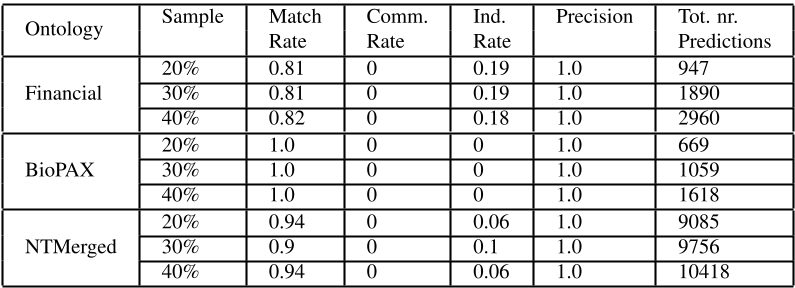
The authors tested their method against the state-of-the-art (SOTA) system AMIE using the Financial, BioPAX, and NTMerged ontologies.
Key Findings:
- Logical Integrity: The method achieved a 0% Commission Error Rate. This means every single assertion predicted by the rules was logically consistent with the full ontology.
- Discovery Power: In the BioPax ontology, their method found nearly 300 valid rules where AMIE found less than 10.
- Induction: The rules were able to "guess" facts that were not logically derivable, filling in the gaps of incomplete datasets.
Comparison with SOTA (AMIE)
While AMIE is faster because it ignores the schema, this method produces higher quality rules because it understands the hierarchy. For example, if a rule predicts something is a "Father," this system knows it is redundant to also predict it is a "Parent" because of the TBox subsumption ().
Critical Analysis & Conclusion
Takeaway
This paper proves that semantics matter in data mining. By bridging the gap between Inductive Logic Programming (ILP) and Description Logics, the authors have provided a viable pathway for "self-healing" ontologies that grow more robust as more data is added.
Limitations & Future Work
- Scalability: Reasoning is computationally expensive. Running a reasoner at every step of a level-wise search limits this to medium-sized ontologies.
- Rule Complexity: Currently, the rules are primary Horn-clauses.
- Future Path: The authors suggest using indexing and caching for reasoning results to scale to the massive Linked Open Data (LOD) cloud.
In the era of Knowledge Graphs, this work serves as a foundational bridge between raw data patterns and formal machine reasoning.