
Beyond Direct Interaction: Mapping Interest Congruence via Ontological Navigation
Ontology Facilitated Community Navigation -Who Is Interesting for What I m Interested in?
This paper introduces an ontology-facilitated approach for community navigation, specifically designed to interlink individuals with shared interests who lack direct social ties. By integrating user-weighted ontologies with Social Network Analysis (SNA), the authors developed the "Conavi" tool to visualize and recommend relevant experts and peers within large-scale online forums.
TL;DR
In large online communities, who you talk to defines your network, but what if your most valuable contact is in a different sub-forum entirely? This paper proposes an ontology-enhanced social network analysis that detects "interest congruence" between strangers. By leveraging semantic relationships between topics (e.g., knowing that "Dismissal" is a subtopic of "HR Management"), the authors' Conavi system builds bridges across social silos, recommending experts based on conceptual alignment rather than just chat history.
Problem & Motivation: The "Invisibility" of Distributed Expertise
Standard Social Network Analysis (SNA) is great for mapping who talks to whom, but it suffers from a major limitation: it cannot find links that don't exist yet.
In massive forums, users tend to stay within their niche. Two people might be world-class experts in related fields, but if they never post in the same thread, they remain invisible to each other in a traditional sociogram. Existing solutions like expertise tracking often fail because they confuse "talkativeness" with "knowledge" or struggle with "free-riders" who consume info without creating trackable social edges. The authors argue that we need to stop looking only at the people and start looking at the objects (topics) they interact with as mediators of interest.
Methodology: Folding the Semantic Space
The core innovation is a hybrid approach that merges SNA with User-Weighted Ontologies.
1. Hybrid Actor-Topic Networks
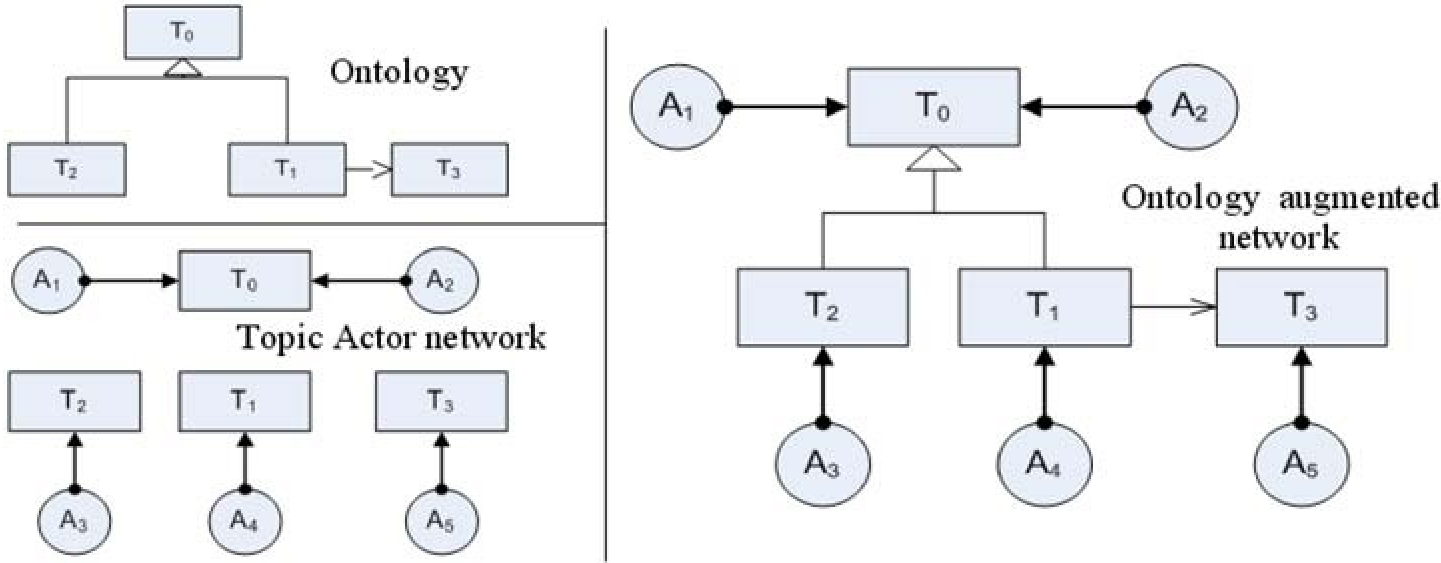
The system treats both people (agents) and topics (conceptual objects) as nodes in a bipartite graph. To bridge two people who haven't met, the system uses an ontology—a structured map of how topics relate to each other.
2. The Weighting Mechanism
Not all topic relations are equal. The authors allow for user-specific weighting:
- Is-a relations: A general interest in "Programming" likely implies an interest in "Python."
- Path Distance: Interest decays as the distance between concepts in the ontology increases.
- Damping Factor: To calculate "folded" links, the system uses a transformation matrix where the weight of a suggested connection is the reciprocal of the shortest path between topics.
Experiments & Results: Making the Invisible Visible
The authors tested their system on a forum for freelancers. In one case study, a user (P300) had only posted in a niche thread about "Dismissal."
- Traditional SNA: Only recommended one other person who posted in that exact thread.
- Conavi System: Recognized "Dismissal" as a subtopic of "Human Resource Management." It "folded" the network, connecting P300 to a wide array of experts in the broader HR category.
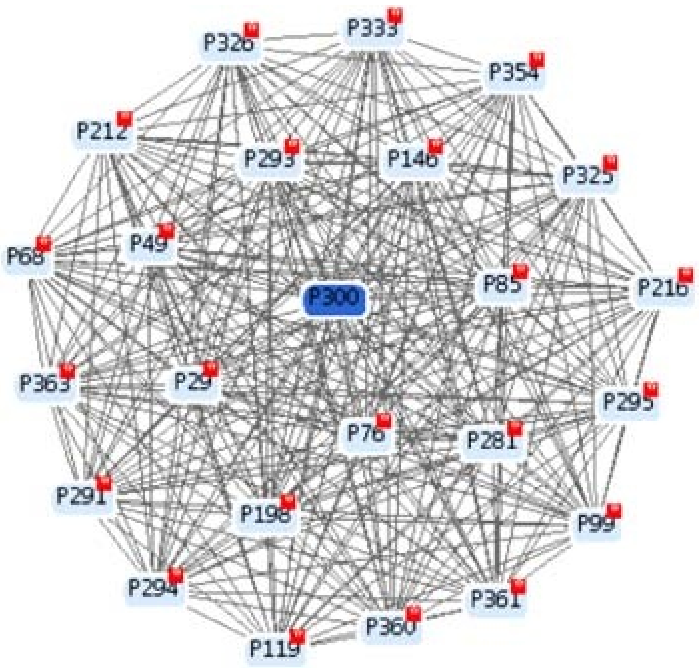
The result is a person-person network where edge weights represent potential interest congruence. This allows users to filter out "weak" links and focus on highly relevant potential collaborators.
Critical Analysis & Conclusion
The Takeaway
The true value of this work lies in its shift from interaction-based networking to intent-based networking. By using ontologies as "boundary objects," the researchers provide a mathematical framework for serendipity—helping users find exactly who they need to know, even if they've never shared a digital room.
Limitations & Future Work
The primary bottleneck identified is the manual classification of threads into ontological categories. While the 2006 context of the paper suggests using SVMs or k-means for automation, a modern implementation would likely utilize Large Language Models (LLMs) to perform zero-shot mapping of forum content to complex knowledge graphs.
This approach paves the way for "Shared Information Spaces" where our digital footprints are analyzed not just for where we've been, but for the conceptual destination we are trying to reach.