
OntoRecommender: Bridging Semantic Gaps in Scholar Information Retrieval
Ontology-Supported Web Recommender for Scholar Information
The paper introduces OntoRecommender, an ontology-supported web recommendation system designed to extract and suggest scholarly information. It integrates domain ontology with data mining tools (SPSS Clementine) and the CKIP segmentation system to achieve hybrid filtering (Content-based and Collaborative) for academic data like courses and research activities.
TL;DR
OntoRecommender is a hybrid recommendation system that leverages Domain Ontologies and Data Mining (SPSS Clementine) to accurately classify and recommend scholarly resources. By moving beyond simple keyword matching to a semantic-weighted model, it achieves high reliability (up to 0.856) in identifying relevant courses and academic activities.
Background & Motivation: The Keyword Dilemma
In the era of "information explosion," searching for specific academic expertise is surprisingly difficult. General-purpose search engines like Google rely heavily on keywords, but this approach fails in two critical scenarios:
- Semantic Ambiguity: The same keyword holds different values across different research fields.
- Incomplete Intent: User queries are often too brief to capture the full context of the scholarly demand.
The authors argue that Ontology—a formal representation of knowledge—is the key to solving these issues by providing a shared semantic model that understands the relationship between entities, attributes, and domains.
Methodology: The Core Architecture
The OntoRecommender workflow is a sophisticated pipeline that transitions from raw web data to structured academic insights.
1. The Ontology Foundation
The team built a knowledge base derived from prominent AI and Fuzzy System associations in Taiwan. Each keyword is assigned a weight based on its frequency in professional profiles (e.g., "Deep Learning" might appear in 9 out of 10 expert pages, giving it a 0.9 weight).
2. Processing Pipeline
The system follows a rigorous sequence:
- Segmenting: Using the CKIP system for Chinese natural language processing.
- Fixing: Refining segmentation errors (e.g., ensuring "National Taiwan University" isn't split into separate, meaningless entities).
- Mining: Using SPSS Clementine (following the CRISP-DM standard) to perform association analysis and classification.
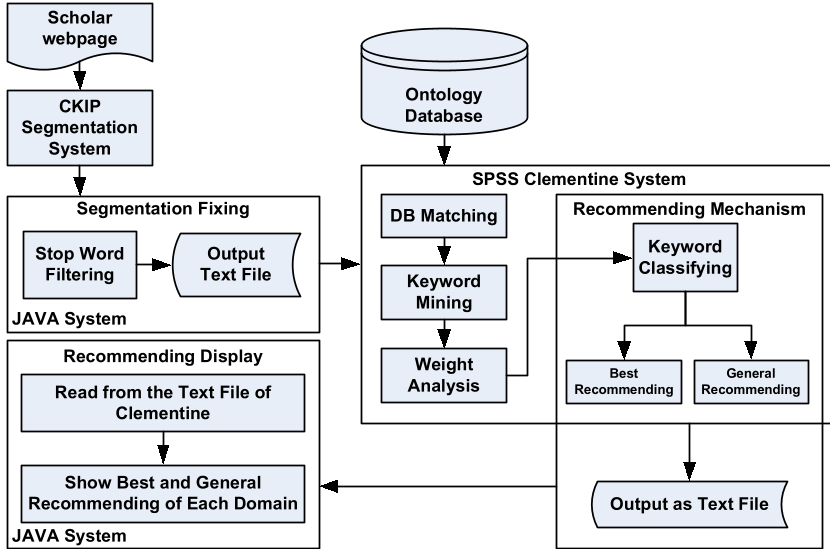 Fig. 1: The operation structure of OntoRecommender, showcasing the transition from CKIP segmentation to SPSS mining.
Experiments and Quantitative Analysis
The effectiveness of a recommender is measured by Reliability (stability of the tool) and Validity (correctness of the reflection). The authors use a mathematical model to calculate these coefficients:
Where is error variance and is observed variance.
Key Breakthroughs:
- Precision in Classification: The system achieved high accuracy in categorizing scholars into specific domains like AI, Fuzzy Systems, or Neural Networks.
- High Recommendation Scores:
- Courses: Mean Reliability of 0.856.
- Academic Activities: Mean Reliability of 0.756.
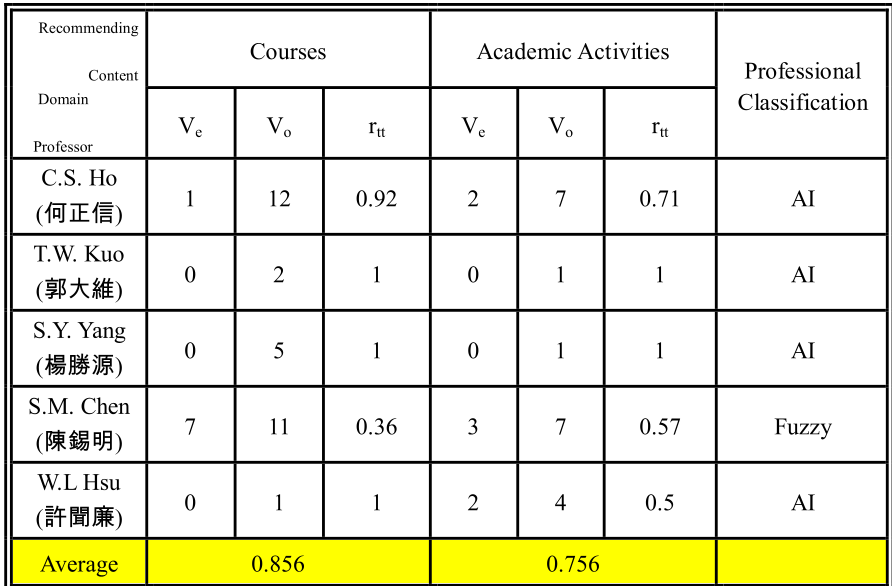 Fig. 2: Quantitative breakdown of recommendation reliability () across different academic domains.
Critical Insight: Why it Works
Unlike black-box neural networks, OntoRecommender uses Heuristic Intuition. By explicitly modeling the synonym/keyword relationship in an ontology, the system eliminates "man-made subjective factors" in information analysis. It combines Content-based Filtering (judging if a page fits a domain) with Collaborative Filtering (recommending courses based on what similar scholars teach), creating a robust "Hybrid" approach.
Summary and Future Outlook
OntoRecommender proves that ontology-supported data mining is a feasible and reliable technique for scholarly web recommendations. While state-of-the-art Large Language Models (LLMs) now dominate NLP, the structural grounding provided by ontologies remains vital for accuracy and interpretability in vertical domains.
Future Directions:
- Continuously expanding the ontology database to cover more diverse disciplines.
- Integrating real-time data crawling to keep academic profiles synchronized with current research trends.
- Developing middle-ware to bridge manual mining tools with automated web interfaces.