
Beyond Blind Faith: A Formal Ontology of Trust and Its Transitivity
An ontology of trust: formal semantics and transitivity
This paper presents a formal "Ontology of Trust" using situation calculus to provide a rigorous logical foundation for the Semantics of Trust. It distinguishes between "Trust in Belief" and "Trust in Performance," providing a formal proof that Trust in Belief is transitive, which justifies trust propagation in social networks and Web-of-Trust applications.
TL;DR
In the decentralized landscape of the Semantic Web, we are forced to interact with "strangers." This paper provides the mathematical "glue" for these interactions by formalizing an Ontology of Trust. By using Situation Calculus, the authors prove that while you might not trust a stranger's performance directly, you can logically inherit that trust through a chain of "Trust in Belief."
The Problem: Is "Trusting a Friend of a Friend" Mathematically Sound?
We often hear that trust is the "reduction of complexity" in social life. On the Web, this manifests as social network-based trust (A B C). However, most existing models treat trust like a simple number—if A trusts B at 0.9 and B trusts C at 0.9, A trusts C at 0.81.
The problem is that this assumes trust is transitive, which it often isn't. (If I trust my mechanic to fix my car, and my mechanic trusts his surgeon to perform surgery, I certainly don't trust my mechanic to perform surgery on me).
The authors argue that without a formal semantic definition, we cannot know when trust propagation is valid and when it is a logical fallacy.
Methodology: Deconstructing Trust with Situation Calculus
The authors define trust as a combination of:
- Expectancy: Expecting a specific behavior.
- Belief: Faith that the expectancy will be met based on competence.
- Willingness to be Vulnerable: Accepting the risk of being wrong.
They formalize this using Situation Calculus, treating trust as a fluent (a property that changes across situations). They identify two critical "flavors" of trust:
- Trust in Performance (): Trusting an entity to do something (e.g., provide high-quality goods).
- Trust in Belief (): Trusting an entity's judgment (e.g., trusting a partner's recommendation of a supplier).
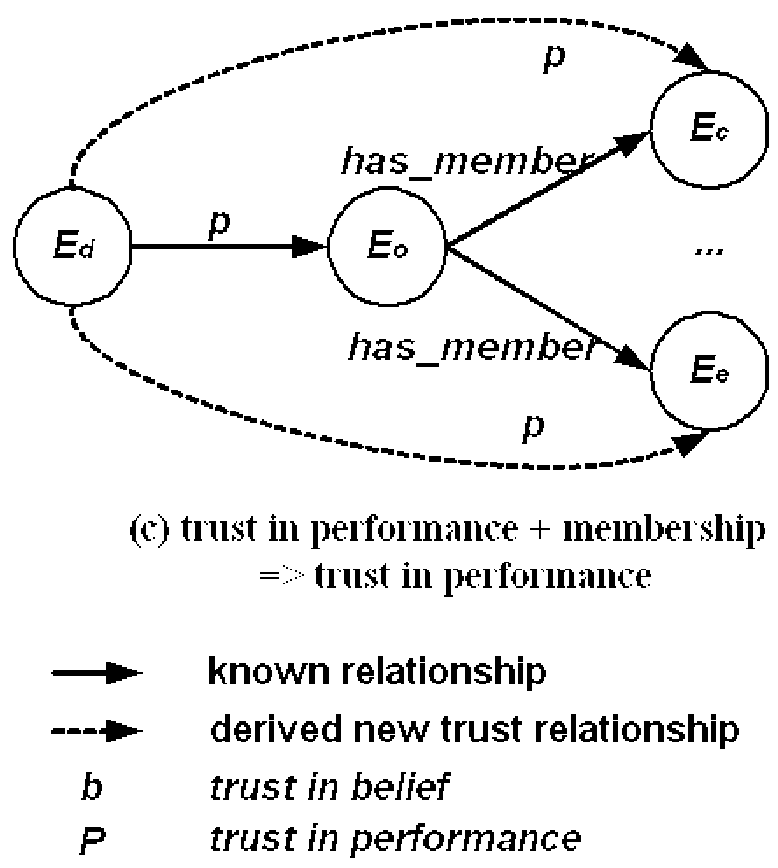 Figure 1: The logic flows of trust propagation. Note how Trust in Belief acts as the bridge.
The Core Breakthrough: Proving Transitivity
The paper’s "Holy Grail" is Theorem 8. It provides the formal proof that while performance trust is not transitive, Trust in Belief is.
The Logic Flow:
If Trustor A trusts Trustee B regarding what B believes (), and Trustee B trusts Trustee C regarding what C performs (), then Trustor A logically inherits trust in C's performance.
This works because if B believes C is competent, and A believes B's judgment is correct, then A must believe C is competent.
Comparison Table: Inter-individual vs. Relational vs. System Trust
| Source Type | Mechanism | Example |
|---|---|---|
| Inter-individual | Direct Experience | F trusts P because they've worked together for years. |
| Relational | Transitive Propagation | F trusts J because F trusts P's belief, and P trusts S, who trusts J. |
| System | Institutional Compliance | F trusts J because J has an ISO-9000 certification. |
Experimental Validation: Case Studies
The authors apply their ontology to a B2B "Gift Company" scenario. Through a series of logical derivations (Axioms 1-4), they demonstrate how a software agent can autonomously decide to trust a new porcelain manufacturer () based on a chain of existing business relationships.
 Above: The formal derivation proving that Trustor F can accept the performance of Manufacturer J via mid-stream belief trust.
Critical Insights & Future Outlook
The primary takeaway is that context is the boundary of trust. You cannot simply "trust" someone; you trust them in a context (e.g., porcelain quality). The transitivity only holds if the contexts overlap or satisfy one another.
Limitations: The current model is a certainty model (binary trust). In the real world, trust is rarely 100% or 0%. The authors acknowledge that the next step is integrating uncertainty (probability/fuzzy logic) into this formal framework.
Conclusion: By moving trust from "vague social concept" to "formal logical property," this work enables the creation of autonomous agents that can safely navigate the "Web of Trust" without human intervention.