
PROMPTDIFF: Beyond Textual Diffing—How Structural Heuristics Revolutionize Ontology Versioning
O n t o l o g i e s Ontology Versioning in an Ontology Management Framework
The paper introduces PROMPTDIFF, a structural diff algorithm for ontology versioning within the PROMPT management framework. It leverages an extensible set of heuristic matchers and a fixed-point algorithm to automatically identify changes between ontology versions, achieving high precision in mapping concepts without relying on change logs.
TL;DR
Ontologies are the backbone of the Semantic Web and medicine, but tracking their evolution is a nightmare for developers. Unlike software code, ontologies can remain conceptually identical while their text files look completely different. Enter PROMPTDIFF, a component of the PROMPT framework that uses a fixed-point algorithm and structural heuristics to find the "semantic diff" between ontology versions with over 90% precision, even when change logs are missing.
The Problem: Why git diff Fails Ontologies
In software engineering, a diff compares lines of text. However, an ontology is a graph of classes, slots, and relations. You could reorder the definitions in a file or change the storage syntax (from RDF/S to OWL), and while the text changes drastically, the knowledge remains the same.
The authors identify a critical gap: as ontology development becomes collaborative and decentralized, we cannot rely on developers to keep perfect change logs. We need a tool that looks at the structure—how nodes are connected, what attributes they have, and their hierarchies—to tell us what actually changed.
Methodology: The Fixed-Point Structural Diff
The core of the paper is the PROMPTDIFF algorithm. It treats ontology comparison not as a text-matching task, but as a graph-mapping problem.
1. The Fixed-Point Approach
The algorithm operates on a "monotonicity principle": once a match is made, it is never retracted. It runs an extensible set of matchers in a loop. Results from one matcher (e.g., "these two classes have the same name") provide context for the next (e.g., "since their parents match, these unique subclasses must also match").
2. Heuristic Matchers
The authors describe several powerful heuristics:
- Same Name/Type Matcher: The simplest "anchor." If a class is named
Winein both versions, they likely match. - Single Unmatched Sibling: If everything else in a hierarchy matches except for one node in V1 (
Blush wine) and one in V2 (Rosé wine), they are mapped as the same concept despite the name change. - Inverse Relation Matcher: If two slots are matches, their inverse slots (like
makesandproduced_by) are also likely matches.
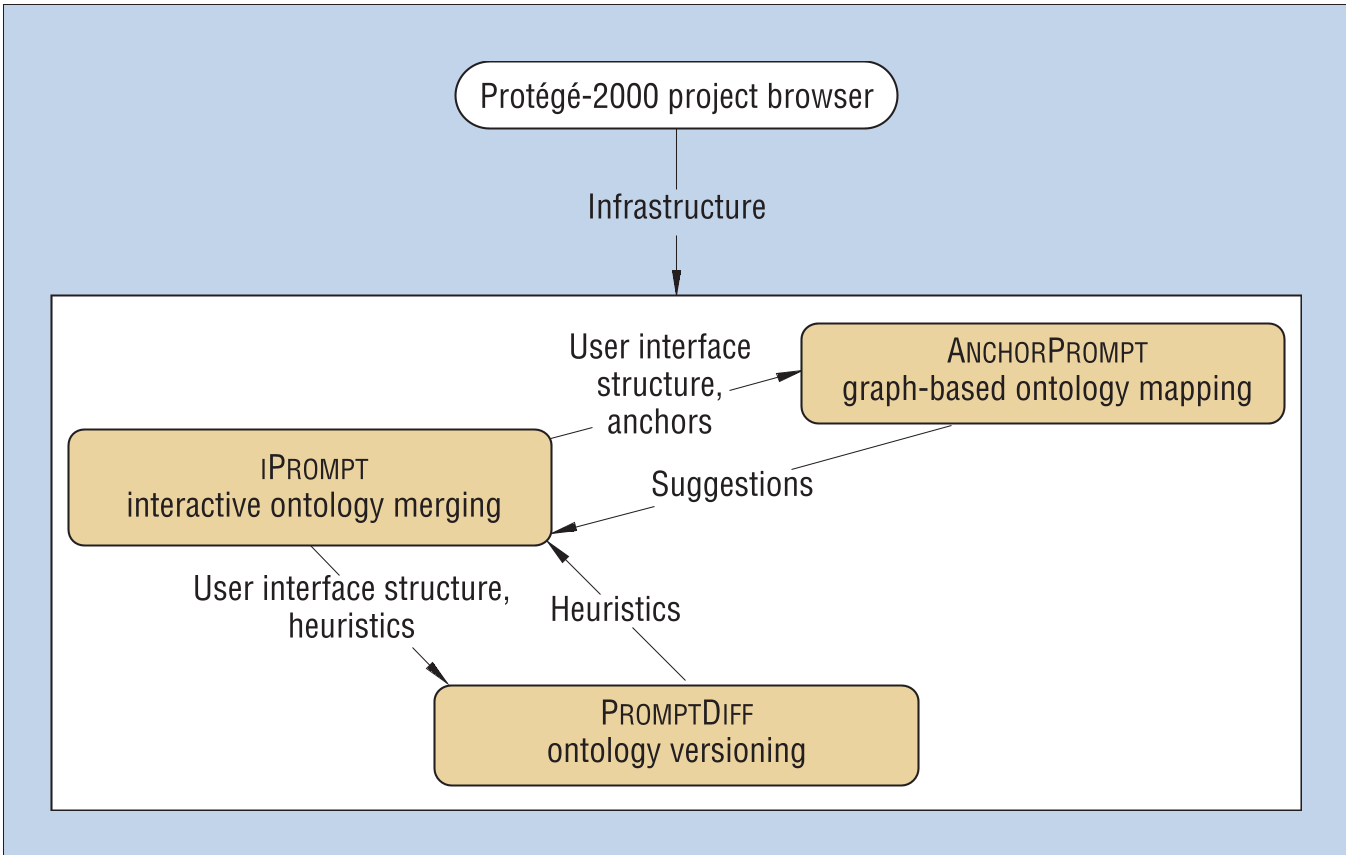 Figure 1: The PROMPT framework integrates merging (iPROMPT), graph-based matching (AnchorPROMPT), and versioning (PROMPTDIFF).
Experiments: Slashing Human Effort
The researchers tested PROMPTDIFF on substantial real-world datasets like PharmGKB. In one experiment involving nearly 1,900 concepts, they found that while 83 frames had changed, the algorithm narrowed the human review task down to just 19 frames.
Key Metrics:
- Recall: 96% (It finds almost every change a human would).
- Precision: 93% (When it says it found a match, it is almost always right).
- Efficiency: On average, 97.9% of an ontology remains stable between versions; PROMPTDIFF lets users focus exclusively on the volatile 2.1%.
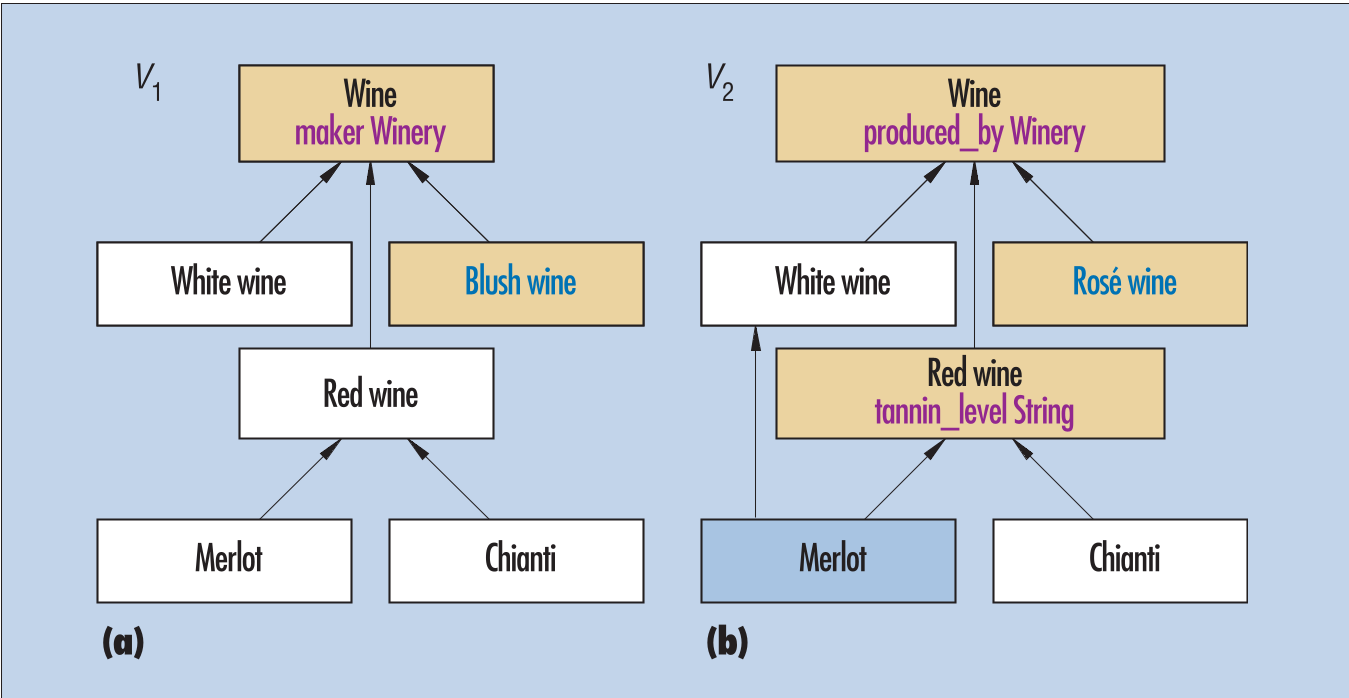 Figure 2: Visualizing changes (shading) between wine ontology versions—renaming, adding slots, and changing hierarchies.
Critical Insight: The Synergy of Management Tasks
The paper's most profound takeaway is that Ontology Merging and Ontology Versioning are two sides of the same coin.
- In Merging, we look for similarities between different sources.
- In Versioning, we look for changes (differences) between the same source.
By building these tools into a single framework (Protégé), the authors show that a heuristic developed for merging (like identifying similar slot ranges) can be "tightened" and used for versioning with even higher confidence.
Conclusion & Future Work
PROMPTDIFF shifts the paradigm from "tracking edits" to "analyzing structures." While it performs exceptionally well, the authors acknowledge that it might miss nuances that only a human could catch (e.g., purely semantic synonyms like Finding vs. Physical_Finding without structural clues).
The next frontier is using these structural diffs to generate Transformation Scripts, allowing data to migrate automatically from an old version of an ontology to a new one—the "holy grail" of automated knowledge management.