
OpenDeepThink: Scaling Reasoning Breadth via Bradley–Terry Population Dynamics
OpenDeepThink: Parallel Reasoning via Bradley–Terry Aggregation
OpenDeepThink is a parallel test-time compute framework that scales LLM reasoning breadth through a population-based evolutionary loop. Using pairwise Bradley–Terry aggregation for selection and natural-language critiques for mutation, it elevates Gemini 3.1 Pro's Codeforces Elo by +405 points without requiring external verifiers.
TL;DR
Researchers from UCSD, Princeton, Berkeley, and UW have introduced OpenDeepThink, a training-free, verifier-free framework that scales LLM test-time compute by evolving a population of candidate solutions. By replacing biased pointwise scoring with pairwise Bradley–Terry ranking and using comparative feedback to drive mutations, they achieved a +405 Elo boost on Codeforces, matching the gains of specialized reasoning models like Gemini 3 Deep Think.
Problem & Motivation: The Selection Bottleneck
Test-time compute scaling is the current "Holy Grail" of LLM research, popularized by models like OpenAI’s o1 and DeepSeek-R1. However, most approaches follow two paths:
- Sequential Scaling: Making a single "Chain of Thought" longer. This is slow (high wall-clock time) and brittle (one wrong step ruins the whole chain).
- Parallel Scaling (Best-of-N): Sampling many solutions. This is fast but requires a way to pick the winner.
The authors argue that pointwise judging (asking an LLM "Is this solution correct?") is fundamentally flawed due to positive bias—LLMs are great at recognizing correct answers but terrible at rejecting subtle bugs. OpenDeepThink solves this by shifting from "Is this good?" to "Which of these two is better?"—a much easier discriminative task for the model.
Methodology: Evolution without an Oracle
OpenDeepThink treats reasoning as an evolutionary process. It doesn't need a compiler or hidden test cases; the LLM itself acts as the "environment" through three main steps:
1. Pairwise Bradley–Terry Selection
Instead of scoring candidates 1-10, the model compares random pairs. These results are aggregated using the Bradley–Terry (BT) model, which calculates a global strength score for each candidate. This handles the noise of "incomplete" comparisons (where every candidate hasn't faced every other candidate).
2. Feedback-Driven Mutation
The top 75% of solutions are mutated. Crucially, the mutator is given the natural-language critiques generated by the judge during the pairwise comparison. If a solution lost a "match," the judge’s explanation of why it lost becomes the prompt for the next generation's improvement.
3. Architecture of the Pipeline
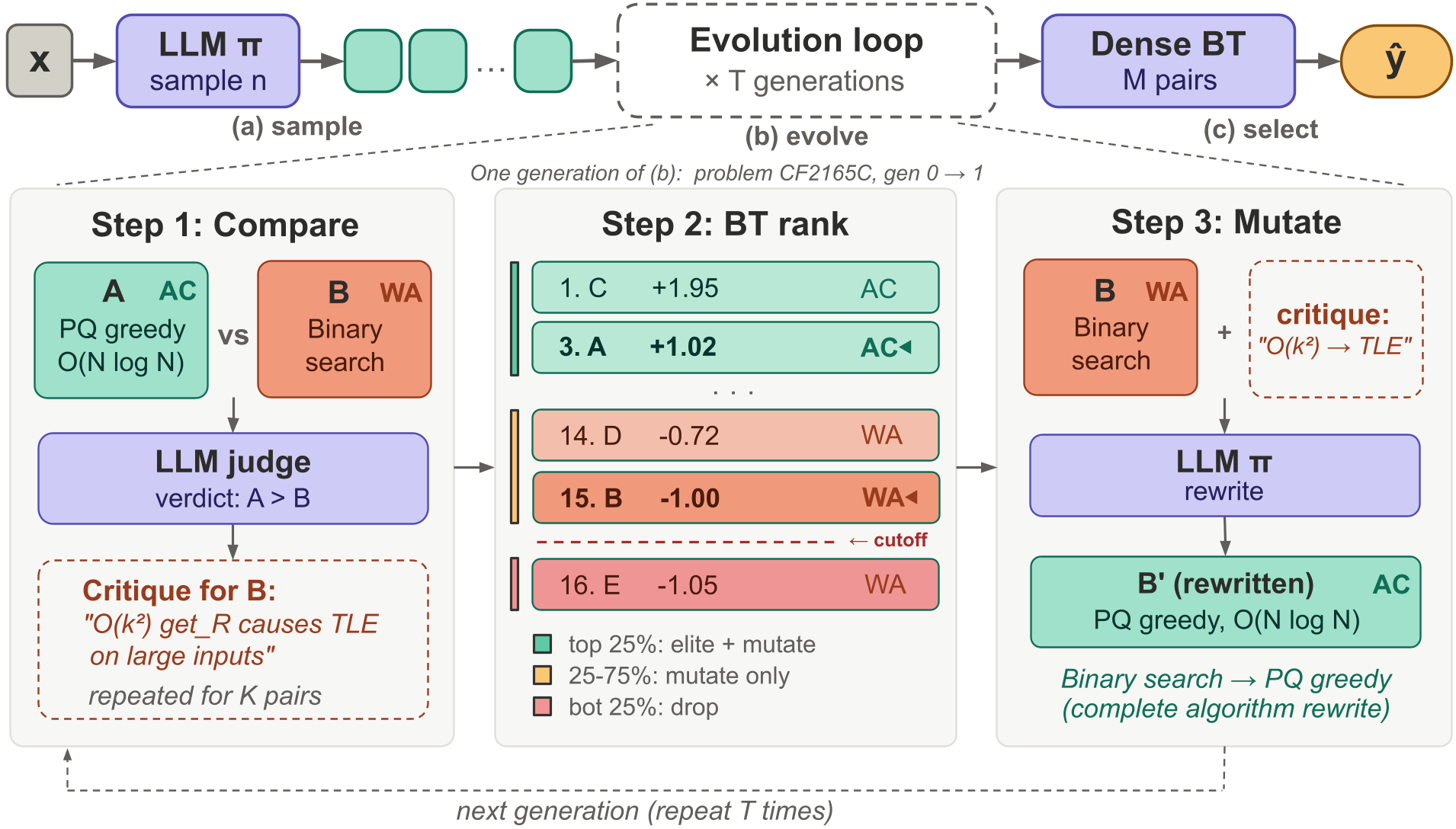 The iterative loop: Sample -> Compare -> Aggregate -> Mutate -> Selection.
Experiments & Results: Amplifying Partial Competence
The authors tested the framework across 192 competition-level programming problems (including a new expert-curated set, CF-73).
- The "Hard" Tier Breakthrough: On problems where the base model (Gemini 3.1 Pro) only had an 11% success rate, OpenDeepThink pushed the final accuracy to 50%.
- Elo Gains: The system provided a +405 Elo lift, essentially turning a "standard" model into a "reasoning" model through pure inference-time orchestration.
- Universal Transfer: The same hyperparameters worked across Gemini 3 Flash and Gemini 2.5 Pro without any specific tuning, suggesting the "population-based search" is a general property of LLM scaling.
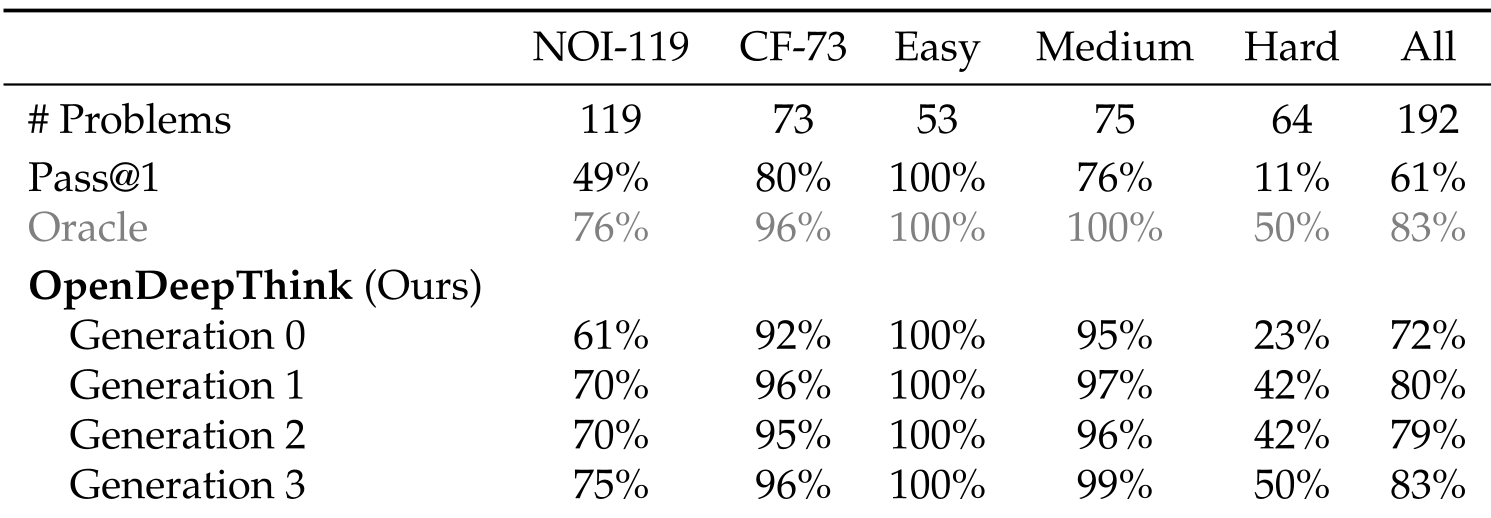 Table 1: Evolution consistently raises the ceiling on Hard problems while selection (BT) extracts the best remaining candidates.
Critical Analysis: Where the Judge is Law
The framework's primary strength is its verifier-free nature. However, it reveals a double-edged sword: the "Soft Verifier" is only as good as the model's ability to discriminate.
In the Humanity’s Last Exam (HLE) benchmark, performance actually declined in subjective fields like Humanities. Why? Because the LLM judge couldn't reliably pick a "winner" in subjective tasks, leading the evolutionary loop to amplify noise rather than signal.
Another key insight is the "License to Abandon": the authors found that mutation only works if the model is explicitly told it can throw away its current code and start over. Without this, models tend to apply "local patches" to fundamentally broken logic.
Conclusion
OpenDeepThink provides a blueprint for "thinking in parallel." By using Bradley–Terry aggregation, it bypasses the bias of pointwise evaluation and proves that iterative, population-based evolution is a viable alternative to ultra-long sequential chains of thought. For developers and researchers, the takeaway is clear: if you have the parallel compute, spend it on competition and mutation, not just more samples.
Takeaway: The bottleneck for LLM reasoning isn't just generating the right answer—it's having a robust enough mechanism to recognize it when it appears.