
Turning Mobile Networks into Semantic Data: The Power of Live Crowdsourcing
13294_Turning the OpenMobileNetwork into a live crowdsourcing platform for semantic context-aware services.
The paper introduces the evolution of the OpenMobileNetwork into a live crowdsourcing platform that utilizes Linked Data principles and gamification to map mobile network topologies. It integrates dynamic network context data (traffic, service usage) with static topologies to enable advanced Semantic Context-aware Services (CAS).
TL;DR
The OpenMobileNetwork project transitions from a static data repository to a live, semantic crowdsourcing platform. By merging Linked Data principles with gamification, the researchers have created a system that not only maps where cell towers are but also understands their real-time state—such as current traffic and active services. This "Live" approach enables revolutionary Semantic Context-aware Services (CAS), such as dynamically deactivating low-traffic cells to save energy.
The Problem: The "Secret" Topography of Our Airwaves
For years, mobile network topology has been a "black box" held tightly by operators. While giants like Google and Apple have built massive proprietary databases, open-source alternatives like OpenCellID have struggled with two major issues:
- Static Data: They only know where a cell is, not how it's currently performing.
- The Motivation Gap: Why would a user spend their battery and time mapping networks? Without incentives, data is often clustered only on main highways, leaving rural areas as "blind spots."
Methodology: Gamifying the Airwaves
The authors solve the data scarcity problem through a sophisticated Measurement Framework that balances two distinct collection modes:
1. The Gamified Incentive: Jewel Chaser
Instead of asking users to "perform measurements," the platform offers a game. Users collect virtual jewels at specific locations. Crucially, the system uses a Location Provider (shown in Figure 2) that calculates "Framework Measurement Locations" (FMLs)—spots where the database is missing data—and places rewards there to guide users.
2. The Semantic Backbone: Multi-Layered Ontologies
The real magic happens in how the data is stored. By using RDF ontologies, the network isn't just a list of coordinates; it’s a living graph linked to DBpedia and LinkedGeoData.
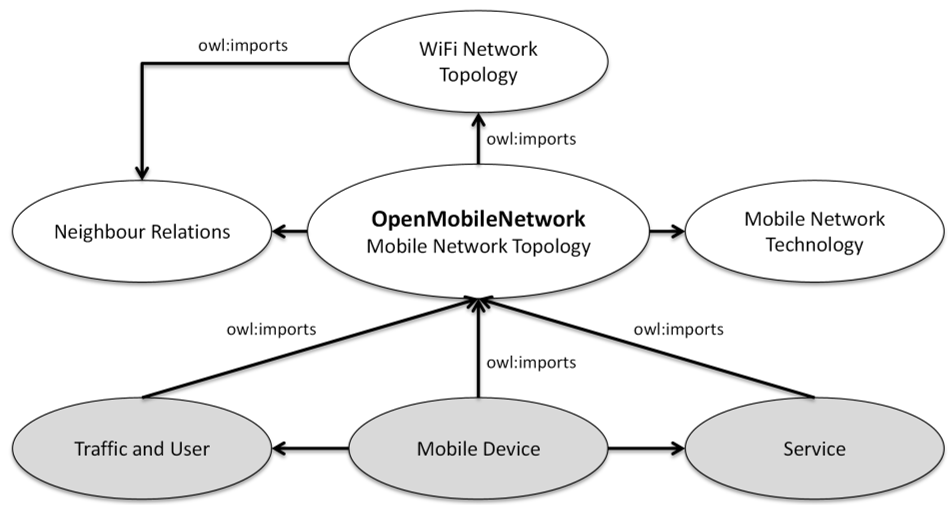
The ontology set bridges static topology (white) with dynamic context like traffic and service types (grey).
Experiments: Does Gamification Work?
The results prove that a "Human-in-the-loop" approach works. While the background service (OMNApp) was great for systematic "wardriving" by enthusiasts, the game (Jewel Chaser) successfully expanded the reach to a global scale.
Key Statistics:
- Scale: 44 countries, 85 providers.
- Volume: 151,204 measurements.
- Infrastructure mapped: 9,810 unique cells (a mix of 2G and 3G).

The distribution of measurements across continents highlights the effectiveness of the hybrid collection strategy.
Critical Insight: The "Green" Potential
The most compelling takeaway from this research is the "Communicate Green" demo. By querying the semantic database, researchers could identify specific T-Mobile cells in Berlin that had:
- Low current traffic (< 4 Mbits).
- Overlapping neighbors covering >70% of the same area.
The result? These cells are perfect candidates for temporary deactivation to reduce power consumption without impacting user experience. This level of granular, automated decision-making is only possible when network data is treated as a semantic, live resource rather than a static table.
Conclusion & Limitations
While the platform is a breakthrough, it faces the "Unreachable Jewel" problem—where the algorithm places a reward in a lake or a highway median (see Figure 8 in the paper). Future iterations will need to integrate more geographic context (like street maps) into the incentive engine to ensure "discoverable" targets are actually reachable.
Ultimately, this work demonstrates that the future of context-aware services lies in the synergy between crowdsourced intelligence and the Semantic Web.