
Competition in the Social Cloud: Pricing Strategies for Semi-Rational Communities
Operations Research Letters
This paper introduces a game-theoretic framework for market pricing where two competing sellers offer similar products to a social network of "semi-rational" agents. The model utilizes population games and logit-response dynamics to show that buyers converge to a unique equilibrium, treatable as a full potential game, while providing polynomial-time algorithms to compute pricing strategies for sellers.
TL;DR
How do two companies compete when their customers are influenced by their friends but occasionally make "irrational" choices? This paper models social networks as clusters of communities and proves that buyer behavior follows a Full Potential Game. By using logit-response dynamics, the authors provide a polynomial-time algorithm to find the optimal price point—effectively turning a chaotic social market into a solvable optimization problem.
Problem & Motivation: The Gap Between Myopia and Rationality
Prior research in social network marketing usually falls into two extremes:
- Fully Rational Agents: Buyers who never make mistakes and have perfect information.
- Myopic Agents: Buyers who act purely on immediate impulse without considering long-term utility.
Real humans are semi-rational. We try to coordinate with our neighbors (Positive Externalities), but we also make mistakes due to incomplete information or "noise." Furthermore, most models treat every person as a single node, which is computationally explosive. This paper shifts the focus to communities—large groups of agents acting as a continuum—allowing for more robust mathematical modeling of population-level shifts.
Methodology: The Power of Potential Functions
The heart of the paper lies in proving that the interaction between buyers is a Full Potential Game.
1. The Logic of Logit-Response
Instead of assuming agents always pick the best product, the authors use logit-response dynamics. Under this protocol, the probability of an agent choosing a product is proportional to the exponential of the utility (). As the noise parameter grows, the market concentrates on the global maximum of a specific Potential Function ().
2. Community Homogeneity
A critical insight (Lemma 5) is that in the long run, communities become homogeneous. Everyone in a specific neighborhood will eventually settle on the same product. This allows the researchers to treat the state of each community as a binary choice (Product A or B).
3. Solving through Graph Theory
The authors transform the problem of finding the market's stationary state into a Maximum Weighted Set Problem (MWSP). By constructing a dual graph where edges represent community influence and weights represent price/utility trade-offs, they solve for the market equilibrium using a Minimum Cut algorithm.

Experiments & Results: Is There a Nash Equilibrium?
The paper doesn't just stop at the buyers; it looks at the Sellers' Game. When Sellers A and B adjust their prices to maximize profit (), does the system stabilize?
- The Uniqueness Theorem: They prove that if a Nash Equilibrium exists, it is unique and usually involves Seller B playing a zero-price strategy to survive.
- Graph Specificity: The authors demonstrate that in Regular Graphs and Preferential Attachment Graphs (which mirror real-world social networks like Twitter or LinkedIn), a unique Nash Equilibrium is guaranteed to exist.
- Computational Efficiency: Using their Algorithm 1, a seller can compute their "Best Response" to a competitor's price in polynomial time relative to the number of communities.
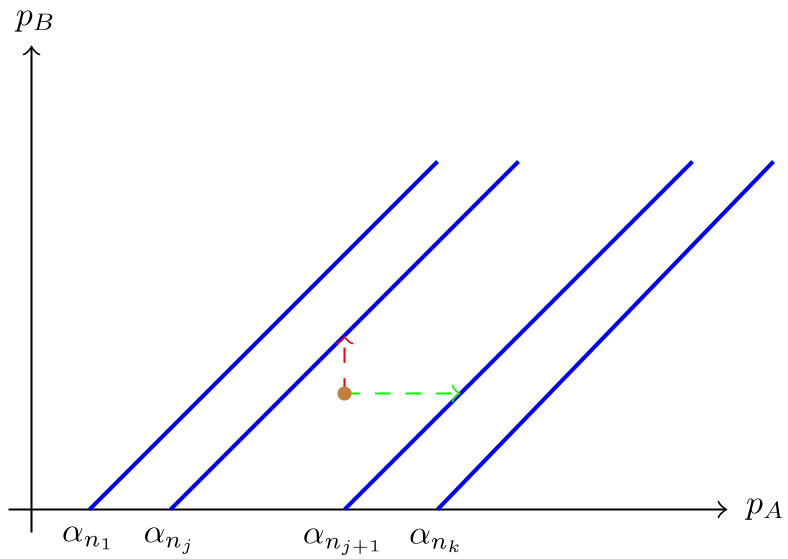 Figure 2: The utility of Company A vs its price relative to Company B. Notice the discrete "threshold points" where mass shifts suddenly.
Critical Analysis & Conclusion
Takeaway
The significant contribution of this work is the bridge it builds between evolutionary game theory and algorithmic market design. By treating communities as potential-driven entities, it simplifies the "noisy" behavior of semi-rational agents into a deterministic min-cut problem.
Limitations
- Binary Choice: The model only considers two products. In real markets, the entry of a third competitor (C) could disrupt the potential game structure.
- Uniform Behavior: While communities have different masses, they are assumed to have the same "sensitivity" to social pressure ( and ).
Future Work
The next frontier is Dynamic Pricing. If a seller knows the convergence rate, they might offer "flash sales" to flip a community before a competitor can react. Additionally, exploring how influencers (specific high-degree nodes within a community) change the potential landscape remains a high-value research target.
Senior Editor's Note: This paper is a masterclass in reducing behavioral complexity into combinatorial optimization. It moves marketing theory away from "guessing" and toward "computing" social equilibrium.