
Opinion Behavior Analysis: How Port-Hamiltonian Systems Decode Social Media Influence
Opinion Behavior Analysis in Social Networks Under the Influence of Coopetitive Media
The paper introduces a Port-Hamiltonian (PH) based mathematical model to analyze opinion evolution in social networks under the influence of coopetitive (cooperative and competitive) media. By leveraging passivity theory and community-based structures, the authors predict long-term public opinion patterns and define conditions for consensus, polarization, and neutralization.
TL;DR
This paper presents a novel framework for understanding how public opinion is shaped not just by who we talk to, but by how media outlets compete and cooperate. By modeling social entities as Port-Hamiltonian (PH) systems, the researchers provide a mathematical proof for why societies polarize, reach consensus, or become indifferent (neutralized) under the influence of "coopetitive" media.
Background: The Quorum-Sensing of Society
In social science, we often think of communication as direct peer-to-peer interaction. However, modern influence flows through intermediates—traditional media, social platforms, and legislative committees. The authors draw a fascinating parallel between social networks and biological quorum-sensing, where populations coordinate behaviors through shared environmental signals.
The Core Challenge: Why Traditional Models Fail
Previous models like DeGroot focus on "What" happens (averaging opinions) but ignore "Why" individuals react differently based on their internal state. They often assume agents are purely passive or rational. But humans have self-dynamics: inherent biases, aesthetic standards, and a "moral compass" that resists or dissipates external information.
Methodology: Port-Hamiltonian Representation
The breakthrough here is viewing social entities through the lens of Energy-Based Control. By assigning a "Hamiltonian" (a Lyapunov-like energy function) to an opinion, the researchers can use the Passivity Property.
- Internalization: The model captures how information flows through an actor, influenced by a conservative component (keeping the opinion alive) and a dissipative component (forgetting or moderating the opinion).
- Coopetition: Using signed graphs, the model accommodates both positive ties (trust/cooperation) and negative ties (distrust/competition), specifically among media entities.
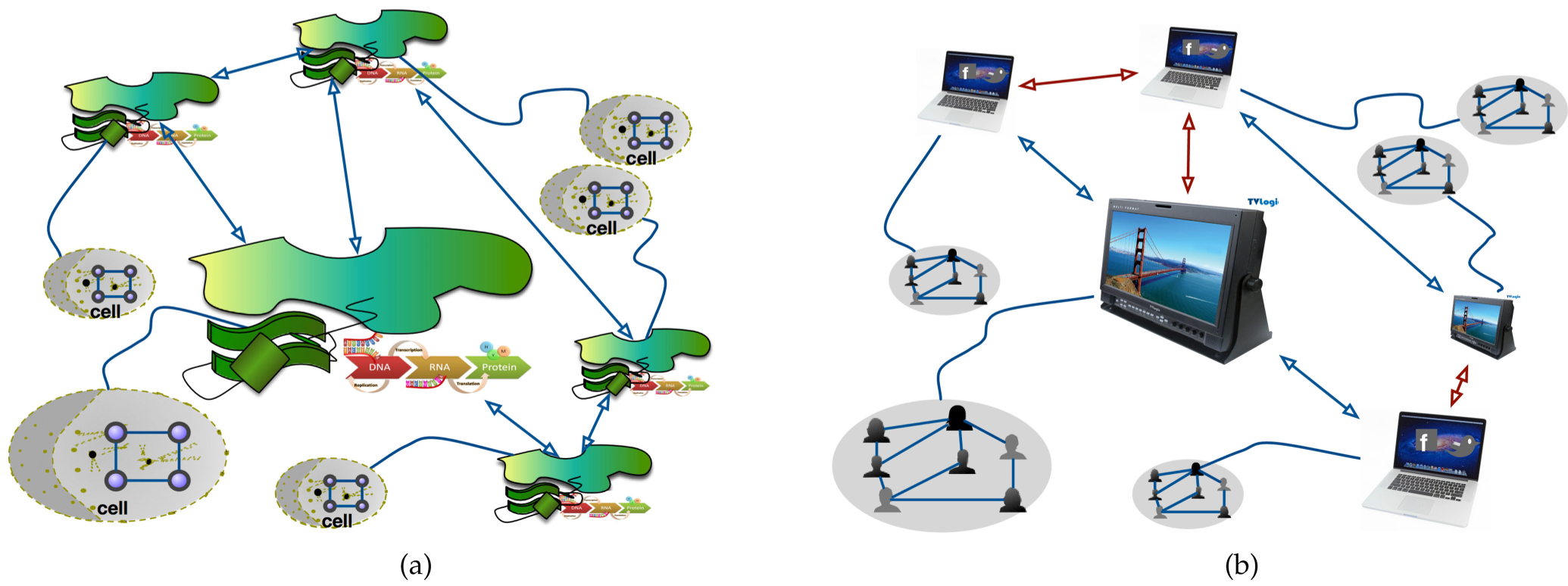 Figure 1: Comparison between biological quorum-sensing and social communication architectures.
Key Findings: Polarization vs. Neutralization
The paper derives several rigorous conditions for how a society ends up:
- Output Modulus Synchronization: When the modular difference between opinions vanishes, but the "sign" (support or protest) might differ.
- Bipartite Synchronization (Polarization): If the media graph is "Structurally Balanced" (split into two hostile camps), the entire population follows suit, resulting in two opposing but stable opinion groups.
- Neutralization: If the media network is "Structurally Unbalanced" (complex, overlapping rivalries), the opinions eventually decay to a neutral zero, as conflicting signals cancel each other out.
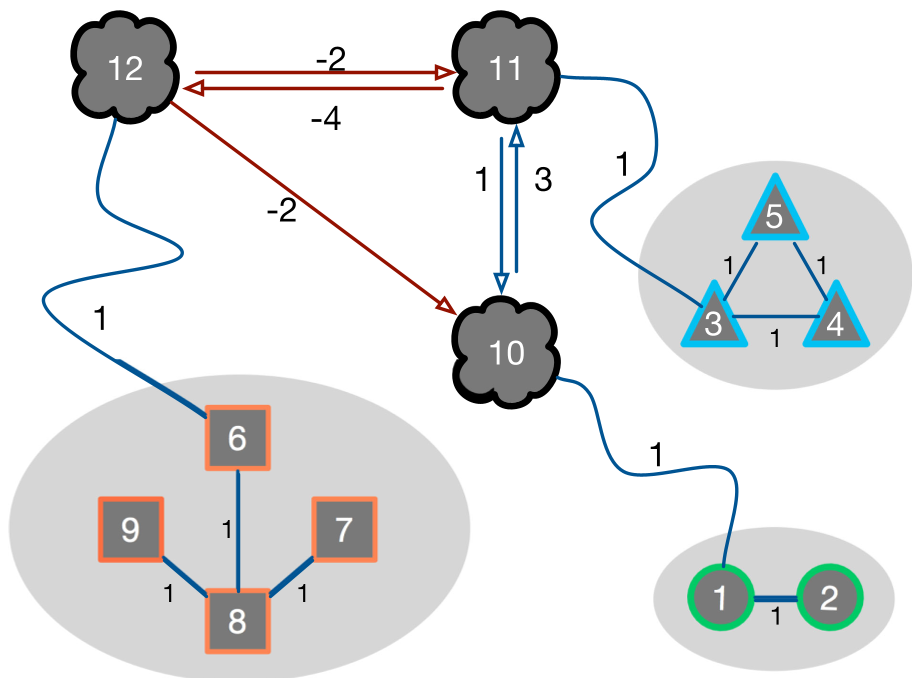 Figure 2: Numerical simulation of a community-based social network splitting into hostile camps.
The "Iron Law of Oligarchy" in Control Theory
A particularly chilling part of the analysis explores Autocratic Media. The authors show that if media entities ignore the public (no feedback from actors) and coordinate among themselves, they function as a "dominant exosystem." In this state, interpersonal communication between citizens becomes irrelevant—public opinion is purely a function of the media's internal state.
Critical Insight & Conclusion
This paper isn't just about math; it's a structural warning. It demonstrates that the topology of media is just as important as the content they provide. If the media landscape is structurally balanced into two camps, no amount of "peer-to-peer" chatting will stop polarization.
Takeaway: To solve social cleavage, we must look at the "dissipative" properties of individual self-dynamics and the "balance" of the institutions that broadcast info to us.
Future Work
The authors suggest moving towards nonlinear dynamics and accounting for communication delays, reflecting the reality that we often react to "old news" in an increasingly fast-paced digital world.