
Opinion Containment: Steering Social Discourse Through Issue Sequences
Opinion containment in social networks over issue sequences
This paper investigates opinion containment in social networks over issue sequences using the Friedkin-Johnsen (F-J) model. It establishes necessary and sufficient conditions for opinions of non-stubborn and partially stubborn agents to converge into a convex hull defined by stubborn agents, achieving state-of-the-art theoretical alignment between multi-agent control theory and social influence networks.
TL;DR
Can we predict the range of opinions in a society where some individuals are "stubborn" and others are "malleable"? This paper moves beyond simple consensus to Opinion Containment. It defines under what conditions a network's opinions will fall within a specific "safety zone" (a convex hull) and proves that discussing a sequence of related issues actually makes it easier to influence the collective range of thought than focusing on a single topic.
The Shift from Consensus to Containment
Most classical models (like DeGroot or basic F-J models) ask: Where will everyone agree? But in the real world, agreement is rare. We care more about boundaries. For a government or organization, the goal is often to ensure opinions stay within a reasonable range.
The authors identify a gap in the literature: while "containment control" is a well-known concept in robotics (getting a swarm of drones to stay within a boundary set by leaders), it hadn't been rigorously applied to social networks with partially stubborn agents—people who listen to others but also cling to their original bias.
Methodology: The Geometry of Stubbornness
The paper utilizes the Friedkin-Johnsen (F-J) model, where each agent has a susceptibility score .
- : Fully stubborn (Leaders).
- : Fully open (Followers).
- : Partially stubborn.
The Single-Issue Condition
The first major insight is that for opinions to stay within the "influence zone" of leaders, the network topology must satisfy a specific graph-theoretic property: Every Independent Strongly Connected Component (ISCC) must contain at least one stubborn agent. If even one cluster of agents is isolated from stubborn influencers, the "containment" fails.
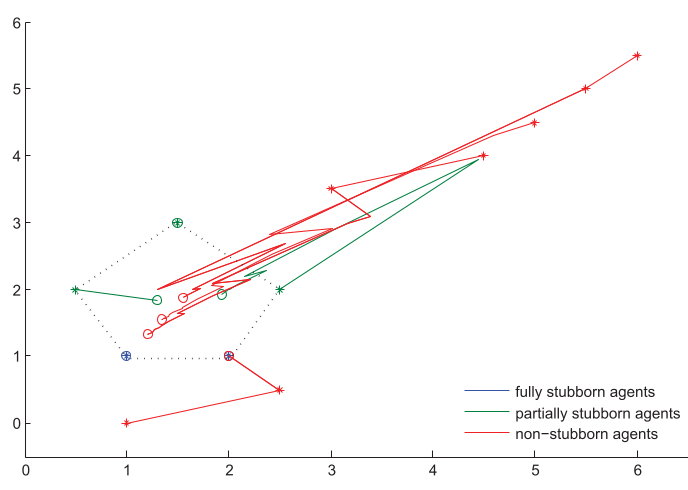 Fig 1: A sample network G(W1) showing different types of agent connectivity.
The Core Discovery: Issue Sequences
The real "Aha!" moment comes when the authors analyze Issue Sequences. Imagine a group of generals deciding on "Attack" or "Retreat" across multiple battles. Their final opinion on Battle 1 becomes their initial bias for Battle 2.
The paper proves a "Connectivity Enhancement" theorem:
As the network moves through a sequence of issues (), the effective influence network becomes denser.
Mathematically, the relationship is captured by . The authors show that becomes a "link" in this sequential influence graph if there is any directed path in the original graph. This means that over time, the "stubbornness" of leaders reaches much farther than it does in a single conversation.
Experimental Proof
The authors simulated a 12-agent network. In the single-issue case, agents' opinions (stars) move toward the convex hull but are limited by their initial biases.
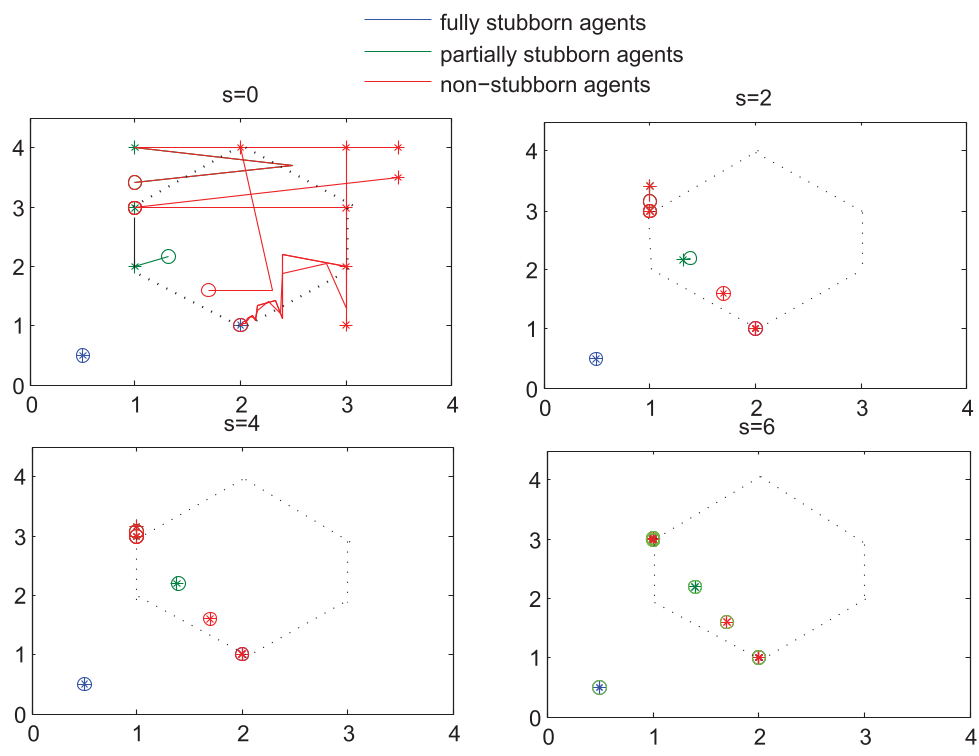 Fig 2: Trajectories of opinions moving toward the contained zone as time (k) increases.
In the Issue Sequence simulation, as (the issue index) increases from 0 to 6, the opinions of even the most stubborn "partially stubborn" agents eventually gravitate into the target convex hull. The sequential nature of the discussion "erodes" the isolation of certain agents.
Critical Insight & Conclusion
This paper provides a rigorous mathematical foundation for what many social scientists have observed qualitatively: Persistent engagement on a topic is more effective than a one-time campaign.
Takeaway for the AI & Control Community:
- Topology Matters: You can't contain opinions if you can't reach every ISCC.
- Time is a Force Multiplier: Sequential issues act as a mechanism for "pathway activation," bringing outlying opinions into the fold.
Limitations: The model assumes susceptibilities () are constant. In reality, people might become more stubborn if they feel they are being manipulated into a convex hull. Future research into "reactive stubbornness" would be a fascinating next step.